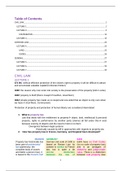
UU Psychologie: Sensation & Perception Samenvatting Myrthe Schroevers
Dear reader,
Sensation and perception was my absolute favourite class in Cognitive Neurobiological
Psychology. Ben Harvey gives the greatest lectures I have ever encountered in my time as a
student at Utrecht University. His slides contain all the information you need, but just to
make things a bit more orderly and slim down the information, I made this summary.
Summary Sensation & Perception Lectures 1st half
Index
Lecture Subject Lecturer Page
Lecture 1 Introduction Maarten van der Smagt Page 2
Lecture 2 The Eye Maarten van der Smagt Page 10
Lecture 3 Spatial Vision Maarten van der Smagt Page 14
Lecture 4 Object Recognition Ben Harvey Page 21
Lecture 5 Colour Ben Harvey Page 29
Lecture 6 Space and Depth Ben Harvey Page 38
Lecture 7 Attention and Scenes Ben Harvey Page 43
,Introduction to sensation & perception
What is perception?
Perception is a translation of the physical environment into a pattern of neural activity that
can be used by our brain to guide behaviour. Perception is thus a useful representation of
our environment.
- Perception is limited by the physical properties of our sensors. Humans are limited
by the ability of our senses and the range in which they can detect input. Like for
ranges of wavelengths in the cones in the eye and frequencies in the ear.
For this last reason, perception is selective. It is only limited to the physical magnitudes that
are relevant to us as an organism. We don’t need sonar like bats or water detecting neurons
like some fish.
For this reason, different organisms perceive the same scene differently. Bees see using UV
light, and to them, flowers look very different.
+ Perception is influenced by ‘higher order’ cognitive processes such as memory and
verbal knowledge.
Because our perception is influenced by other cognitive processes, what we perceive isn’t
always ‘veridical’ or ‘truthful.’
In the picture on the right it appears like the upper
block is darker than the one bellow. This is because
we ‘know’ light generally comes from the sun above.
Even though the two blocks have the same colour,
we perceive them as different colours.
Cognitive processes influencing our view of the world is called the perceptual bias.
The approach to studying perception
- Dualism assumes that mind and brain are separated, the mind is some non-physical
substance and is home to our subjective perceptions. This is however untestable and
we can’t make any hypothesis about this so this approach is barely (read never) used.
- Materialism asserts our ‘perceptual experience is a functional property of brain
processing embodied in, and inseparable from, the active brain.’ This is the most
useful approach for it is testable.
Some other approaches include: the biological approach, the modelling / computational
approach and the psychological approach.
All approaches have their merits and a combination of approaches often is most useful.
,UU Psychologie: Sensation & Perception Samenvatting Myrthe Schroevers
The biological approach
Most of these biological approaches we know from CNW:
- EEG / MEG
- PET / fMRI
- TMS (artificial lesions)
- Neurophysiology
The modelling / computational approach
Creating models for how the brain works, more in the next lecture.
The psychological approach
The just noticeable difference (JND)
This experiment consisted of showing participants candles. After adding a candle, they asked
if the candles looked brighter. When there were only 4 candles total and one was added,
they did look brighter to the participants, but when there were 20 candles total and one was
added, they did not look brighter to the participants. However, when there were 20 candles
total and 5 were added, it díd look brighter.
The experimenters called this ‘the Weber-Fechner Law’. This describes the relationship
between a physical intensity and its perceived intensity or sensation. This relationship is
logarithmic. The JND is the difference threshold.
Measuring thresholds of the senses
Discrimination (difference threshold) = The stimulus strength is increased in small steps by
the experimenter until the observer indicates that the stimulus is just (un)equal in strength
to a reference stimulus.
Do the two stimuli differ?
Detection (absolute threshold) = The stimulus strength is increased in small steps by the
experimenter until the observer indicates that he just feels / sees / hears / smells the
stimulus.
Is the stimulus present?
Unfortunately, detection isn’t discrete. Noise blurs the image.
Sources of noise are:
- Attention changes
- Neural fluctuations
- Physical fluctuations
, Discrimination = Do the two stimuli differ?
Detection = Is the stimulus present?
Scaling = How strong is the stimulus?
Identification = What is the stimulus?
With scaling and identification, it is hard to measure a threshold. In scaling, people
experience different scales differently: two people might rate the same pain with different
marks. In identification, the scale is often nominal: is this a dog or a cat? There isn’t really an
in-between.
With detection and discrimination there are several options:
- The method of limits
- The method of adjustment
- The method of constant stimuli
- Adaptive methods
The method of limits
This method is very efficient. Both the questions in discrimination and detection (is the
stimulus present? & do the two stimuli differ?) can be answered with a simple yes or no. For
many people in many conditions it is measured if they answer the question with a yes or a
no. Then the average of the upper and lower limits is taken and that is declared the
threshold.
The method of adjustment
This method is similar to the method of limits but uses only one participant.
For detection: the observer varies the stimulus strength until he reaches the threshold.
For discrimination: the observer varies the stimulus strength until he judges it to be the
same as the reference stimulus.
Instead of taking the averages of the different participants, the average of the different trials
of one participant are used to decide what the threshold is.
The method of constant stimuli
The experimenter chooses a set of stimulus strengths. Each stimulus strength is presented
several times in a random order. The observers task is to determine whether the stimulus
was present or which stimulus was stronger. This is the only method that gives you the exact
form of the psychometric curve and many trials in which the stimulus strength is way above
the threshold, this gives the observer confidence. The biggest disadvantages is that it is very
inefficient, it takes ages.
Dear reader,
Sensation and perception was my absolute favourite class in Cognitive Neurobiological
Psychology. Ben Harvey gives the greatest lectures I have ever encountered in my time as a
student at Utrecht University. His slides contain all the information you need, but just to
make things a bit more orderly and slim down the information, I made this summary.
Summary Sensation & Perception Lectures 1st half
Index
Lecture Subject Lecturer Page
Lecture 1 Introduction Maarten van der Smagt Page 2
Lecture 2 The Eye Maarten van der Smagt Page 10
Lecture 3 Spatial Vision Maarten van der Smagt Page 14
Lecture 4 Object Recognition Ben Harvey Page 21
Lecture 5 Colour Ben Harvey Page 29
Lecture 6 Space and Depth Ben Harvey Page 38
Lecture 7 Attention and Scenes Ben Harvey Page 43
,Introduction to sensation & perception
What is perception?
Perception is a translation of the physical environment into a pattern of neural activity that
can be used by our brain to guide behaviour. Perception is thus a useful representation of
our environment.
- Perception is limited by the physical properties of our sensors. Humans are limited
by the ability of our senses and the range in which they can detect input. Like for
ranges of wavelengths in the cones in the eye and frequencies in the ear.
For this last reason, perception is selective. It is only limited to the physical magnitudes that
are relevant to us as an organism. We don’t need sonar like bats or water detecting neurons
like some fish.
For this reason, different organisms perceive the same scene differently. Bees see using UV
light, and to them, flowers look very different.
+ Perception is influenced by ‘higher order’ cognitive processes such as memory and
verbal knowledge.
Because our perception is influenced by other cognitive processes, what we perceive isn’t
always ‘veridical’ or ‘truthful.’
In the picture on the right it appears like the upper
block is darker than the one bellow. This is because
we ‘know’ light generally comes from the sun above.
Even though the two blocks have the same colour,
we perceive them as different colours.
Cognitive processes influencing our view of the world is called the perceptual bias.
The approach to studying perception
- Dualism assumes that mind and brain are separated, the mind is some non-physical
substance and is home to our subjective perceptions. This is however untestable and
we can’t make any hypothesis about this so this approach is barely (read never) used.
- Materialism asserts our ‘perceptual experience is a functional property of brain
processing embodied in, and inseparable from, the active brain.’ This is the most
useful approach for it is testable.
Some other approaches include: the biological approach, the modelling / computational
approach and the psychological approach.
All approaches have their merits and a combination of approaches often is most useful.
,UU Psychologie: Sensation & Perception Samenvatting Myrthe Schroevers
The biological approach
Most of these biological approaches we know from CNW:
- EEG / MEG
- PET / fMRI
- TMS (artificial lesions)
- Neurophysiology
The modelling / computational approach
Creating models for how the brain works, more in the next lecture.
The psychological approach
The just noticeable difference (JND)
This experiment consisted of showing participants candles. After adding a candle, they asked
if the candles looked brighter. When there were only 4 candles total and one was added,
they did look brighter to the participants, but when there were 20 candles total and one was
added, they did not look brighter to the participants. However, when there were 20 candles
total and 5 were added, it díd look brighter.
The experimenters called this ‘the Weber-Fechner Law’. This describes the relationship
between a physical intensity and its perceived intensity or sensation. This relationship is
logarithmic. The JND is the difference threshold.
Measuring thresholds of the senses
Discrimination (difference threshold) = The stimulus strength is increased in small steps by
the experimenter until the observer indicates that the stimulus is just (un)equal in strength
to a reference stimulus.
Do the two stimuli differ?
Detection (absolute threshold) = The stimulus strength is increased in small steps by the
experimenter until the observer indicates that he just feels / sees / hears / smells the
stimulus.
Is the stimulus present?
Unfortunately, detection isn’t discrete. Noise blurs the image.
Sources of noise are:
- Attention changes
- Neural fluctuations
- Physical fluctuations
, Discrimination = Do the two stimuli differ?
Detection = Is the stimulus present?
Scaling = How strong is the stimulus?
Identification = What is the stimulus?
With scaling and identification, it is hard to measure a threshold. In scaling, people
experience different scales differently: two people might rate the same pain with different
marks. In identification, the scale is often nominal: is this a dog or a cat? There isn’t really an
in-between.
With detection and discrimination there are several options:
- The method of limits
- The method of adjustment
- The method of constant stimuli
- Adaptive methods
The method of limits
This method is very efficient. Both the questions in discrimination and detection (is the
stimulus present? & do the two stimuli differ?) can be answered with a simple yes or no. For
many people in many conditions it is measured if they answer the question with a yes or a
no. Then the average of the upper and lower limits is taken and that is declared the
threshold.
The method of adjustment
This method is similar to the method of limits but uses only one participant.
For detection: the observer varies the stimulus strength until he reaches the threshold.
For discrimination: the observer varies the stimulus strength until he judges it to be the
same as the reference stimulus.
Instead of taking the averages of the different participants, the average of the different trials
of one participant are used to decide what the threshold is.
The method of constant stimuli
The experimenter chooses a set of stimulus strengths. Each stimulus strength is presented
several times in a random order. The observers task is to determine whether the stimulus
was present or which stimulus was stronger. This is the only method that gives you the exact
form of the psychometric curve and many trials in which the stimulus strength is way above
the threshold, this gives the observer confidence. The biggest disadvantages is that it is very
inefficient, it takes ages.