AP Mathematics - Notes
Complex Numbers
Content:
Complex Numbers:
1.1 Important Definitions and Notes for Complex Number
1.2 Multiplication, Addition and Subtraction
1.3 Division
1.4 Quadratic Formula
1.5 Determining the original quadratic equation from its roots
1.6 Solving Simultaneous Equations
1.7 Factorising
1.8 Solving Equations with Polynomials
1.9 Graphical Representation
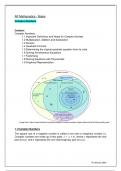
Image from: https://www.linkedin.com/pulse/complex-numbers-window-higher-dimensional-thinking-reality-ganti
1.1 Complex Numbers
The square root of a negative number is called a non-real or imaginary number (𝑖).
Complex numbers are made up of two parts: 𝑧 = 𝑎 + 𝑏𝑖, where 𝑎 represents the real
part (𝑅𝑒(𝑧)) and 𝑏 represents the non-real/imaginary part (𝐼𝑚(𝑧)).
Pia Eklund 2024
, Some Important Notation:
𝑖 = √−1
𝑖 2 = (√−1)2 = −1
𝑖 3 = (√−1)3 = 𝑖 2 . 𝑖 = (−1). 𝑖 = −𝑖
𝑖 4 = (√−1)4 = 𝑖 2 . 𝑖 2 = (−1)(−1) = 1
∴ 𝑖 𝑚𝑢𝑙𝑡𝑖𝑝𝑙𝑒 𝑜𝑓 4 = 1
Worked Example 1
Given the complex numbers 𝑞 = −2 − 8𝑖 and 𝑠 = 5𝑖 + 9, find the following:
a) 𝑅𝑒(𝑞)
b) 𝑅𝑒(𝑠)
c) 𝐼𝑚(𝑞)
d) 𝐼𝑚(𝑠)
a) 𝑅𝑒(𝑞) = −2
b) 𝑅𝑒(𝑠) = 9
c) 𝐼𝑚(𝑞) = −8
d) 𝐼𝑚(𝑠) = 5
Worked Example 2
Determine the value of the following:
a) 𝑖 7
b) 𝑖 64
c) 𝑖 1999
d) 𝑖 2009
a) 𝑖 7
= 𝑖 4 . 𝑖 3 = (1)(−𝑖) = −𝑖
b) 𝑖 64
= 1 (recall: 𝑖 𝑎𝑛𝑦 𝑚𝑢𝑙𝑡𝑖𝑝𝑙𝑒 𝑜𝑓 4 = 1))
Pia Eklund 2024
Complex Numbers
Content:
Complex Numbers:
1.1 Important Definitions and Notes for Complex Number
1.2 Multiplication, Addition and Subtraction
1.3 Division
1.4 Quadratic Formula
1.5 Determining the original quadratic equation from its roots
1.6 Solving Simultaneous Equations
1.7 Factorising
1.8 Solving Equations with Polynomials
1.9 Graphical Representation
Image from: https://www.linkedin.com/pulse/complex-numbers-window-higher-dimensional-thinking-reality-ganti
1.1 Complex Numbers
The square root of a negative number is called a non-real or imaginary number (𝑖).
Complex numbers are made up of two parts: 𝑧 = 𝑎 + 𝑏𝑖, where 𝑎 represents the real
part (𝑅𝑒(𝑧)) and 𝑏 represents the non-real/imaginary part (𝐼𝑚(𝑧)).
Pia Eklund 2024
, Some Important Notation:
𝑖 = √−1
𝑖 2 = (√−1)2 = −1
𝑖 3 = (√−1)3 = 𝑖 2 . 𝑖 = (−1). 𝑖 = −𝑖
𝑖 4 = (√−1)4 = 𝑖 2 . 𝑖 2 = (−1)(−1) = 1
∴ 𝑖 𝑚𝑢𝑙𝑡𝑖𝑝𝑙𝑒 𝑜𝑓 4 = 1
Worked Example 1
Given the complex numbers 𝑞 = −2 − 8𝑖 and 𝑠 = 5𝑖 + 9, find the following:
a) 𝑅𝑒(𝑞)
b) 𝑅𝑒(𝑠)
c) 𝐼𝑚(𝑞)
d) 𝐼𝑚(𝑠)
a) 𝑅𝑒(𝑞) = −2
b) 𝑅𝑒(𝑠) = 9
c) 𝐼𝑚(𝑞) = −8
d) 𝐼𝑚(𝑠) = 5
Worked Example 2
Determine the value of the following:
a) 𝑖 7
b) 𝑖 64
c) 𝑖 1999
d) 𝑖 2009
a) 𝑖 7
= 𝑖 4 . 𝑖 3 = (1)(−𝑖) = −𝑖
b) 𝑖 64
= 1 (recall: 𝑖 𝑎𝑛𝑦 𝑚𝑢𝑙𝑡𝑖𝑝𝑙𝑒 𝑜𝑓 4 = 1))
Pia Eklund 2024