STS-C Exam Questions & Answers 100% Correct
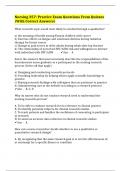
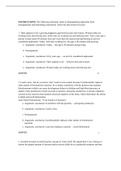
Where should the worker's hands be placed when climbing on ladders? -Both hands on a ladder rung -One hand on a rung, and one on a rail -Wherever the worker finds it most comfortable -Both hands on the ladder rails - Answer Both hands on a ladder rung Source: Construction Safety Management and Engineering, Hill, American Society of Safety Engineers, 2nd Edition, 2014, pg. 298. A supervisor's responsibility is to influence change among their team members. Which is the FIRST step in helping individuals embrace change? -Document your view of a successful solution. -Plan ahead and understand your audience. -Engage in mutual problem solving. -Create a positive environment for discussions. - Answer Plan ahead and understand your audience. Source: The Safety Professionals Handbook, Technical Applications, Haight, American Society of Safety Engineers, 2nd Edition, 2012, pg. 926-927. When rigging slings for lifting materials, the actual load on the sling increases as the angle decreases from 90 degrees (vertical). As a best safety practice to prevent overloads, the sling angle should always be greater than: -55 degrees. -70 degrees. -45 degrees. -80 degrees. - Answer 45 degrees. Source: Handbook of Rigging, MacDonald, Rossnagel, McGraw Hill, 5th Edition, 2009, pg. 230. A behavioral approach to safety focuses on consequences as an important motivator for future safe behaviors. Consequences can be described by their timing, consistency, and significance. The MOST powerful consequences are: -Delayed, uncertain, positive. -Soon, uncertain, positive. -Soon, certain, negative. -Soon, certain, positive. - Answer Soon, certain, positive. Source: The Behavior-Based Safety Process, Krause, Van Nostrand Reinhold, 2nd Edition, pg. 38. When electric current passes through the body, the result can range from a mild tingling to immediate cardiac arrest. The magnitude of the effect is determined by the amount of current flowing through the body, the path of current through the body, and: -The voltage applied to the circuit. -The age and physical condition of the worker. -The length of time the body remains in the circuit. -The relative humidity of the work setting. - Answer The length of time the body remains in the circuit. Source: Construction Safety Management and Engineering, Hill, American Society of Safety Engineers, 2nd Edition, 2014, pg. 428. A chemical cartridge respirator is an example of which type of respiratory protective device? -Air purifying respirator -Rescue respirator -Air supplying respirator -One designed for use in oxygen deficient environments - Answer Air purifying respirator Source: The Safety Professionals Handbook, Technical Applications, Haight, American Society of Safety Engineers, 2nd Edition, 2012, pg. 884. Which is the recommended safety factor (the ratio between its breaking strength and safe working load) for BEST condition (new) fiber ropes? -8:1 -4:1 -6:1 -12:1 - Answer 4:1 Source: Handbook of Rigging, MacDonald, Rossnagel, McGraw Hill, 5th Edition, 2009, pg. 180. A key element of effective communication between a supervisor and subordinate is to: -Speak with authority. -Use short, concise statements. -Create a shared understanding. -Document all verbal communications. - Answer Create a shared understanding. Source: Supervisors' Safety Manual, Crittenden (Editor), National Safety Council, 10th Edition, 2009, pg. 28. When MUST an employer disclose chemical identifying information that they consider a trade secret? -To a healthcare professional when needed to treat a medical emergency -To a public safety officer upon request -To colleagues of injured or ill employees -To a regulatory authority following a verbal request - Answer To a healthcare professional when needed to treat a medical emergency. Source: Accident Prevention Manual for Business and Industry: Administration and Programs; Hagan, Montgomery, O'Reilly. National Safety Council, 13th Edition, 2009, pg. 85. Forklifts equipped with approved cages are sometimes used to lift workers for elevated work. Which is a best safety practice for such situations? -No more than a single worker may occupy the cage at any one time. -It is only acceptable to transport workers across the job site while they are in the cage if the ground is firm and level. -Once at elevation, the lifeline should be detached from the cage and reconnected to a structural building component. -Workers should be securely attached to the cage with a lifeline and full body harness. - Answer Workers should be securely attached to the cage with a lifeline and full body harness. Source:Fall Protection and Scaffolding Safety, Gagnet, Government Institutes, 2000, pg. 158-159. As the site safety supervisor, you have been instructed to create and train a fire brigade to minimize property damage from unexpected fire incidents. You have decided that the fire brigade will only be responsible to fight small fires that can be controlled with portable fire extinguishers without the need for protective clothing or breathing apparatus. Which is this type of fire brigade called? -Structural fire brigade -First response brigade team -Incipient stage fire brigade -Interior fire brigade - Answer Incipient stage fire brigade. Source: Supervisors' Safety Manual, Crittenden (Editor), National Safety Council, 10th Edition, 2009, pg. 549. Employees that pour or finish wet concrete without personal protective equipment can be exposed to hand injuries because wet concrete: -Has abrasive properties. -May conceal sharp edges of embedded rebar. -Becomes very hot as it cures. -Has caustic chemical properties. - Answer Has caustic chemical properties. Source: Construction Safety Management and Engineering, Hill, American Society of Safety Engineers, 2nd Edition, 2014, pg. 565. Which jobs represent the highest priority for a formal job safety analysis (JSA)? -Jobs that are performed by the largest number of employees -New jobs or tasks that are being completed for the very first time -Simple jobs because JSAs are not appropriate for complex jobs -Jobs with a high frequency of injuries - Answer Jobs with a high frequency of injuries. Source: Accident Prevention Manual for Business and Industry: Administration and Programs; Hagan, Montgomery, O'Reilly. National Safety Council, 13th Edition, 2009, pg. 241-242. Heat syncope is a condition where individuals, especially those not acclimatized to a hot work environment, may faint because blood redistribution to cool peripheral tissues reduces the blood flow to the brain. The first aid treatment for heat syncope is: -Give the victim salt tablets to reduce sweating. -Immediately and rapidly cool the victim. -Remove victim to a cooler location and have them lie down. -Replace body fluids quickly, using an intravenous drip if necessary. - Answer Remove victim to a cooler location and have them lie down. Source: Safety and Health for Engineers, Brauer, Wiley - Interscience, 2006, pg. 344. Which is a best safety practice when a group of employees are working simultaneously on a piece of equipment that has been locked out? -This is a situation where tagging out is preferable to locking out. -Only one employee is allowed to apply a lock and work at any one time. -Each employee should apply their own lock to group lockout device. -The project supervisor is responsible for applying and monitoring a single lock. - Answer Each employee should apply their own lock to group lockout device.
Written for
- Institution
- STS-C
- Course
- STS-C
Document information
- Uploaded on
- March 29, 2024
- Number of pages
- 18
- Written in
- 2023/2024
- Type
- Exam (elaborations)
- Contains
- Questions & answers
Subjects
- sts c exam stuvia
-
sts c exam questions answers 100 correct
-
where should the workers hands be placed when cli
-
a supervisors responsibility is to influence chan

Also available in package deal