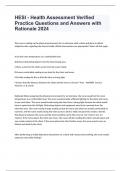
HESI - Health Assessment Verified Practice Questions and Answers with Rationale 2024
HESI - Health Assessment Verified Practice Questions and Answers with Rationale 2024 The nurse is setting up the physical environment for an interview with a client and plans to obtain subjective data regarding the client's health. Which interventions are appropriate? Select all that apply. A.Set the room temperature at a comfortable level. B.Remove distracting objects from the interviewing area. C.Place a chair for the client across from the nurse's desk. D.Ensure comfortable seating at eye level for the client and nurse. E.Provide seating for the so that the faces a strong light. F.Ensure that the distance between the client and the nurse is at least 7 feet. Correct Answers: A, B, and D Rationale:When preparing the physical environment for an interview, the nurse would set the room temperature at a comfortable level. The nurse would provide sufficient lighting for the client and nurse to see each other. The nurse would avoid having the client face a strong light because the client would have to squint into the full light. Distracting objects and equipment need to be removed from the interview area. The nurse would arrange seating so that the nurse and client are seated comfortably at eye level, and the nurse avoids facing the client across a desk or table, because this creates a barrier. The distance between the nurse and the client would be set by the nurse at 4 to 5 feet (1.2 to 1.5 meters). If the nurse places the client any closer, the nurse will be invading the client's private space and may create anxiety in the client. If the nurse places the client farther away, the nurse may be seen as distant and aloof by the client. After performing an initial abdominal assessment on a client with nausea and vomiting, the nurse would expect to note which finding? A. Waves of loud gurgles auscultated in all four quadrants. B. Low-pitched swishing auscultated in one or two quadrants. C. Relatively high-pitched clicks or gurgles auscultated in one or two quadrants. D. Very high pitched, loud rushes auscultated in especially in one or two quadrants. Correct Answer: A Rationale:Although frequency and intensity of bowel sounds vary, depending on the phase of digestion, normal bowel sounds are relatively high-pitched clicks or gurgles. Loud gurgles (borborygmi) indicate hyperperistalsis and are commonly associated with nausea and vomiting. A swishing or buzzing sound represents turbulent blood flow associated with a bruit. Bruits are not normal sounds. Bowel sounds are very high-pitched and loud (hyperresonance) when the intestines are under tension, such as in intestinal obstruction. Therefore, options 2, 3, and 4 are incorrect. The nurse is performing a neurological assessment on a client and elicits a positive Romberg's sign. The nurse makes this determination based on which observation? A. An involuntary rhythmic, rapid twitching of the eyeballs. B. A dorsiflexion of the ankle and great toe with fanning of the other toes. C. A significant sway when the client stands erect with feet together, arms at the side and the eyes closed. D. A lack of sense of position when the client is unable to return extended fingers to a point of reference. Correct Answer: C Rationale:In Romberg's test, the client is asked to stand with the feet together and the arms at the sides, and to close the eyes and hold the position; normally the client can maintain posture and balance. A positive Romberg's sign is a vestibular neurological sign that is found when a client exhibits a loss of balance when closing the eyes. This may occur with cerebellar ataxia, loss of proprioception, and loss of vestibular function. A lack of normal sense of position coupled with an inability to return extended fingers to a point of reference is a finding that indicates a problem with coordination. A positive gaze nystagmus evaluation results in an involuntary rhythmic, rapid twitching of the eyeballs. A positive Babinski's test results in dorsiflexion of the ankle and great toe with fanning of the other toes; if this occurs in anyone older than 2 years, it indicates the presence of central nervous system disease.
Written for
- Institution
- HESI - Health Assessment .
- Course
- HESI - Health Assessment .
Document information
- Uploaded on
- March 28, 2024
- Number of pages
- 112
- Written in
- 2023/2024
- Type
- Exam (elaborations)
- Contains
- Questions & answers
Subjects
-
hesi health assessment verified practice questio
-
the nurse is setting up the physical environment f
-
after performing an initial abdominal assessment o
-
the nurse is performing a neurological assessme

Also available in package deal