
Organizational Psychology
Lecture 1
-an organization is a group of people that regularly work together to achieve a common goal
Three levels of study
-individuals
-groups (teams)
-organizations
Difference with organizational behavior
-investigates the impact that individuals , groups and structure have on behavior wing
organizations
-goal is to improve performance of organization in terms of effectiveness and efficiency
Central place of work
-work centrality-the degree of importance that work plays in somebody’s life
*human mind and behavior are not random , they have predictable patterns
*helps with managing as we can direct peopleś mind and behavior to achieve define goals
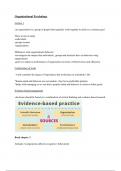
Evidence based management
-decisions should be based on a combination of critical thinking and evidence based research
Book chapter 3
Attitude-3 components (affective/cognitive/ behavioral)
,-job satisfaction A positive feeling about
one’s job resulting from an evaluation of its
characteristics.
-job involvement The degree to which
a person identifies with a job, actively
participates in it, and considers performance
important to self-worth.
-organizational commitment The degree to
which an employee identifies with a particular organization and its goals and wishes to
maintain membership in the organization.
-Generally, interesting jobs that provide training, variety, independence, and
control satisfy most employees
-People who have a positive core self-evaluation (CSE)—who
believe in their inner worth and basic competence—are more satisfied with
their jobs than people with negative CSEs.
-In sum, CSR (doing positive humanitarian actions like donations or volunteering from
companies ) is a needed, positive trend of accountability and serving. It can
also contribute significantly to increased employee job satisfaction when managed well.
Lecture 2
,Attitudes are objective statements about people, events , objects
-they can be favorable or unfavorable and the underlying reasons can be complex
*The Hawthrone studies suggested a link between workers attitudes and their performance
Hawthorne studies
-the initial goal -examine the relationship between physical working conditions and productivity
-the unexpected results was that productivity increased despite the worsening or bettering of the
conditions
-the reason was because the workers were given more attention which increased their satisfaction
and thus their productivity
-thus the hawthorne effects where workers perform better when they feel singled out or are given
extra attention
Job satisfaction
-an appraisal or evaluation of one’s job / a single overall rating of one's job
*Facet satisfaction-the rating of each subface like coworkers / pay/tasks/supervisors
-in general pay has a small effect on job satisfaction and in some cases eben a negative
correlation / in general there is a stronger positive association at lower pay levels
-managers tend to overestimate how satisfied the employees are which is why surveys should be
performed regularly
Work engagement
-more effective than job satisfaction
-positive , fulfilling state of mind , characterized by vigor , dedication and absorption
-mediator -explanatory mechanism , intervening variable
-moderator - buffer or amplifier
*work engagement predict performance about as strong as job satisfaction does
Lecture 3
Emotions at work
-affect is an umbrella term for both emotions and moods
, -emotions are specific events followed by specific reactions /brief , last for seconds or minutes
/very specific /action oriented
-moods are more spontaneous and can be longer like hours or days /more general/differentiated
based on positive or negative effects /cognitive in nature
*six basic emotions by Ekman
Problems with Ekman studies
• Some (fundamental) emotions are too complex to be represented on
faces (e.g., love).
• Display rules: cultures differ in norms of emotional expressions (e.g.,
smile in U.S. vs. Middle East)
• Study: Japanese and U.S. American participants, sad movie, either alone or in a
group (of their fellow country-men)
Basic moods
• Positive vs. negative
• Most people are in a positive mood most of the time./Positivity offset
• Negative emotions lead to negative moods.
• Negativity bias - negative events have a stronger impact than positive events, when
of similar intensity.
Sources of emotions and moods
-positive moods peak during the middle part of the day
-negative moods show very little variation during the day
-negative moods are highest on sunday and monday and decrease throughout the week
-positive moods are the highest at the end of the week
Lecture 1
-an organization is a group of people that regularly work together to achieve a common goal
Three levels of study
-individuals
-groups (teams)
-organizations
Difference with organizational behavior
-investigates the impact that individuals , groups and structure have on behavior wing
organizations
-goal is to improve performance of organization in terms of effectiveness and efficiency
Central place of work
-work centrality-the degree of importance that work plays in somebody’s life
*human mind and behavior are not random , they have predictable patterns
*helps with managing as we can direct peopleś mind and behavior to achieve define goals
Evidence based management
-decisions should be based on a combination of critical thinking and evidence based research
Book chapter 3
Attitude-3 components (affective/cognitive/ behavioral)
,-job satisfaction A positive feeling about
one’s job resulting from an evaluation of its
characteristics.
-job involvement The degree to which
a person identifies with a job, actively
participates in it, and considers performance
important to self-worth.
-organizational commitment The degree to
which an employee identifies with a particular organization and its goals and wishes to
maintain membership in the organization.
-Generally, interesting jobs that provide training, variety, independence, and
control satisfy most employees
-People who have a positive core self-evaluation (CSE)—who
believe in their inner worth and basic competence—are more satisfied with
their jobs than people with negative CSEs.
-In sum, CSR (doing positive humanitarian actions like donations or volunteering from
companies ) is a needed, positive trend of accountability and serving. It can
also contribute significantly to increased employee job satisfaction when managed well.
Lecture 2
,Attitudes are objective statements about people, events , objects
-they can be favorable or unfavorable and the underlying reasons can be complex
*The Hawthrone studies suggested a link between workers attitudes and their performance
Hawthorne studies
-the initial goal -examine the relationship between physical working conditions and productivity
-the unexpected results was that productivity increased despite the worsening or bettering of the
conditions
-the reason was because the workers were given more attention which increased their satisfaction
and thus their productivity
-thus the hawthorne effects where workers perform better when they feel singled out or are given
extra attention
Job satisfaction
-an appraisal or evaluation of one’s job / a single overall rating of one's job
*Facet satisfaction-the rating of each subface like coworkers / pay/tasks/supervisors
-in general pay has a small effect on job satisfaction and in some cases eben a negative
correlation / in general there is a stronger positive association at lower pay levels
-managers tend to overestimate how satisfied the employees are which is why surveys should be
performed regularly
Work engagement
-more effective than job satisfaction
-positive , fulfilling state of mind , characterized by vigor , dedication and absorption
-mediator -explanatory mechanism , intervening variable
-moderator - buffer or amplifier
*work engagement predict performance about as strong as job satisfaction does
Lecture 3
Emotions at work
-affect is an umbrella term for both emotions and moods
, -emotions are specific events followed by specific reactions /brief , last for seconds or minutes
/very specific /action oriented
-moods are more spontaneous and can be longer like hours or days /more general/differentiated
based on positive or negative effects /cognitive in nature
*six basic emotions by Ekman
Problems with Ekman studies
• Some (fundamental) emotions are too complex to be represented on
faces (e.g., love).
• Display rules: cultures differ in norms of emotional expressions (e.g.,
smile in U.S. vs. Middle East)
• Study: Japanese and U.S. American participants, sad movie, either alone or in a
group (of their fellow country-men)
Basic moods
• Positive vs. negative
• Most people are in a positive mood most of the time./Positivity offset
• Negative emotions lead to negative moods.
• Negativity bias - negative events have a stronger impact than positive events, when
of similar intensity.
Sources of emotions and moods
-positive moods peak during the middle part of the day
-negative moods show very little variation during the day
-negative moods are highest on sunday and monday and decrease throughout the week
-positive moods are the highest at the end of the week



