A. DIFFUSION
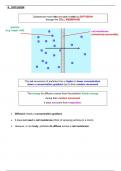
Substances move into and out of cells by DIFFUSION
through the CELL MEMBRANE
particle
(e.g. sugar, salt) cell membrane
(selectively permeable)
The net movement of particles from a higher to lower concentration,
down a concentration gradient due to their random movement
The energy for diffusion comes from the particles’ kinetic energy
during their random movement
It does not come from respiration.
• Diffusion needs a concentration gradient.
• It does not need a cell membrane (think of spraying perfume in a room).
• However, in our body, particles do diffuse across a cell membrane.
, B. CONCENTRATION GRADIENT
HIGHER CONCENTRATION GRADIENT LOWER CONCENTRATION GRADIENT
OUTSIDE CELL INSIDE CELL OUTSIDE CELL INSIDE CELL
The DIFFERENCE in CONCENTRATION (across the CELL MEMBRANE is known as the CONCENTRATION GRADIENT
HIGHER CONCENTRATION GRADIENT =
LARGER DIFFERENCE IN CONCENTRATION ACROSS THE MEMBRANE =
FASTER DIFFUSION
Substances move into and out of cells by DIFFUSION
through the CELL MEMBRANE
particle
(e.g. sugar, salt) cell membrane
(selectively permeable)
The net movement of particles from a higher to lower concentration,
down a concentration gradient due to their random movement
The energy for diffusion comes from the particles’ kinetic energy
during their random movement
It does not come from respiration.
• Diffusion needs a concentration gradient.
• It does not need a cell membrane (think of spraying perfume in a room).
• However, in our body, particles do diffuse across a cell membrane.
, B. CONCENTRATION GRADIENT
HIGHER CONCENTRATION GRADIENT LOWER CONCENTRATION GRADIENT
OUTSIDE CELL INSIDE CELL OUTSIDE CELL INSIDE CELL
The DIFFERENCE in CONCENTRATION (across the CELL MEMBRANE is known as the CONCENTRATION GRADIENT
HIGHER CONCENTRATION GRADIENT =
LARGER DIFFERENCE IN CONCENTRATION ACROSS THE MEMBRANE =
FASTER DIFFUSION