Bio 315- Exam 1 Questions & Answers, Already Passed!!
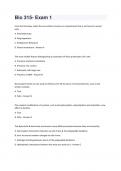
From the list below, select the one cellular structure or compartment that is not found in animal cells: A. Plasmodesmata B. Golgi apparatus C. Endoplasmic Reticulum D. Plasma membrane - Answer-A The most reliable feature distinguishing a eukaryotic cell from prokaryotic cell is the: A. Presence of plasma membrane B. Presence of a nucleus C. Eukaryotic cells larger size D. Presence of DNA - Answer-B Noncovalent bonds are too weak to influence the 3D structure of macromolecules, such as the protein complex A. True B. False - Answer-B The covalent modification of a protein, such as phosphorylation, ubiquitylation and acetylation, may affect its location A. True B. False - Answer-A The alpha helix & beta sheet are found in many different proteins because they are formed by A. Noncovalent interactions between aa side chains & the polypeptide backbone B. Ionic structures between charged aa side chains C. Hydrogen bonding between atoms of the polypeptide backbone D. Hydrophobic interactions between the many non polar aa's - Answer-CThe sugar-phosphate backbone of the DNA double helix contains many negative charges, and is hydrophilic A. True B. False - Answer-A Each eukaryotic chromosome must contain the following DNA sequence elements: multiple origins or replication, two telomeres and one centromere A. True B. False - Answer-A Which of the following statements is NOT true about his tones? A. They are rich in positively charged aa's B. There is a great deal of diversity in histones from various eukaryotes C. They form dimers through "handshake" interactions D. The modification of histone tails, such as methylation, acetylation, phosphorylation, or the removal of these functional groups, is important for the regulation of chromatin structure and gene expression - Answer-B The replication fork is asymmetrical because it contains two DNA polymerase molecules that are structurally distinct A. True B. False - Answer-B The gene encoding DNA polymerase can be inactivated by a mutation in a cell. The cell attempts to replicate its DNA. What will likely happen in the absence of DNA polymerase? A. No replication can take place at all. RNA primers will be laid down at the origin of replication B. The lagging DNA strand will consist of newly synthesized fragments with both DNA & RNA - Answer-A Describe the consequences that would arise if a eukaryotic chromosome lacked one or both telomeres A. The rate of DNA replication would severely limit the rate of cell division B. Many mutations occur during DNA replicationC. The chromosome ends would gradually shrink. Eventually, essential genes would be lost, leading to cell death D. Newly replicated chromosomes could not be partitioned accurately between 2 daughter cells - Answer-C Comparing the eukaryotic transcription with the bacterial transcription, which statement is NOT true? A. Bacterial cells contain a single RNA polymerase whereas eukaryotic cells have 3 B. Bacterial RNA polymerase can not initiate transcription without the help of many general transcription factors C. In eukaryotic cells, gene regulatory proteins can influence transcription initiation thousands of nucleotides away from the promoter whereas bacterial regulatory sequences are very close to the promoter D. Eukaryotic transcription is affected by chromatic structure and nucleosomes whereas bacterial transcription is not - Answer-B Small non-protein coding RNAs, such as miRNAs can regulate expression of protein-coding genes by controlling mRNA stability and translation A. True B. False - Answer-A The difference between multicellular organisms are largely explained by the different kinds of genes carried on their chromosomes A. True B. False - Answer-B When a mutation arises, it can have 3 possible consequences: A. Beneficial to the individual, B. Selectively neutral, or C. Detrimental. The spread of a mutation in subsequent generations will, of course, depend on its consequences to individuals that inherit it. Order the 3 possibilities above from that which is most likely to spread & become over-represented in subsequent generations to that which is most likely to become under-represented or disappear from the population. A. A,C,B B. A,B,C C. B,C,A D. C,B,A - Answer-A
Written for
- Institution
- Bio 315
- Course
- Bio 315
Document information
- Uploaded on
- March 25, 2024
- Number of pages
- 11
- Written in
- 2023/2024
- Type
- Exam (elaborations)
- Contains
- Questions & answers
Subjects

Also available in package deal