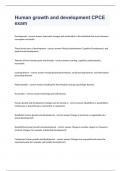
Human growth and development CPCE exam verified/passed
Human growth and development CPCE examDevelopment - correct answer Systematic changes and continuities in the individual that occur between conception and death Three broad areas of development - correct answer Physical development, Cognitive Development, and psychosocial development Theories of how humans grow and develop - correct answer Learning, cognitive, psychoanalytic, humanistic Learning theory - correct answer Including behavioral theories, social learning theories, and information-processing theories Psychoanalytic - correct answer Including the Neo-freudian and ego psychology theories Humanistic - correct answer Psychology and self theories Human growth and development changes can be viewed as - correct answer Qualitative or quantitative, Continuous or discontinuous, mechanistic or organismic Qualitative human growth and development - correct answer Change in structure or organization (i.e. sexual development) Quantitative human growth and development - correct answer Change in number, degree or frequency (content changes, for example, intellectual development) Continuous human growth and development - correct answer Changes are sequential and cannot be separated easily (for example, personality development) Discontinuous human growth and development - correct answer Certain changes in abilities or behaviors can be separated from others which argues for stages of development (for example, language development). Mechanistic human growth and development - correct answer this is the reduction of all behavior to common elements (for example, instinctual, reflexive behavior). Organismic human growth and development - correct answer because of new stages, there is a change or discontinuity; it is more than stimulus-response. The organism is involved including the use of cognition. Examples would be moral or ethical development. Self-concept - correct answer Your perception of your qualities, attributes and traits. Self-concept at birth - correct answer infants have no sense of self. In early months, this quickly changes. Self-concept by 24 months - correct answer at this point, most infants show signs of self-recognition; they can identify social categories they are in such as age and gender, "who is like me and who is not like me"; they exhibit various temperaments. Self-concept of pre-school child - correct answer Self-concept is very concrete and physical. By 8 or so, they can describe inner qualities. Self-concept by adolescence - correct answer self-concepts (self-descriptions) become more abstract and psychological. Stabilization of self-concept attributes continues. Cultural and family factors influence the development of attributes and some traits. Developmental concepts - correct answer Nature vs. nurture, genotype and phenotype, tabula rasa, plasticity, resiliency.
Written for
- Institution
- CPCE
- Course
- CPCE
Document information
- Uploaded on
- March 22, 2024
- Number of pages
- 18
- Written in
- 2023/2024
- Type
- Exam (elaborations)
- Contains
- Questions & answers
Subjects
-
human growth and development cpce exam

Also available in package deal