Certified Crop Advisor Terms 2024
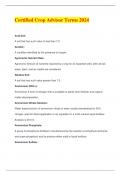
Certified Crop Advisor Terms 2024 Acid Soil: A soil that has a pH value of less than 7.0. Aerobic: A condition identified by the presence of oxygen. Agronomic Nutrient Rate: Agronomic Amount of nutrients required by a crop for an expected yield, after all soil, water, plant, and air credits are considered. Alkaline Soil: A soil that has a pH value greater than 7.0. Ammonium (NH4+): Ammonium A form of nitrogen that is available to plants from fertilizer and organic matter decomposition. Ammonium Nitrate Solution: Water based solution of ammonium nitrate in water usually standardized to 20% nitrogen used for direct application or an ingredient in a multi-nutrient liquid fertilizer. Analysis is 20-0-0. Ammonium Phosphate: A group of phosphorus fertilizers manufactured by the reaction of anhydrous ammonia and super-phosphoric acid to produce either solid or liquid fertilizer. Ammonium Sulfate: A fertilizer with an analysis of 21-0-0 and 24% sulfur. Anaerobic: A condition identified by the absence of oxygen Anhydrous Ammonia (NH3): Nitrogen fertilizer made by compressing air and natural gas under high temperature in the presence of a catalyst. Analysis is 82-0-0. Animal Unit: 1000 pounds of live animal weight, a term used to determine volumes of animal manure produced. Anion: An ion that has a negative electrical charge. Common anions include sulfate, and nitrate. Anion Exchange Capacity: The sum total of exchangeable anions that a soil can adsorb. Expressed as centimoles of charge per kilogram (cmolc/kg) of soil or milliequivalents per 100 g of soil (meq/100 g of soil). Application Rate: The weight or volume of a fertilizer, soil amendment, or pesticide applied per unit area. Available Nutrient: The form of a nutrient that the plant is able to use. Many nutrients are in forms the plant cannot u and must be converted to forms available to the plant to be useful. Banded Nutrients: Placing fertilizer nutrients in a band near the seed at planting. Also may include a separate surface or subsurface band application of either solid or liquid materials before or after planting. Base Saturation Percentage: The proportion of the soil's cation exchange capacity occupied by basic cations. Bioremediation: The use of biological agents to reclaim soil and/or water polluted by substances hazardous to human health or the environment. Biosolid: Any organic material, such as livestock manure, compost, sewage sludge or yard wastes applied to the soil to add nutrients or for soil improvement. Buildup and Maintenance: Nutrients applied in order to build up a target soil test level and then maintained by annual addition of the quantity of nutrients expected to be removed in the harvested portion of the crop. Calcite Lime: Limestone consisting of CaCO3 based material with low magnesium levels. Calcium Carbonate Equivalent (CCE): The liming potential of material as compared to CaCO3. Cation: An ion that has a positive electrical charge. Common soil cations are calcium, magnesium, hydrogen, sodium and potassium. Cation Exchange Capacity (CEC): The amount of exchangeable cations that a soil can adsorb at a specific pH, expressed as milliequivalents per 100 gram of soil (meq/100 g soil) or (cmol charge/kg). Cation Exchange Sites: Negatively charged sites on the surfaces of clays and organic matter. Chelated Molecule: A large water-soluble organic molecule that binds with a free metal ion to form a water- soluble complex. Chelation improves the solubility and plant availability of the metal ion. Comprehensive Nutrient Management Plan: A group of conservation practices and management activities unique to animal feeding operations, which ensures efficient crop production as well as natural resource protection. Critical Value: The point between sufficiency and deficiency levels of a nutrient. Crop Nutrient Requirement: The amount of nutrients needed to growa specified crop yield, expressed per unit area. Crop Removal Rate: The amount of nutrients that are removed from the field in the plant harvest, including grain, fruit forage and residues that are removed from the field. Crop Rotation: A planned sequence of crops growing in a regularly recurring succession to the same area. Crop Utilization Rate:
Written for
- Institution
- Certified Crop Advisor
- Course
- Certified Crop Advisor
Document information
- Uploaded on
- March 22, 2024
- Number of pages
- 50
- Written in
- 2023/2024
- Type
- Exam (elaborations)
- Contains
- Questions & answers
Subjects
-
certified crop advisor terms 2024

Also available in package deal