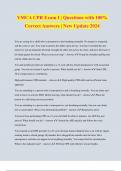
YMCA CPR Exam I | Questions with 100% Correct Answers | New Update 2024
YMCA CPR Exam I | Questions with 100% Correct Answers | New Update 2024 You are caring for a child who is unresponsive but breathing normally. No trauma is suspected, and the scene is safe. You want to protect the child's open airway. You have extended the arm nearest to you up alongside the head, brought the other arm across his chest, and have the back of his hand against his cheek. What is your next step? - Answer ️️ -Grasp the shoulder and hip and roll the child onto his side. You and another provider are attending to a 17-year-old boy found unresponsive with occasional gasps. You are not certain if a pulse is present. What should you do? - Answer ️️ -Start CPR; 30:2 compressions to ventilations. High-performance CPR includes: - Answer ️️ -High-quality CPR skills and an efficient team approach You are attending to a person who is unresponsive and is breathing normally. You are alone and need to leave to activate EMS. Before leaving, what should you do? - Answer ️️ -Place the person in a side-lying recovery position. You are attending to a person who is unresponsive, not breathing normally, but you can clearly feel a carotid pulse. What is the determined problem? - Answer ️️ -Respiratory arrest You have been performing CPR on a 9-year-old child for about 4 minutes. An AED has just arrived. What should you do? - Answer ️️ -Attach the AED quickly and follow the voice instructions. You respond as an EMS provider to a 51-year-old man found collapsed near a car with its engine running inside a closed garage. Bystanders have dragged him outside onto the lawn. He is unresponsive and does not appear to be breathing normally. You cannot feel his carotid pulse. What is the indicated care? - Answer ️️ -Perform CPR with effective rescue breaths. A roofer was electrocuted when his aluminum ladder contacted an energized power line. The scene has been made safe and you have determined he is in cardiac arrest. The AED has analyzed the heart and is indicating a shock is advised. What should you do? - Answer ️️ -Clear the person and immediately deliver the shock. When providing CPR on a child or infant: - Answer ️️ -Ensure there is an open airway for rescue breaths. You have responded to a report of an abrupt collapse of a middle-aged man at a local office building. Your BLS assessment shows the man is unresponsive, not breathing normally, and has no carotid pulse. This condition is most likely caused by and treated with: - Answer ️️ -Sudden cardiac arrest; CPR, defibrillation Prevention of airway and breathing emergencies; early CPR with an emphasis on effective rescue breaths and, if needed, rapid defibrillation; early activation of the appropriate emergency response protocol; effective BLS and ALS care and transportation; and effective post-cardiac arrest care at a hospital are the links in which chain of survival? - Answer ️️ -Children and infants You find an 11-year-old child who is unresponsive and blue. She is not breathing normally and you cannot feel a carotid pulse. Her friend states that she collapsed and stopped moving after playing the "pass out" choking game. You are the only trained BLS provider. What do you need to do? - Answer ️️ -Send the friend to activate EMS and get an AED, then begin CPR yourself. To observe standard precautions means: - Answer ️️ -To follow a set of infection control practices used whether or not an infection is suspec
Written for
- Institution
- YMCA CPR
- Course
- YMCA CPR
Document information
- Uploaded on
- March 22, 2024
- Number of pages
- 4
- Written in
- 2023/2024
- Type
- Exam (elaborations)
- Contains
- Questions & answers
Subjects
-
ymca cpr exam i questions with 100 correct answ

Also available in package deal