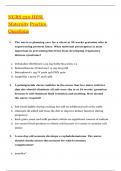
NURS 220 HESI Maternity Practice Questions
NURS 220 HESI Maternity Practice Questions 1.The nurse is planning care for a client at 30 weeks gestation who is experiencing preterm labor. What maternal prescription is most important in preventing this fetus from developing respiratory distress syndrome? taline (Brethine) 0.25 mg SubQ Q15 mins x 3 b.Betamethasone (Celestone) 12 mg deep IM c.Butorphanol 1 mg IV push q2h PRN pain d.Ampicillin 1-gram IV push q8h 2.A primigravida client confides in the nurse that her sister told her that she should eliminate all salt once she is at 26 weeks’ gestation because it will eliminate fluid retention and swelling. How should the nurse respond? a.Salt foods lightly during cooking but add no additional salt at the table. nate all added salt from the diet to improve kidney function during pregnancy grain, meat and milk products which are significant sources of sodium canned food products to obtain salt because it is easier to monitor salt intake 3.A one-day-old neonate develops a cephalohematoma. The nurse should closely assess this neonate for which common complication? ice* damage appetite lycemia 4.The mother of a breastfeeding 24 hr old infant is very concerned about the techniques involved in breastfeeding. She calls the nurse with each feeding to seek reassurance that she is “doing it right.” She tells the nurse, “I just know my daughter is not getting enough to eat.” What response would be best for the nurse to make? your baby hourly until you feel confident that your child is receiving enough milk ’t worry, soon your milk will come in, and you will feel how full your breasts are you are so concerned, you should probably supplement breastfeeding with formula your baby’s urine is straw-colored, she is getting enough milk* 5.A client at 30 weeks gestation reports that she has not felt the baby move in the last 24 hours. Concerned, she arrives in a panic at the obstetric clinic where she is immediately sent to the hospital. Which assessment finding warrants immediate intervention by the nurse? onset of uterine contractions ng amniotic fluid heart rate 60 beats/min* red amniotic membrane 6.A client at 40-weeks’ gestation presents to the obstetrical floor and indicates that the amniotic membranes ruptured spontaneously at home. She is in active labor and feels the need to bear down and push. What information is most important for the nurse to obtain first? estimated amount of fluid the membranes ruptured and consistency of the fluid odor noted when membranes ruptured. 7.A 32-week gestation client has deep tendon reflexes (DTRs) are 4+. What action should the nurse take first? s the urine for proteinuria d the finding on a flowsheet n blood pressure reading y the healthcare provider 8.The nurse is preparing to draw blood from a newborn to obtain hemoglobin and hematocrit levels. What is the best method to obtain this blood sample? a butterfly, small gauge needle to do a venous puncture on the hand blood from the infant's antecubital vein using a small gauge needle a small gauge needle to puncture the vastus lateralis a lancet to puncture the outer lateral aspect of the heel * 9.A 25-year-old client who had a severe postpartum hemorrhage following the vaginal birth of twins is transferred to the postpartum unit. The nurse knows that assessment for what complication has the highest priority for this client? artum psychosis , painful uterine afterpains nta accreta minated intravascular coagulation* 10.A primigravida client receives a prescription for an infusion of oxytocin (Pitocin) at 12 milliunits/minute. The available solution is ringers lactated 1,000 ml with Piton 10 units. The nurse should program the infusion pump to deliver how many ml/hour? 11.A client is admitted to the postpartum unit and tells the nurse she had rheumatic fever as a child, which resulted in some “heart damage.” The nurse knows that this client is at particular risk for developing heart failure during the immediate postpartum period. Based on this client’s history, which nursing diagnosis has the highest priority? deprivation for infection volume excess * a and vomiting rd greens 13.A client at 34 weeks gestation comes to the birthing center complaining of vaginal bleeding that began one hour ago. The nurse’s assessment reveals approximately 30 ml of bright red vaginal bleeding, FHR of 130 to 140 beats/min, no contraction, and no complaints of pain. What is the most likely case of this client’s bleeding? nta previa b.a ruptured blood vessel in the vaginal vault l bloody show indicating initiation of labor tio placenta 14.A client at 26 weeks gestation recently indicated a yellow discharge from her right breast. How should the nurse respond? need to wear a good support bra need to discuss this with your HCP probably have an infection is normal * 15.When assessing a pregnant woman at 39 weeks gestation who is admitted to labor and delivery, which finding is most important to report to the HCP? a. +1 pedal edema b. 130/70 blood pressure c. 101.2 F oral temp * d. +1 proteinuria 16.When performing the daily head to toe assessment of a one-day old newborn, the nurse observes a yellow tint to the skin on the forehead, sternum, and abdomen. What action should the nurse take? w maternal medical records for blood type and Rh factor re the newborn for phototherapy ate cord blood Coombs’ test results re bilirubin levels using transcutaneous bilirubinometer 17.A pregnant client mentions in her history that she changes a cat’s litter box daily. Which test should the nurse anticipate the HCP to prescribe? a.Biophysical profile b.TORCH screening c.Fern Test centesis 18.Assessment findings of a 3-hour old newborn include: axillary temperature of 97.7 F, heart rate of 140 beats/min with a soft murmur, and irregular respiratory rate at 42 breaths/min. Based on these findings, what action should the nurse implement? d findings in electronic medical record n venous blood sample for glucose level h a pulse oximeter on the heel the infant under the radiant warmer 19.Which type of anesthesia, used with a client in labor, produces a loss of sensation only to the vagina and perineum? dal block ral block e block ervical block 20.A new mother asks the nurse about an area of swelling on her baby’s head near the posterior fontanel that lies across the suture line. How should the nurse respond? is called a caput succedaneum. it will absorb and cause no problems* is called a cephalohematoma. it can cause jaundice as it is absorbed is called a cephalohematoma. it will cause no problems is called a caput succedaneum. it will have to be drained 21.A 5-day old infant with a serum bilirubin of 19 mg/dl is being discharged from the hospital. Which instruction should the nurse include in the discharge teaching plan? tfeed infant every 4 hours or skin and eyes for yellow tinge ition the infant every 2 hours e diapers every hour 22.The current vital signs for a primipara who delivered vaginally during the previous shift are: temperature 100.4 F, heart rate 58 beats/min, respiratory rate 16 breaths/min, and blood pressure 130/74. What action should the nurse implement? ister a PRN dose of acetaminophen t heart rate to HCP ent the vital signs in the record s the perineum for excessive lochia 23.A client who suspects she is pregnant tells the nurse she has a peptic ulcer that is being treated with misoprostol (Cytotec), a synthetic prostaglandin E drug. How should the nurse respond? may have an increased chance of having preeclampsia medication will have no effect on your unborn child may experience postpartum hemorrhage after delivery may be at higher risk for having a spontaneous miscarriage * 24.A pregnant woman who is at 10-weeks’ gestation and is 35 years of age tells the nurse that she is concerned about the possibility of having a baby with Down Syndrome. Which information should the nurse provide this client? amniocentesis conducted at 24 weeks’ gestation confirms or denies Down Syndrome in the fetus nal serum Human Chorionic Gonadotropic (HCG) can identify Down Syndrome at 6 weeks of gestation c.Weekly fundal height measurements are a noninvasive method used to check for Down Syndrome d.Chorionic villus sampling at 12 weeks gestation is the earliest screening test used to identify Down Syndrome * 25.A client who is anovulatory and has hyperprolactinemia is being treated for infertility with metformin (Glucophage), menotropins (Repronex, menopur) and HCG. Which side effect should the nurse tell the client to report immediately? stent daytime fatigue increase in abdominal girth a and vomiting des of headache and irritability 26.The HCP prescribes 10 units/L of oxytocin (Pitocin) via IV drip to augment a client’s labor because she is experiencing a prolonged active phase. Which finding would cause the nurse to immediately discontinue the oxytocin? decelerations of FHR s is soft c.Four contractions in 10 minutes action duration of 100 seconds * 27.The nurse receives a newborn within the first minutes after a vaginal delivery and intervenes to establish adequate respirations. What priority should the nurse address to ensure the newborn’s survival? balance lycemia loss ing tendencies 28.One day after vaginal delivery of a full-term baby, a postpartum client’s white blood cell count is 15,000/mm3. What action should the nurse take first? the differential, since the WBC is normal for this client * y the HCP, since this finding is indicative of infection s the client’s temperature, pulse and respirations q4h s the clients perineal area for signs of perineal hematoma 29. The nurse is performing a newborn assessment. Which symptom, if present in a newborn would indicate respiratory distress? ratory rate of 50 breaths per min ng of the nares * ow and irregular respirations inal breathing with synchronous chest movement 30.The nurse is caring for a client following an emergency cesarean delivery under a general anesthesia. Which assessment finding, occurring in the first 8 hours after delivery, is more critical and requires immediate intervention? nausea and anorexia
Written for
- Institution
- NURS 220 HESI Maternity
- Course
- NURS 220 HESI Maternity
Document information
- Uploaded on
- March 22, 2024
- Number of pages
- 42
- Written in
- 2023/2024
- Type
- Exam (elaborations)
- Contains
- Questions & answers
Subjects
-
nurs 220 hesi maternity practice questions 1the