combinations-
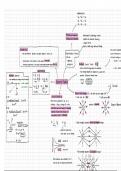
• + + Q- =
- t - = t
• Q+ + Qt = Qt
(t) forces are repulsive Electrostatic fields obeys inverse
(-) forces are attractive square law and has infinitely
ranged forces.
Electric fields only deal with charge.
coulombs law: An electron is placed
Force of attraction between two point charges Q1 and Q2 is: Electrostatic Forces A p-d of 100 volts is a
can be of force acting on
- proportional to the product of two charges (F α Q1 Q2] • repulsive V-100 r= 10
- Inversely proportional to the square of the distance between charges (F α ½] • attractive Uniform Electric Fields- E- ¥
• can be created using plates of a capacitor. = 100 ÷ (10×10
EQUATIONS: • Field strength depends on separation of plates and
Example Question- potential difference between them.
É:? E-E
Find resultant force acting on Pdueto A and B. 1 Q2 E = Y
: acm P -lanc Include magnitude
4TEO r² UTEO T2
Electric Fields v
Ve = ' 2 E-E (VECTOR)
and direction! PETE r
som UTEO T
EF W-GAVE 9=9.0×10⁹
+12:? Electric field strength (E) is the force per unit charge (NC-1)
A-P: Electric Potential- • field lines for Qt- • field lines for Q-
F =/9×109/(8×10-9) (6×10⁻⁹) = 5.3×10⁻⁵N • The electric potential, Ve, at a
A
(9×10-212 distance r from a charge Q is the positive = outwards negative = inwards
P→B: work done per unit charge in bringing t -
FB= (9×10⁹) (6×10⁻⁹) (12×10-9) = 26×10-SN a positive charge from infinity to r
(5×10⁻²) 2 in an electric field. (SCALAR)
FB
E
magnitude- • Field strength between positive and negative charges:
26×10-5
(26×10-512 + (s-3×10-512
Viko ♀ "¥
of
FA EF = 27×10-SN potential difference =
5. 3×10⁻⁵
O-tan-' 26×10-s work done per unit charge
5. 3×10⁻⁵ Qt -
0=78-5. V21 repulsion (t)
v2-I att traction (-)
• Field strength between two negative charges
Two trend lines as we consider (tor)
direction due to repulsion and attraction. field
Q- Q-
EF
• + + Q- =
- t - = t
• Q+ + Qt = Qt
(t) forces are repulsive Electrostatic fields obeys inverse
(-) forces are attractive square law and has infinitely
ranged forces.
Electric fields only deal with charge.
coulombs law: An electron is placed
Force of attraction between two point charges Q1 and Q2 is: Electrostatic Forces A p-d of 100 volts is a
can be of force acting on
- proportional to the product of two charges (F α Q1 Q2] • repulsive V-100 r= 10
- Inversely proportional to the square of the distance between charges (F α ½] • attractive Uniform Electric Fields- E- ¥
• can be created using plates of a capacitor. = 100 ÷ (10×10
EQUATIONS: • Field strength depends on separation of plates and
Example Question- potential difference between them.
É:? E-E
Find resultant force acting on Pdueto A and B. 1 Q2 E = Y
: acm P -lanc Include magnitude
4TEO r² UTEO T2
Electric Fields v
Ve = ' 2 E-E (VECTOR)
and direction! PETE r
som UTEO T
EF W-GAVE 9=9.0×10⁹
+12:? Electric field strength (E) is the force per unit charge (NC-1)
A-P: Electric Potential- • field lines for Qt- • field lines for Q-
F =/9×109/(8×10-9) (6×10⁻⁹) = 5.3×10⁻⁵N • The electric potential, Ve, at a
A
(9×10-212 distance r from a charge Q is the positive = outwards negative = inwards
P→B: work done per unit charge in bringing t -
FB= (9×10⁹) (6×10⁻⁹) (12×10-9) = 26×10-SN a positive charge from infinity to r
(5×10⁻²) 2 in an electric field. (SCALAR)
FB
E
magnitude- • Field strength between positive and negative charges:
26×10-5
(26×10-512 + (s-3×10-512
Viko ♀ "¥
of
FA EF = 27×10-SN potential difference =
5. 3×10⁻⁵
O-tan-' 26×10-s work done per unit charge
5. 3×10⁻⁵ Qt -
0=78-5. V21 repulsion (t)
v2-I att traction (-)
• Field strength between two negative charges
Two trend lines as we consider (tor)
direction due to repulsion and attraction. field
Q- Q-
EF