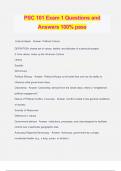
PSC 101 Exam 1 Questions and Answers 100% pass
PSC 101 Exam 1 Questions and Answers 100% pass Cultural Ideals - Answer- Political Culture: DEFINITION: shared set of values, beliefs, and attitudes of a particular people 3 Core values: make up the American Culture Liberty Equality Democracy Political Efficacy - Answer- Political efficacy is the belief that one has the ability to influence what government does. Citizenship - Answer- Citizenship: derived from the Greek ideal, refers to "enlightened political engagement." Nature of Political Conflict- 2 sources - Answer- Conflict rooted in two general conditions of society: Scarcity of Resources Difference in values Government defined - Answer- institutions, processes, and rules designed to facilitate control over a particular geographic area Autocracy/Oligarchy/Democracy - Answer- Autocracy: government by a single, nonelected leader (e.g., a king, queen, or dictator). Oligarchy: government by a small group that is not accountable to the citizens (e.g., military officers or landowners). Democracy: a system of rule that permits citizens to play a significant part in the governmental process, usually through the election of key public officials. Constitutional/Authoritarian/Totalitarian governments - Answer- Totalitarian governments recognize no limits on their authority. Authoritarian governments recognize no limits on their authority, but they are constrained by other institutions, such as business or a church. Constitutional governments are limited both in what they can do (substantive limits) and the methods they can employ (procedural limits). Representative Democracy (Republic) v. Direct (pure) democracy - Answer- Pure: people directly make policy Forms of direct democracy in Nevada: Initiative Example: recreational marijuana Gun control background checks Referendum: uphold or reveal existing laws Recall: remove officials prior to the expiration of their term (only state officials) Representative: people vote for representatives who serve their interests Power/Authority - Answer- Power Ability to influence governmental decisions Authority Recognized right to make binding decisions Politics-Lasswell and text definition - Answer- Harold Lasswell (famous political scientist) defines politics as: the process of deciding "who gets what, when & how" Pluralism - Answer- Groups and organized interests also participate in politics. Groups and organized interests provide funds for candidates, lobby, and try to influence public opinion. The pattern of struggles among interests is called group politics, or pluralism. Equality of opportunity v. Political equality - Answer- Political Equality "One man, One Vote" We're all equal in the political process Popular Sovereignty, Majority Rule, Minority Rights - Answer- When ultimate power rests with the citizenry, this is called popular sovereignty. In America, the people are sovereign and majority rules, but the individual rights of the minority are still protected. Tyranny of the Majority - Answer- Federalists saw the need for a strong central government, and divided its powers to prevent tyranny of the majority. Rules of American Politics ('the game') - Answer- People must know the rules of the game in order to engage or influence the outcome. Separation of Powers-Montseiu and features of checks and balances - Answer- 3 branches all with their own powers granted to each
Written for
- Institution
- PSC 101
- Course
- PSC 101
Document information
- Uploaded on
- March 20, 2024
- Number of pages
- 13
- Written in
- 2023/2024
- Type
- Exam (elaborations)
- Contains
- Questions & answers
Subjects
-
psc 101 exam 1 questions and answers 100 pass

Also available in package deal