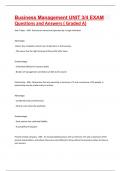
Business Management UNIT 3/4 EXAM Questions and Answers ( Graded A)
Business Management UNIT 3/4 EXAM Questions and Answers ( Graded A) Sole Trader - ANS- Businesses owned and operated by a single individual. Advantage: -Owner has complete control over all decisions in the business - The owner has the right to keep all the profits after taxes Disadvantage: - Unlimited liability for business debts - Burden of management and failure all falls to the owner Partnership - ANS- Businesses that are owned by a minimum of 2 and a maximum of 20 people. A partnership may be made orally or written. Advantage: - Combined funds and financials - Partners can share the workload Disadvantage: - Each partner has unlimited liability - A possibility of disputes Private limited company - ANS- An incorporated business with a minimum of 5 and a maximum of 50 private shareholders, and whose shares are only offered to those whom the business wishes to have as part owners. Advantage: - Limited liability - Existence of the business is not threatened by death or removal of one of the directors or shareholders Disadvantage: - Higher degree of government control and reporting requirements - Higher degree of complexity in establishing Public Listed Company - ANS- An incorporated business with a minimum of 5 shareholders, and whose shares are publicly listed on the ASX (Australian Securities Exchange). E.g. Telstra, Westpac, Woolworths and Virgin Australia Advantage: - Easier to attract public finance because the business has been incorporated - Limited liability Disadvantage: - Double taxation higher operating fees - Shareholders may have diverse priorities, which can be difficult to satisfy Social Enterprise - ANS- A business that operates with the main objective of fulfilling a social need, rather than making a profit. E.g. The Big Issue, Thank You Water Advantages: - Can open up new markets - Positive impact on the community/society increases reputation of the business Disadvantage: - Significant operating costs - Can be difficult to focus on both social and financial objectives Government Business Enterprise (GBE) - ANS- A business that is government owned and operated. GBEs seek to run profitably by controlling costs and selling their goods and services at a price to cover costs. E.g. VicRoads or Aus Post Advantages: + A GBE is able to carry out government policies, delivering community services in areas where private sector businesses might hesitate to invest. + The provision of healthy competition to businesses operating in the private sector Disadvantages: -Inefficiencies caused by government 'red tape'—excessive regulation or rigid conformity to rules. -There can be less accountability within a GBE, resulting in less productivity and negative attitudes amongst staff. Objective - ANS- A desired goal, outcome or specific result the business wishes to achieve Business Objectives - ANS- - To make a profit - To increase market share - To fulfil a market need - To fulfil a social need - To meet shareholder expectations Stakeholders - ANS- Stakeholders are groups and individuals who interact and have a vested interest in the businesses activities. Internal: - Managers - Employees - Shareholders External: - Competitors - Customers - Suppliers Potential conflict between stakeholders - ANS- - Employees and shareholders - management and customers - management and suppliers - Employees and management Corporate Social Responsibility (CSR) - ANS- The obligations a business has above and beyond it's legal responsibilities to the wellbeing of employees, managers, shareholders, customers and the community as well as the environment. Areas of management responsibility (functional areas) - ANS- Operations Responsible for the production of the business's product, whether it is a manufactured good or the provision of a service. Operation managers have the responsibility to ensure that the product or service is actually produced - e.g. production schedules and stock levels Finance Responsible for managing the financial aspects of the business. This can include developing financial policies, raising finance, budgeting, accounting and reporting, and cash control. Other aspects include: · prepare budgets · cost analysis · pricing Human Resources Responsible for managing the relationship between the employer and employees. Sales and Marketing The sales and marketing area is responsible for promoting the business and selling its products in the market. Technology Support Responsible for installing and maintaining technology, as well as providing assistance to the users of technology in the business. These technologies may include: · mobile phones · computers · computer networks · software products · other electronic
Written for
- Institution
- Business Management
- Course
- Business Management
Document information
- Uploaded on
- March 16, 2024
- Number of pages
- 23
- Written in
- 2023/2024
- Type
- Exam (elaborations)
- Contains
- Questions & answers
Subjects
-
business management unit 34 exam

Also available in package deal