1.7 Notes- AP History question n answers graded A+
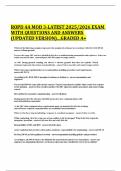
1.7 Notes- AP HistoryThe author makes the claim that states in core areas of civilization grew larger, while smaller states began to decline. Identify and explain two examples that prove this argument. - correct answers States in core areas of civilization grew larger because of cultural and technological progression. For example, the Song Dynasty in China was maintained for a long period of time due to the advancements that occurred. Also, the Chola Kingdom and Vijayanagar Empire used trade to construct strong states. Smaller states declined due to the lack of innovation. How was the role of religion in empire and state building similar or different throughout Afro-Eurasia? - correct answers Religion was a vital part of state-building in much of the world because it helped to unite a diverse population and strengthen political control over territories. One prime example of how religion worked with state-building was the Islamic world because Islam provided the basis for the legitimacy of rulers from West Africa to Southeast Asia. Other states strengthened by religion include the Song Dynasty (used Confucianism), Neo-Confucianism spread to Korea and Japan (allowed rulers in these East Asian regions to justify their power), and rulers in Southeast and South Asia relied on Buddhism and Hinduism to help strengthen states as well. However, Europe's relationship between the Roman Catholic Church and state-building was slightly different. Sometimes, the Church was part of the state-building process, but due to European states being so weak for most of the Middle Ages, the Church had given an alternative structure for organizing society. Between 1200 and 1450, more powerful states in France and the Holy Roman Empire emerged, which caused the Church to become the rival power on occasions. Explain how the increase in cross-cultural exchanges impacted regions through Afro-Eurasia. - correct answers These exchanges were fueled by increased trade and as these occurred, so did the exchange of technology and innovation. One example of innovations in crop innovation was when Champa rice was spread from Vietnam to China. This helped the Song Dynasty feed and maintain a growing population, which resulted in a larger and more urban citizenry that was supported by the proto-industrialization of China's economy. The production of steel, silk, porcelain, and iron all increased during this time as well. Paper manufacturing reached its way to Europe in the 13th century, which caused an increase in printed material that led to increased literacy rates across Europe, Southwest Asia, and North Africa. This led to advances in math and medicine. Europe was still dependent on the manorial system and serfdom, which may have caused a halt in European technological innovation. Conflict occurred because of the transfers of knowledge paralleling the spread of religion along trade networks. Cross-cultural interactions and transfers intensified and several of the first direct contacts between Europe and China was facilitated by Mongol rule.
Written for
- Institution
- AMSCO AP
- Course
- AMSCO AP
Document information
- Uploaded on
- March 16, 2024
- Number of pages
- 2
- Written in
- 2023/2024
- Type
- Exam (elaborations)
- Contains
- Questions & answers
Subjects

Also available in package deal