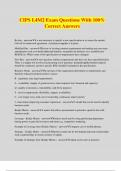
CIPS L4M2 Exam Questions With 100% Correct Answers
CIPS L4M2 Exam Questions With 100% Correct Answers Re-buy - answerIt is not necessary to specify a new specification or to source the market. Call-off or framework agreement. A preferred supplier is in place Modified Buy - answerReview of existing contract requirements and making any necessary amendments such as to build additional benefits, streamline the business or to establish new KPIs/SLAs. Where some of the specification or requirements have changed. New Buy - answerA new purchase outlines requirements that have not been specified before. There is a higher risk involved in procuring a new purchase, demand/supplier/market analysis should be conducted, and new specific KPIs should be included in the specification. Business Needs - answerThe mission of the organisation determines its requirements and therefore what procurement needs to source. R - regulatory (any legal requirements) A - availability (supply of goods/services when required, risk, financial and capacity) Q - quality (consistency, repeatability, and fit for purpose) S - service requirements (flexibility, support, availability) C - cost (target costs, total cost of ownership, continuous improvement) I - innovation (improving customer experience) - answerA model that can be used to identify business needs. Kraljic Matrix - answerA matrix that allows procurement to prioritise spend in line with business needs. Leverage - Kraljic Matrix - answerBusiness needs met by using purchasing department buying power to gain the best price and terms e.g. competitive tendering. Example of Leverage item (Kraljic Matrix) - answerCompany cars or mobile phones. Strategic - Kraljic Matrix - answerBusiness needs met by developing long term relationships such as partnerships to ensure security of supply. Example of Strategic item (Kraljic Matrix) - answerCapital assets such as premises Routine - Kraljic Matrix - answerBusiness needs met by trying to buy these more efficiently through blanket ordering, e-procurement and vendor managed inventory leadership in procurement and supply. Example of Routine item (Kraljic Matrix) - answerStationary Bottleneck - Kraljic Matrix - answerBusiness needs met by developing appropriate contracts (such as call off contracts, framework agreements) in which the buyer can ensure that stock levels and maintained and speed of re-ordering. Example of Bottleneck item (Kraljic Matrix) - answerSpare parts or oil for machines Cost and risk - Kraljic Matric - answerLow cost / high risk - Bottleneck High cost / high risk - Strategic High cost / low risk - Leverage Low cost / low risk - Routine Total cost of ownership - answerIs how much it costs to own the product over its lifetime until disposal. Whole life costing - answerIs a technique used to arrive at the total cost of ownership Planning, preparation and implementation - answerThree stages of WLC WLC - planning - answerDetermines the budget for the asset being purchased, helps improve the specification to reduce cost, and simulation or decision support models can be used to assist. WLC - preparation - answerTesting the various models for calculating WLC and is necessary to choose the best model. WLC - implementation - answerImplements the model to get the results. A review and intervals for regular recalculation. Acquisition, operation and disposal - answerThere is a vital difference between purchase price and total cost of ownership. This includes 3 categories. Cost based pricing - answerAllows the supplier to cover its costs and make a profit. Limits to cost based pricing - answerIgnores competition and other influences on pricing and are quite inflexible. They also don't give a supplier an incentive to reduce or manage costs. Cost behaviour - answerThe way in which costs of outputs are affected by fluctuations in the level of activity. Open book costing - answerThe supplier provides the buyer with information about their costs to be scrutinised e.g. reassures there is VFM, facilitates cost based pricing. Costing methods - answerMarginal, absorption, activity based Marginal costing method - answerIs widely used by managers and is useful in the distinction between variable costs and fixed costs. Variable costs are always the relevant costs in terms of decision making. Absorption costing method - answerThe challenge is to attribute a 'fair' amount of fixed costs to each unit of production output. Traditionally this has been done by determining the amount of some measurable resource consumed in a production period and the overheads of that resource. Activity based costing method - answerThis is based on the identification of cost drivers and cost pools. There is a difference between purchase price and total cost of ownership. Best value = the lowest whole life cost. Profit - answerThe difference between the selling price of a product and the cost of producing the product. Cash flow forecast - answerIs designed to identify the sources and amounts of cash inflows, and the destinations and amount of cash outflows, over a given budgetary period. Cash flow projection - answerDesigned to project the future cash position of the firm or project. Cash flow management - answerEnsuring that we time incoming and outgoing cash flows. Business case - answerIs the justification for undertaking an action and its purpose is to seek approval and finance for the recommended action. Companies will use a substitute product/service if the economics of doing so are favourable. This depends on 3 things: - answerThe relationship between the value the org gets from the product and it's price, how costly the change would be, and the inclination of the buyer to make a change. Line of best fit - answerThe line that goes approx. through the middle of the data points with an equal number of data points above and below it. Open-ended problems - answerWhen something is stopping the achievement of an objective or blocking progress e.g. agreement from senior management is required before progressing. Closed problems - answerThese appear when something happens that should not have happened e.g. price of raw materials suddenly increase. Primary market data - answerIs collected for a specific purpose, direct from relevant sources e.g. customers. This data is tailor made and is considered direct and a reliable source. However it is timely, costly and possibly considered biased.
Written for
- Institution
- CIPS
- Course
- CIPS
Document information
- Uploaded on
- March 16, 2024
- Number of pages
- 14
- Written in
- 2023/2024
- Type
- Exam (elaborations)
- Contains
- Questions & answers
Subjects
-
cips l4m2 exam questions with 100 correct answers

Also available in package deal