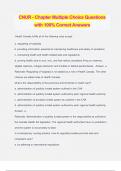
CNUR - Chapter Multiple Choice Questions with 100% Correct Answers
CNUR - Chapter Multiple Choice Questions with 100% Correct Answers Health Canada fulfills all of the following roles except: a. regulating of hospitals b. providing information essential to maintaining healthcare and safety of canadians c. overseeing health and health-related laws and regulations d. proving health care to inuit, innu, and first nations canadians living on reserves, eligible veterans, refugee claimants; and inmates in federal penitentiaries - Answer- a. Rationale: Regulating of hospitals is not stated as a role of Health Canada. The other choices are stated roles of Health Canada. what is the responsibility of the provinces and territories in health care? a. administration of publicly funded system outlined in the CHA b. administration of publicly funded system outlined by each regional health authority c. administration of privately funded system as outlined in the CHA d. administration of publicly funded system outlined by each regional health authority - Answer- a. Rationale: Administration of publicly funded system is the responsibility as outlined in the Canada Health Act legislation. The regional health authorities have no jurisdiction, and the system is not privately funded. In contemporary nursing practice, how do regulatory bodies promote safe and competent care? a. by adhering to international regulations b. by adhering to hospital specific standards c. by adhering to provincial and territorial guidelines d. by adhering to national nursing competencies for entry to practice - Answer- d. Rationale: Professional competencies provide benchmarks for safe and competent professional practice. Professional guidelines require application of judgment according to professional competencies and standards; provincial and territorial guidelines are not benchmarks for nursing regulation; hospital standards are not benchmarks for nursing regulation. Our understanding of health has grown over the last few decades such that the determinants of health established originally by the legislation of the 1980s have changed. Which of the following can be considered determinants of health in contemporary canadian society? - Answer- b. Rationale: Gender, sex, and stress are considered standard determinants of health (SDoH) according to the definition of SDoH. Siblings, family size, family composition, social life, and amount of paid vacation are by definition not considered SDoH. Although culture may be considered an SDoH, hobbies and political opinion are not. Professional self-regulation is: a. A physiological process in the human body b. a right of all professions c. A privilege granted to some professions d. A strategy to inform the public about professionals - Answer- c. Rationale: Professional self-regulation is a privilege granted to some professions; nursing is one of those professions. Match these regulatory terms to the appropriate definition: a. duty to report b. fitness to practice c. standard d. continuing competence I. all the qualities and capabilities of an individual relevant to his or her capability to practice as a nurse II. Nurses or others who observe practice in nurses or other health professionals who place patients at risk have an ethical and legal duty to report concerns to the appropriate person III. An authoritative statement that describes the required behavior of every nurse and is used to evaluate individual performance iv. the ongoing ability of an RN to integrate and apply the knowledge, skills, judgement, and personal attributes required to practice safely and ethically in a designated role and setting - Answer- a. II b. I c. III d. IV The nursing regulatory bodies influence what you need to learn in your nursing education program by establishing which of the following? a. the structure and sequence of nursing and non-nursing courses b. the forms used to create student performance with patients c. the entry-level competencies and standards of practice d. the policies for student grades and conduct - Answer- c. Rationale: All items except the entry-level competencies and standards of practice are decisions made by the educational institution offering the nursing education program. Individual self regulation and evidence of your continued competence are requirements for registration to practice. The typical requirements of continuing competence is set by the regulatory bodies are: a. Written examinations every 3 years b. learning plans based on self assessment c. learning plans developed by the nurse manager d. certificates of short course completion - Answer- b. Rationale: Learning plans may need to use feedback from nurse managers to inform the self-assessment. The final responsibility for the learning plan rests with the individual nurse. Written examinations or certificates of continuing education credits are not common requirements in Canada for year-by-year continuing competence requirements. student nurses are learning about regulation and the standards of practice, to what extent are students held accountable to practice in accordance with the standards of practice before they graduate? a. to the same extent as newly graduated registered nurses b. to the extent that students have been educated so far to practice competently c. to a limited extent and only when ethical and integrity issues arise d. to the full extent that the scope of nursing practice allows - Answer- b
Written for
- Institution
- CNUR
- Course
- CNUR
Document information
- Uploaded on
- March 16, 2024
- Number of pages
- 41
- Written in
- 2023/2024
- Type
- Exam (elaborations)
- Contains
- Questions & answers
Subjects
-
cnur chapter multiple choice questions with 100

Also available in package deal