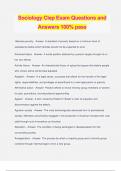
Sociology Clep Exam Questions and Answers 100% pass
Sociology Clep Exam Questions and Answers 100% pass Absolute poverty - Answer- A standard of poverty based on a minimum level of subsistence below which families should not be expected to exist. Achieved status - Answer- A social position attained by a person largely through his or her own efforts. Activity theory - Answer- An interactionist theory of aging that argues that elderly people who remain active will be best-adjusted. Adoption - Answer- In a legal sense, a process that allows for the transfer of the legal rights, responsibilities, and privileges of parenthood to a new legal parent or parents. Affirmative action - Answer- Positive efforts to recruit minority group members or women for jobs, promotions, and educational opportunities. Ageism - Answer- A term coined by Robert N. Butler to refer to prejudice and discrimination against the elderly. Agrarian society - Answer- The most technologically advanced form of preindustrial society. Members are primarily engaged in the production of food but increase their crop yield through such innovations as the plow. Alienation - Answer- The condition of being estranged or disassociated from the surrounding society. Amalgamation - Answer- The process by which a majority group and a minority group combine through intermarriage to form a new group. Anomie - Answer- Durkheim's term for the loss of direction felt in a society when social control of individual behavior has become ineffective. Anomie theory of deviance - Answer- A theory developed by Robert Merton that explains deviance as an adaptation either of socially prescribed goals or of the norms governing their attainment, or both. Anticipatory socialization - Answer- Processes of socialization in which a person "rehearses" for future positions, occupations, and social relationships. Anti-Semitism - Answer- Anti-Jewish prejudice. Apartheid - Answer- The former policy of the South African government designed to maintain the separation of Blacks and other non-Whites from the dominant Whites. Argot - Answer- Specialized language used by members of a group or subculture. Ascribed status - Answer- A social position "assigned" to a person by society without regard for the person's unique talents or characteristics. Assimilation - Answer- The process by which a person forsakes his or her own cultural tradition to become part of a different culture. Authority - Answer- Power that has been institutionalized and is recognized by the people over whom it is exercised. Bilateral descent - Answer- A kinship system in which both sides of a person's family are regarded as equally important. Bilingualism - Answer- The use of two or more languages in particular settings, such as workplaces or educational facilities, treating each language as equally legitimate. Birthrate - Answer- The number of live births per 1,000 population in a given year. Also known as the crude birthrate. Black power - Answer- A political philosophy promoted by many younger Blacks in the 1960s that supported the creation of Black-controlled political and economic institutions. Bourgeoisie - Answer- Karl Marx's term for the capitalist class, comprising the owners of the means of production. Bureaucracy - Answer- A component of formal organization in which rules and hierarchical ranking are used to achieve efficiency. Bureaucratization - Answer- The process by which a group, organization, or social movement becomes increasingly bureaucratic. Capitalism - Answer- An economic system in which the means of production are largely in private hands and the main incentive for economic activity is the accumulation of profits. Castes - Answer- Hereditary systems of rank, usually religiously dictated, that tend to be fixed and immobile. Causal logic - Answer- The relationship between a condition or variable and a particular consequence, with one event leading to the other. Census - Answer- An enumeration, or counting, of a population. Charismatic authority - Answer- Max Weber's term for power made legitimate by a leader's exceptional personal or emotional appeal to his or her followers. Class - Answer- A term used by Max Weber to refer to a group of people who have a similar level of wealth and income. Class consciousness - Answer- In Karl Marx's view, a subjective awareness held by members of a class regarding their common vested interests and need for collective political action to bring about social change. Classical theory - Answer- An approach to the study of formal organizations that views workers as being motivated almost entirely by economic rewards. Class system - Answer- A social ranking based primarily on economic position in which achieved characteristics can influence mobility. Closed system - Answer- A social system in which there is little or no possibility of individual mobility. Coalition - Answer- A temporary or permanent alliance geared toward a common goal. Code of ethics - Answer- The standards of acceptable behavior developed by and for members of a profession. Cognitive theory of development - Answer- Jean Piaget's theory explaining how children's thought progresses through four stages. Cohabitation - Answer- The practice of living together as a male-female couple without marrying. Colonialism - Answer- The maintenance of political, social, economic, and cultural dominance over a people by a foreign power for an extended period of time. Community - Answer- A spatial or political unit of social organization that gives people a sense of belonging, based either on shared residence in a particular place or on a common identity. Concentric-zone theory - Answer- A theory of urban growth that sees growth in terms of a series of rings radiating from the central business district. Conflict perspective - Answer- A sociological approach that assumes that social behavior is best understood in terms of conflict or tension between competing groups. Conformity - Answer- Going along with one's peers, individuals of a person's own status, who have no special right to direct that person's behavior. Contact hypothesis - Answer- An interactionist perspective that states that interracial contact between people of equal status in cooperative circumstances will reduce prejudice. Content analysis - Answer- The systematic coding and objective recording of data, guided by some rationale. Control group - Answer- Subjects in an experiment who are not introduced to the independent variable by the researcher. Control theory - Answer- A view of conformity and deviance that suggests that our connection to members of society leads us to systematically conform to society's norms. Control variable - Answer- A factor held constant to test the relative impact of an independent variable. Correlation - Answer- A relationship between two variables whereby a change in one coincides with a change in the other. Correspondence principle - Answer- A term used by Bowles and Gintis to refer to the tendency of schools to promote the values expected of individuals in each social class and to prepare students for the types of jobs typically held by members of their class. Counterculture - Answer- A subculture that deliberately opposes certain aspects of the larger culture. Creationism - Answer- A literal interpretation of the Bible regarding the creation of man and the universe used to argue that evolution should not be presented as established scientific fact. Credentialism - Answer- An increase in the lowest level of education required to enter a field. Crime - Answer- A violation of criminal law for which formal penalties are applied by some governmental authority. Cult - Answer- Due to the stereotyping, this term has been abandoned by sociologists in favor of new religious movements. Cultural relativism - Answer- The viewing of people's behavior from the perspective of their own culture. Cultural transmission - Answer- A school of criminology that argues that criminal behavior is learned through social interactions. Cultural universals - Answer- General practices found in every culture. Culture - Answer- The totality of learned, socially transmitted behavior. Culture lag - Answer- Ogburn's term for a period of maladjustment during which the nonmaterial culture is still adapting to new material conditions. Culture shock - Answer- The feeling of surprise and dis
Written for
- Institution
- CLEP
- Course
- CLEP
Document information
- Uploaded on
- March 16, 2024
- Number of pages
- 32
- Written in
- 2023/2024
- Type
- Exam (elaborations)
- Contains
- Questions & answers
Subjects
-
sociology clep exam questions and answers 100 pas

Also available in package deal