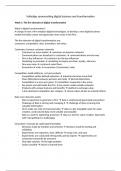
CHES Exam Questions and Answers 100% Correct
CHES Exam Questions and Answers 100% Correct What is the primary purpose of a needs, resources, and capacity assessment? - Answer- To gather data and information to determine what interventions would be appropriate in a given setting Capacity Assessment - Answer- A measure of actual and potential individual, group, and community resources that can be inherent to and/or brought to bear for health maintenance and enhancement. The process of mapping community assets is included in the capacity assessment. 1.1 Plan assessment process for health education/promotion - Answer- Service needs are things health professionals believe a given population must have or be able to do in order to resolve a health problem. Service demands are things people say they must have or e able to do in order to resolve a health problem. Both are important. needs assessment - Answer- The systematic identification of needs within a population and the determination of the degree to which those needs are being meet. 1.1.2 Identify existing and necessary resources to conduct assessments - Answer- The following 6 steps were identified in order to conduct a needs assessment: 1. Determine the scope of work and the purpose for the needs assessment 2. Gather the data 3. Analyze the data 4. Identify any factors linked to the health problem 5. Identify the focus for the program 6. Validate the need before continuing with the planning process Developing an assessment plan will allow health education specialists to establish a roadmap that provides an overview of the process, resources needed, activities, and results the support the goals and objectives of the assessment. Resources can include human resources, supplies, incentives for participation, and travel costs. qualitative data - Answer- Information that is difficult to measure, count, or express in numerical terms. For example, a participant's impression about the fairness of a program rule/requirement is qualitative data. 1.1.3 Engage priority populations, partners, and stakeholders - Answer- Partners are individuals or organizations that bring knowledge, skills, or resources. Stakeholders are the who affect and are affected by change and those who have interest in the results. Increasing these people's participation improves the assessment and increases the value of the results. quantitative data - Answer- Information that can be expressed in numerical terms, counted, or compared, on a scale. Improvement in a child's reading level as measured by a reading test is an example. 1.2 Access existing information and data related to health - Answer- Primary and secondary data should be collected for a needs assessment. However not all collection methods are appropriate in all practice settings. primary data - Answer- Data gathered by health education specialists directly from or about the individual or population of interest. This data answers questions related to the specific needs assessment. Primary data is often collected by means of surveys, interviews, focus groups, and direct observation. 1.2.1 Identify sources of secondary data related to health - Answer- Many health education specialists identify needs of the priority population through a review of the literature. Data should refer to a population similar to that under current assessment. Secondary data can yield insight on community capacity, assets, and needs and often involves gathering epidemiological data, such as health status, risk factors, incidence and/or prevalence rates, death rates, etc. secondary data - Answer- Data that has already been collected by others that may or may not be directly gathered from the individual or population being assessed. Examples include existing research published in peer-reviewed journals and/or datasets, such as the United State Census, vital records, and disease registries. 1.2.2 Establish collaborative relationships and agreements that facilitate access to data - Answer- The relationship requires effort to identify common goals by which the organizations or groups could work together. Establishing an agreement with the organization or group outing the intended outcome, audience, the purposes for which the data will be used, the ownership of the data, confidentiality aspects, and conditions o the release of the data can be an effective method to obtain or exchange needed data and practice data ethics. Stakeholders - Answer- Individuals or agencies that have a vested interest in the health education program. 1.2.3 Review related literature - Answer- A literature review is a systematic method of locating, synthesizing, and interpreting a collection of works by researchers and practitioners. A literature review uncovers what is already known and identifies gaps in knowledge. The basic components of a literature review include:
Written for
- Institution
- Ches
- Course
- Ches
Document information
- Uploaded on
- March 16, 2024
- Number of pages
- 25
- Written in
- 2023/2024
- Type
- Exam (elaborations)
- Contains
- Questions & answers
Subjects
-
ches exam questions and answers 100 correct

Also available in package deal