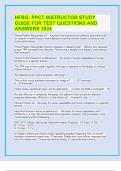
HFRG: PPCT INSTRUCTOR STUDY GUIDE FOR TEST QUESTIONS AND ANSWERS 2024
Threat Pattern Recognition is? - A system that examines the patterns associated with an assault or lethal assault, and engineers a tactical solution based on science and motor performance. Threat Pattern Recognition training indicates in research that? - Officers who received proper TPR decrease their Reaction Time during a deadly force assault, and enhance their precision. Human Factor Research is defined as? - The study of human capabilities & human limitations in a specific domain. The TPR use of force system applies what type of research to the design of training? - Human Factors Pre-Attentive Sub Cortical [superior colliculus]? The cortical visual pathway processes an image in? - 1.) .012 seconds 2.) .33 Seconds Under stress, peripheral vision can be reduced by __% when the SNS is activated? - 70 As task difficulty or complexity increases, the optimum level arousal for effective response decreases. What term is this known as? - Inverted-U Law Human Factors is? - the study of human capabilities and human limitations in a specific domain. High-Risk Human Factors is defined as? - The study of human capabilities and limitations in a high risk environment that is dynamic (chaotic), fluid (uncertain), time compressed and life threatening. Officers feloniously killed with firearm: Distance - 0-5 Feet: 51.9% 6-10 Feet: 19.2% 0-10 Feet: 71.1% In Siddle's follow-up to Hontz's study regarding assailant response time, he found? - Assailant movement speed was .37 seconds. Siddle also found officer response time from the holster was 1.9 seconds without aiming, 2.4 seconds when aiming. The four components of Acceptability? - 1.)Tactical 2.)Legal 3.)Medical 4.) Human Factors Research Mental States in Combat - 1.) Combat Anxiety 2.) Survival Stress 3.) Combat Stress "The anticipation of danger", this application may lead to a gradual deterioration of both mental and physical skills. - Combat Anxiety "Deadly force threat perception that initiates the SNS discharge," the associated physiological changes can affect performance. - Survival Stress The post event mental and physiological symptoms that are a result of the SNS activation and the sudden return to the Parasympathetic Nervous System (PNS) "backlash," which may distort the memory. - Combat Stress The Autonomic Nervous System? - A part of the peripheral nervous system and it controls many organs and muscles within the body. We are often unaware of the workings of this type of system and it controls many organs and muscles within the body. the ANS is divided into? - The Sympathetic Nervous System (SNS) The Parasympathetic Nervous System (PNS) Which system within the Autonomic Nervous system is responsible for the "flight or flee?" (uses more energy, blood pressure increases, heart beats faster, pupils dilate and digestion slows. - Sympathetic Nervous System When activated what system will make the heart beat slower and with less force, the pupils will constrict, mucus production increases and digestion can start? (pupils constrict, blood pressure decreases, heart rate slows, mucus production increases and digestion can start. - Parasympathetic Nervous Sysetm Four triggers that activate the SNS? - 1.) Objective Threat Perceptions 2.) Objective Fear Perceptions 3.) Physical Exhaustion 4.) Startle Response Four triggers that activate the SNS? (1) Objective Threat Perceptions are? - Threat is within close proximity, the time needed to control the threat is minimal, the person is not confident with his/her abilities, or fact that threat perception is new.
Written for
- Institution
- HFRG:
- Course
- HFRG:
Document information
- Uploaded on
- March 15, 2024
- Number of pages
- 8
- Written in
- 2023/2024
- Type
- Exam (elaborations)
- Contains
- Questions & answers

Also available in package deal