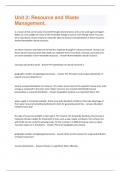
Unit 2: Resource and Waste Management. Exam Questions and Answers
is a resource that can be easily recovered through natural process and can be used again and again. Water, air, and sunlight are some of the renewable energy resources. Even though these resources are in abundance, proper measures should be taken to prevent overexploitation of these resources. - Answer-Renewable natural resources are those resources that take time for Earth to replenish through its natural processes. Humans use these natural resources faster than Earth can replenish them. Fossil fuels, minerals, and metal ores are some examples of non-renewable resources. - Answer-Nonrenewable natural resources not equal around the world. - Answer-The distribution of natural resources is geographic location and geological processes. - Answer-The formation and unequal distribution of natural resources depends on leads to unequal distribution of resources. The tropics (areas close to the equator) receive more solar energy as compared to the polar areas. Water resources are unevenly distributed because precipitation is unevenly distributed. - Answer-Geographic location is an important factor that water supply is constantly available. These areas with abundant rainfall can thus take advantage of their water resource by building hydroelectric dams for generating electricity. - Answer-Abundant rainfall ensures that the type of resources available in that region. For instance, the temperate deciduous forests have a moderate climate suitable for the growth of trees such as oak, maple, and beech. Flat surfaces rich with fertile soil are useful for growing crops. On the contrary, it is difficult to grow crops on steep mountain slopes or in dry deserts. - Answer-The local topography also impacts geographic location and geological processes - Answer-What are the reasons for unequal distribution of natural resources? resource distribution. - Answer-Climate is a significant factor affectingin a region for a long time. Geographical factors, such as altitude or elevation of a place, global wind patterns, topography, ocean currents, and surface of the Earth, affect the climatic conditions of a place. Due to these factors, climatic conditions vary from place to place. Climatic variations have an impact on the distribution of natural resources. This section will deal with the effects of climate and climate change over the distribution of natural resources. - Answer-Climate is the weather conditions specific climatic conditions to grow and survive. Certain crops or vegetables require cooler temperatures to grow, while others require warmer temperatures. - Answer-Plants and crops require require cold climatic regions to grow. Climatic variations make some countries rich in certain type of resources. For example, spices require hot climatic conditions. For this reason, India and Indonesia are major producers of spices. Changes in climate lead to natural calamities, such as heat stress, droughts, and floods. For example, an increase in temperature increases the rate of evaporation. This situation might result in more frequent droughts. - Answer-Apples for example such as forests products, wildlife, and human beings. Climatic variations modify the habitats and force animals to migrate to other regions. - Answer-Climate variations impact other resources plants and animals, such as moose and polar bears, have migrated more toward northern areas in search of colder temperatures. - Answer-Recently, it has been observed that certain hybridization of species, and some species might go extinct. It may also impact the predator-prey relationship of a place. For example, the musk ox faces a serious threat from grizzly bears that migrated to their areas due to climate variations. - Answer-Migration sometimes leads to Some animals that try to adapt to climate changes eventually die due to starvation, as climate change alters the Food web. - Answer-What does climate change alters? This sector is involved in the extraction and use of raw materials. This type of economy makes direct use of both renewable and nonrenewable resources. Farming, fishing, mining, and hunting are the main occupations in a primary sector economy. Generally, in less-developed countries, the primary sector is the largest sector of the economy. However, as an economy develops, the labor force in the primary sector moves to other sectors. For instance, in the nineteenth century, nearly two-thirds of the US population was engaged in the primary sector. Currently, only three percent of the US population is engaged in this sector. - Answer-Primary sector:
Written for
- Institution
- Unit 2: Resource and Waste Management.
- Course
- Unit 2: Resource and Waste Management.
Document information
- Uploaded on
- March 15, 2024
- Number of pages
- 8
- Written in
- 2023/2024
- Type
- Exam (elaborations)
- Contains
- Questions & answers
Subjects
-
unit 2 resource and waste management

Also available in package deal