MBA 5100 All studied chaptersQuestions and Answers Rated A+
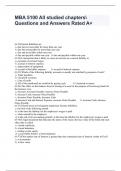
MBA 5100 All studied chaptersQuestions and Answers Rated A+ (8-23)Current liabilities are a. due but not receivable for more than one year. b. due but not payable for more than one year. c. due and receivable within one year. d. due and payable within one year. d. due and payable within one year. (8-24)A transaction that is likely to cause an increase in a current liability is: a. payment of accrued wages. b. accrual of interest expense. c. depreciation of equipment. d. accrual of bad debts expense. b. accrual of interest expense. (8-25) Which of the following liability accounts is usually not satisfied by payment of cash? a. Trade payables. b. Unearned revenues. c. Line of credit. d. All of the mentioned are satisfied by paying cash. b. Unearned revenues. (8-26) The effect on the balance sheet of issuing of a note for the purpose of borrowing funds for the business is to a. decrease Accounts Payable; increase Notes Payable b. increase Cash; increase Notes Payable c. decrease Notes Payable; decrease Cash d. increase Cash and Interest Expense; increase Notes Payable b. increase Cash; increase Notes Payable (8-27) Payroll taxes levied against employees become liabilities: a. the first of the following month b. at the time the liability for the employee's wages is paid c. when earned by the employee d. at the end of an accounting period b. at the time the liability for the employee's wages is paid (8-56)A legal document that indicates the name of the issuer, the face value of the bond and such other data is called a. a bond certificate. b. a bond indenture. c. trading on the equity. d. a convertible bond. b. a bond indenture. (8-57)If the market rate of interest is greater than the contractual rate of interest, bonds will sell a. at a premium. b. at face value. c. at a discount. d. only after the stated rate of interest is increased. c. at a discount. (8-58)If $4,000,000 of 12% bonds are issued at 103¼, the amount of cash received from the sale a. is more than face value. b. is equal to face value. c. is less than face value. d. can not be determined. a. is more than face value. (8-59)Pan Company's bonds are yielding 6% currently. Why is Pan's cost of debt lower than 6%? a. Additional debt is issued less expensively than initial debt. b. Interest is deductible in calculating taxable income. c. Interest rates decreased since Pan issued these bonds. d. Interest rates increased since Pan issued these bonds. d. Interest rates increased since Pan issued these bonds. (8-60) In a bond amortization table for bonds issued at a discount: a . The effective interest expense is less with each successive interest payment. b. The total effective interest over the term to maturity is equal to the amount of the discount plus the total cash interest paid. c. The outstanding balance (carrying amount) of the bonds declines eventually to face value. d. The reduction in the discount is less with each successive interest payment. b. The total effective interest over the term to maturity is equal to the amount of the discount plus the total cash interest paid. (8-61)AMC Corporation issued bonds at a discount. The long-term liability reported on AMC's balance sheet will: a . Increase each year during the term to maturity. b. Decrease each year during the term to maturity. c. Remain the same each year during the term to maturity. d. Increase or decrease each year depending upon the market rate of interest. a. Increase each year during the term to maturity. (8-65) Which of the following is a contingency that should be accrued? a. The company is being sued and a loss is reasonably possible and reasonably estimable. b. The company deducts life insurance premiums from employees' paychecks. c. The company offers a two-year warranty and the expenses can be reasonably estimated. d. It is probable that the company will receive $100,000 in settlement of a lawsuit c. The company offers a two-year warranty and the expenses can be reasonably estimated. (8-82) The charter of a corporation provides for the issuance of 20,000 shares of common stock. Assume that 15,000 shares were originally issued and 3,000 were subsequently reacquired. What is the number of shares outstanding? a. 12,000 b. 15,000 c. 17,000 d. 20,000 a. 12,000
Written for
- Institution
- MBA 5100
- Course
- MBA 5100
Document information
- Uploaded on
- March 13, 2024
- Number of pages
- 40
- Written in
- 2023/2024
- Type
- Exam (elaborations)
- Contains
- Questions & answers
Subjects
-
mba 5100 all studied chaptersquestions and answer

Also available in package deal