Pediatric Primary Care PNCB 1 Questions and Answers(A+ Solution guide)
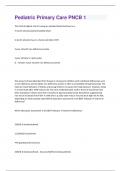
The child at highest risk for having an elevated blood lead level is a: 3 month old exclusively breastfed infant 6 month old who lives in a home built after 1970 2 year old with iron deficiency anemia 2 year old who is a picky eater D. - Answer-2 year old with iron deficiency anemia The amount of lead absorbed from the gut is increased in children with nutritional deficiencies such as iron deficiency anemia (IDA). Iron deficiency anemia is often a comorbidity of lead poisoning. The hand-to-mouth behavior of infants and young children increases their lead exposure. However, living in a home built after 1970 reduces the risk since residential paint used in that era should not have been lead based. Infants more than 4 months of age exclusively breast fed without supplemental iron are at increased risk of IDA. A child who is a picky eater may or may not be at high risk for IDA, depending on foods actually eaten.Which laboratory assessment is the BEST indicator of vitamin D deficiency? Which laboratory assessment is the BEST indicator of vitamin D deficiency? 25(OH)-D (cholecalciferol) 1,25(OH)2-D (calcitriol) PTH (parathyroid hormone) 25(OH)-D (cholecalciferol) - Answer-25(OH)-D (cholecalciferol)The best diagnostic study of vitamin D deficiency is the level of 25(OH)-D (cholecalciferol). 1,25(OH)2-D (calcitriol) is the active metabolite of 25(OH)-D, but due to its short half-life it is not a good indicator of vitamin D sufficiency. The parathyroid hormone releases calcium from bone. Rachitic changes can be seen at growth plates and decreased calcification leads to thickening of the growth plate. Serum calcium and phosphorous are initial screening tests but not the best indicator of vitamin D deficiency. In a 2 month old with visible rib fractures on radiograph, the NEXT most critical evaluation to obtain is a: CT scan of the head long bone series coagulation profile retinal ophthalmologic exam - Answer-CT scan of the head Posterior rib fractures associated with accidental trauma are rare. Posterior fractures can be seen in infants who have been shaken as the perpetrator hands are typically wrapped around the infant's thorax during the shaking, with the vertebrae acting as a fulcrum. These findings should alert the provider to consider shaken baby syndrome (SBS). Subdural and subarachnoid hemorrhages are the most common acute intracranial injuries seen in SBS and are associated with high rates of morbidity and mortality. Thus, the most important study to do next is a CT scan. Studies have shown that nearly one third of confirmed abusive head trauma cases were missed on initial presentation, and many infants then sustain additional brain injury along with poorer neurologic outcomes because of the delay in diagnosis. Long bone studies will be needed as part of a thorough work-up of nonaccidental trauma, but the skull would be the most critical area to image first. Coagulation studies are done to rule out any coagulation problem associated with injury to the brain and are important for medico-legal reasons, but again, brain studies take precedence. A thorough ophthalmologic exam is needed in suspected cases of SBS—preferably done by a pediatric ophthalmologist
Written for
- Institution
- Pediatric Primary Care PNCB 1
- Course
- Pediatric Primary Care PNCB 1
Document information
- Uploaded on
- March 13, 2024
- Number of pages
- 48
- Written in
- 2023/2024
- Type
- Exam (elaborations)
- Contains
- Questions & answers
Subjects
-
pediatric primary care pncb 1

Also available in package deal