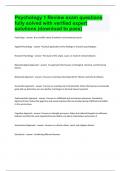
Psychology 1 Review exam questions fully solved with verified expert solutions (download to pass)
Psychology the scientific study of behavior and mental processes Applied Psychology Practical application of the findings of research psychologists. Brainpower Read More Previous Play Next Rewind 10 seconds Move forward 10 seconds Unmute 0:00 / 0:15 Full screen Research Psychology The study of the origin, cause, or result of certain behavior. Biopsychological Approach An approach that focuses on biological, chemical, and hormonal factors. Behavioral Approach Focuses on learning. Developed by B.F. Skinner and John B. Watson. Humanistic Approach Focuses on reaching one's full potential. States that humans are basically good and we determine our own destiny. Carl Rogers is the best known humanist. Psychoanalytic Approach Focuses on childhood and unconscious processes. Founded by Sigmund Freud. States that aggresive and sexual impulses that we develop during childhood are hidden in the unconscious. Cognitive Approach Focuses on thought processes. States that rational thought can influence behavior and that the most important human ability is to take in information and process it. Sociocultural Approach Focuses on cultural, ethnic, racial, and religious factors. Eclecticism Combining different theories. Scientific Method A general approach to gathering information and answering questions so that errors and biases are minimized. Hypothesis An assumption about behavior. Dependent Variable The variable that is measured in an experiment. Independent Variable The experimental factor that is manipulated; the variable whose effect is being studied. Naturalistic Observation Behavior studied in natural environment without subjects knowing. Case Study Research method that involves an intensive investigationof one or more participants. Survey Research method in which data is obtained by asking many individuals a fixed set of questions. Longitudinal Study Research method in which data is collected about a group of participants over a number of years to assess how certain characteristics change or remain the same during development. Cross-Sectional Study Research method in which data is collected from groups of participants of different ages and compared so that conclusions can be drawn about differences due to age. Wilhelm Wundt Considered the "Father of Psychology". Created the first lab for psychological research. Developed the process of introspection. William James One of the founders of American psychology, he thought that human consciousness should be studied as a whole; a theory known as Structuralism. Sigmund Freud The "Father of Psychoanalysis. he developed one of the first comprehensive theories of personality. Believed that behavior is determined by unconscious forces that are rooted in childhood experiences. Ivan Pavlov Russian scientist credited with discovering classical conditioning (learned through involuntary associations); "Pavlov's Dogs" John B. Watson One of the first behaviorists, he stressed the role of learning in human behavior. Focused specifically on child rearing. B.F. Skinner Famous behaviorist who believed that we are controlled by the environment. Believed that psychologists should only study what can be observed. Carl Rogers Famous humanist who emphasized the power of the human spirit and stressed free will. Albert Bandura Pioneer in observational learning (AKA social learning), stated that people profit from the mistakes/successes of others; Studies: Bobo Dolls-adults demonstrated 'appropriate' play with dolls, children mimicked play. Intelligence The ability to acquire new ideas and new behavior, and to adapt to new situations. Stanford-Binet Intelligence Test An adaptation of Binet's test by Stanford University psychologist Lewis Terman, this was for many years the standard for intelligence tests in the U.S. Formula For IQ Mental Age/Chronological Age x 100 Mental Retardation Below average intellectual functi
Written for
- Institution
- Psychology
- Course
- Psychology
Document information
- Uploaded on
- March 13, 2024
- Number of pages
- 8
- Written in
- 2023/2024
- Type
- Exam (elaborations)
- Contains
- Questions & answers
Subjects
-
psychology 1 review exam questions fully solved

Also available in package deal