
Assessment & Reasoning GI/GU System
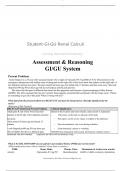
Assessment & Reasoning GI/GU System Present Problem: Jenna Simpson is a 24-year-old Caucasian female who weighs 210 pounds (95.5 kg-BMI of 36.5) who presents to the emergency department with sudden onset of sharp pain in the right side of her lower back that radiates to the right side of her abdomen and into her groin. The pain started ten hours ago, but lasted only 15 minutes and then went away. She took ibuprofen 600 mg PO an hour ago but has not helped, and the pain persists. She states that this pain is different than when she has epigastric pain because of gastroesophageal reflux disease (GERD). She feels nauseated but has not vomited. Jenna appears uncomfortable and pleads with the triage nurse, “Please do something to get rid of this pain! What is wrong with me?” What data from the present problem are RELEVANT and must be interpreted as clinically significant by the nurse? (Reduction of Risk Potential) RELEVANT Data from Present Problem: Clinical Significance: -sharp pain R side of her lower back that Based on the location and onset of pain, renal calculi is suspected. radiates to the R side of her abdomen and into - Pain areas: in the back or side part of the body her groin. - Pain types: can be severe, sharp, or sudden in the abdomen -Pain started 10 hours ago and lasted 15 minutes - Pain circumstances: can occur during urination - took Ibuprofen 600 mg PO one hour ago - Gastrointestinal: nausea or vomiting -Hx of GERD- but this is a different pain NSAIDS may temporarily relieve pain, but because a kidney stone is -nauseated- has not vomitted suspected, the relief will be minimal, if any. What is the RELATIONSHIP of your patient’s past medical history (PMH) and current meds? (Which medication treats which condition? Draw lines to connect.) PMH: Home Meds: Pharm. Class: Mechanism of Action (own words): Anxiety Alprazolam 0.5 mg PO Benzodiazepine GABA’s inhibit excitatory stimulation, every 8 hours PRN which will relax patient due to anxiety. Gastroesophageal reflux Pantoprazole 10 mg PO Proton Pump Inhibits the production of gastric acid disease (GERD) BID Inhibitor which will relieve the s/s associated with GERD Jenna is quickly brought to a room. You are the nurse and quickly collect the following assessment data: Patient Care Begins: Current VS: P-Q-R-S-T Pain Assessment: T: 98.9 F/ 37.2 C (oral) Provoking/Palliative: Nothing changes the level of pain P: 92 (regular) Quality: Sharp, severe R: 28 (regular) Region/Radiation: Right back/flank that radiates into RLQ and groin BP: 148/84 Severity: 10/10 O2 sat: 99% room air Timing: Constant the past hour What vital signs are abnormal? What is the reason (pathophysiology) for these findings? (Reduction of Risk Potential/Health Promotion and Maintenance) Abnormal VS: Clinical Significance: R: 28 Normal value 12-20 : This could be related to pain and anxiety BP: 148/84 Normal value 120/80: This could be related to pain and anxiety Pain 10/10: Nothing Due to the location, onset and type of pain the patient is presenting, kidney stones are changes pain level, sharp, suspected. Kidney stones cause abrupt severe flank pain with radiation to the groin or severe, R back/flank that abdomen, nausea and vomiting. radiates into RLQ and groin- constant for past hour Current Assessment: GENERAL Obese female is sitting upright in bed. Alert, oriented, pleasant, in moderate distress, dress APPEARANCE: appropriate for the season, hygiene and grooming normal for age and gender, anxious, body tense, + grimacing, appears to be uncomfortable. RESP: Breath sounds clear on inspiration and expiration in all lobes anteriorly, posteriorly, and laterally, with equal aeration bilaterally ant/post, nonlabored respiratory effort with + tachypneic. Posture erect, sitting in bed, in moderate distress, on room air, AP diameter 1:2, symmetry of the thoracic cavity noted with inspiration and expiration CARDIAC: Pink, warm & dry, no edema, heart sounds regular with no abnormal beats, pulses strong, equal with palpation at radial/pedal/post-tibial landmarks, brisk cap refill, carotid pulse 3+ and regular bilaterally. Heart tones audible and regular, S1 and S2, noted over the 5 cardiac landmarks with no abnormal beats or murmurs. No JVD noted at 30-45 degrees.
Document information
- Uploaded on
- March 12, 2024
- Number of pages
- 10
- Written in
- 2023/2024
- Type
- Case
- Professor(s)
- Unknown
- Grade
- Unknown


