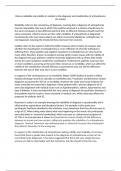
Discuss reliability and validity in relation to the diagnosis and classification of schizophrenia
(16 marks)
Reliability refers to the consistency of diagnosis, meaning that a diagnosis of schizophrenia
must be repeatable. One way in which this could be achieved is a clinician should come to
the same conclusion at two different points of time or different clinicians should reach the
same conclusion, which is known as inter-rater reliability. If schizophrenia is diagnosed
inconsistently, this may mean patients are either incorrectly labelled as ‘schizophrenic’ or
not diagnosed, meaning the treatment they need won’t be received.
Validity refers to the extent to which the DSM measures what it claims to measure and
whether the classification of schizophrenia is a true reflection of what the individual is
suffering from. Many positive and negative symptoms of schizophrenia are also found in
many other disorders, known as symptom overlap which creates issues with the validity of
the diagnosis because patients could be incorrectly diagnosed with an illness that simply
shares the same symptoms needed for classification. Furthermore, patients may have two
or more conditions occurring at the same time, known as co-morbidity, which can affect the
validity of the classification of both illnesses as psychiatrists may not tell the difference
between the two or they may see it as one condition.
In support of the consequences of co-morbidity, Weber (2009) looked at nearly 6 million
hospital discharge records to calculate co-morbidity rates. Psychiatric and behaviour related
diagnoses accounted for 45% of co-morbidity. However the study also found evidence for
many comorbid non-psychiatric diagnoses. Many patients with a primary diagnosis of SZ
were also diagnosed with medical issues such as hypothyroidism, asthma, hypertension and
type II diabetes. It was concluded that the very nature of diagnosis of psychiatric disorders is
that patients tend to receive a lower standard of medical care, which adversely affects the
prognosis for patients with SZ.
Rosenhan’s study is an example showing that reliability of diagnosis is questionable and is
influenced by expectations and situational factors. For example in this study once
participants had been admitted to the institutes, every behaviour that they did was seen as
a sign of SZ. When taking notes about what was happening on the wards, the participants
were described as ‘excessive handwriting’ which was seen as a behavioural symptom of
SZ. This is an issue because it shows that psychiatrists cannot reliably tell the difference
between an insane and sane person, calling into question the reliability of a schizophrenia
diagnosis. ‘Normal’ behaviour was misinterpreted as ‘abnormal’ because they interpreted
the patients’ behaviour in the wrong way.
In support of the classification of schizophrenia lacking validity and reliability, it has been
found that there is gender bias present in the diagnosis of schizophrenia as men are far
more likely to be diagnosed. It has been suggested that this is the case simply because
women are able to cope better with the symptoms, but this should not be the case.
(16 marks)
Reliability refers to the consistency of diagnosis, meaning that a diagnosis of schizophrenia
must be repeatable. One way in which this could be achieved is a clinician should come to
the same conclusion at two different points of time or different clinicians should reach the
same conclusion, which is known as inter-rater reliability. If schizophrenia is diagnosed
inconsistently, this may mean patients are either incorrectly labelled as ‘schizophrenic’ or
not diagnosed, meaning the treatment they need won’t be received.
Validity refers to the extent to which the DSM measures what it claims to measure and
whether the classification of schizophrenia is a true reflection of what the individual is
suffering from. Many positive and negative symptoms of schizophrenia are also found in
many other disorders, known as symptom overlap which creates issues with the validity of
the diagnosis because patients could be incorrectly diagnosed with an illness that simply
shares the same symptoms needed for classification. Furthermore, patients may have two
or more conditions occurring at the same time, known as co-morbidity, which can affect the
validity of the classification of both illnesses as psychiatrists may not tell the difference
between the two or they may see it as one condition.
In support of the consequences of co-morbidity, Weber (2009) looked at nearly 6 million
hospital discharge records to calculate co-morbidity rates. Psychiatric and behaviour related
diagnoses accounted for 45% of co-morbidity. However the study also found evidence for
many comorbid non-psychiatric diagnoses. Many patients with a primary diagnosis of SZ
were also diagnosed with medical issues such as hypothyroidism, asthma, hypertension and
type II diabetes. It was concluded that the very nature of diagnosis of psychiatric disorders is
that patients tend to receive a lower standard of medical care, which adversely affects the
prognosis for patients with SZ.
Rosenhan’s study is an example showing that reliability of diagnosis is questionable and is
influenced by expectations and situational factors. For example in this study once
participants had been admitted to the institutes, every behaviour that they did was seen as
a sign of SZ. When taking notes about what was happening on the wards, the participants
were described as ‘excessive handwriting’ which was seen as a behavioural symptom of
SZ. This is an issue because it shows that psychiatrists cannot reliably tell the difference
between an insane and sane person, calling into question the reliability of a schizophrenia
diagnosis. ‘Normal’ behaviour was misinterpreted as ‘abnormal’ because they interpreted
the patients’ behaviour in the wrong way.
In support of the classification of schizophrenia lacking validity and reliability, it has been
found that there is gender bias present in the diagnosis of schizophrenia as men are far
more likely to be diagnosed. It has been suggested that this is the case simply because
women are able to cope better with the symptoms, but this should not be the case.