Chapter 1 Anatomy and Physiology of the Skin 2024 Complete study guide
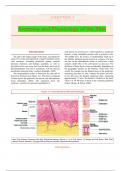
Chapter 1 Anatomy and Physiology of the Skin Complete study guide Introduction The skin is the largest organ of the body, accounting for about 15% of the total adult body weight. It performs many vital functions, including protection against external physical, chemical, and biologic assailants, as well as prevention of ex-cess water loss from the body and a role in thermoregulation. The skin is continuous, with the mucous membranes lining the body’s surface (Kanitakis, 2002). The integumentary system is formed by the skin and its derivative structures (see Figure 1-1). The skin is composed of three layers: the epidermis, the dermis, and subcutaneous tissue (Kanitakis, 2002). The outermost level, the epidermis, consists of a specific constellation of cells known as keratinocytes, which function to synthesize keratin, a long, threadlike protein with a protective role. The middle layer, the dermis, is fundamentally made up of the fibrillar structural protein known as collagen. The der-mis lies on the subcutaneous tissue, or panniculus, which contains small lobes of fat cells known as lipocytes. The thickness of these layers varies considerably, depending on the geographic location on the anatomy of the body. The eyelid, for example, has the thinnest layer of the epidermis, measuring less than 0.1 mm, whereas the palms and soles of the feet have the thickest epidermal layer, measuring approximately 1.5 mm. The dermis is thickest on the back, where it is 30–40 times as thick as the overlying epidermis (James, Berger, & Elston, 2006).
Written for
- Institution
- Human Anatomy and Physiology I
- Course
- Human Anatomy and Physiology I
Document information
- Uploaded on
- March 11, 2024
- Number of pages
- 12
- Written in
- 2023/2024
- Type
- Exam (elaborations)
- Contains
- Questions & answers
Subjects
- anatomy and physiology
- physiology
- anatomy
- the skin
-
human anatomy and physiology

Also available in package deal