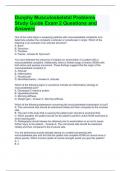
Dunphy Musculoskeletal Problems Study Guide Exam 2 Questions and Answers
Dunphy Musculoskeletal Problems Study Guide Exam 2 Questions and Answers Which of the following statements is true regarding the treatment of carpal tunnel syndrome? A. The goal of treatment is to prevent flexion and extension movements of the wrist. B. Splints are not used in carpal tunnel syndrome, because they restrict complete movement of the fingers and wrist. C. Corticosteroid injections are encouraged in the treatment of carpal tunnel syndrome. D. Treatment that encourages fluid retention, to keep the joints lubricated, is an emphasis of treatment. - Answer-A. The goal of treatment is to prevent flexion and extension movements of the wrist. Sam is a 25-year-old who has been diagnosed with low back strain based on his history of localized low back pain and muscle spasm along with a normal neurological examination. As the clinician, you explain to Sam that low back pain is a diagnosis of exclusion. Which of the following symptoms would alert the clinician to the more serious finding of a herniated nucleus pulposus or ruptured disc? A. Morning stiffness and limited mobility of the lumbar spine B. Unilateral radicular pain symptoms that extend below the knee and are equal to or greater than the back pain C. Fever, chills, and elevated erythrocyte sedimentation rate D. Pathologic fractures, severe night pain, weight loss, and fatigue - Answer-B. Unilateral radicular pain symptoms that extend below the knee and are equal to or greater than the back pain The clinician has instructed Sirius, a 23-year-old patient with low back strain, to use NSAIDs to manage his symptoms of pain and discomfort. Which of the following statements would be most appropriate when teaching Sam about the use of NSAIDs? A. "You should start with the lowest dose that is effective in managing your pain, because long-term use of NSAIDs can result in gastrointestinal (GI) disorders such as ulcers and hemorrhage." B. "You should start with the lowest dose that is effective in managing your pain to avoid developing tolerance to the medication." C. "You should take the maximum recommended dose of NSAIDs so that you will not need to take narcotics to control your pain." D. "It is important to take NSAIDs on an empty stomach in order to increase absorption." - Answer-A. "You should start with the lowest dose that is effective in managing your pain, because long-term use of NSAIDs can result in gastrointestinal (GI) disorders such as ulcers and hemorrhage."
Written for
- Institution
- Dunphy
- Course
- Dunphy
Document information
- Uploaded on
- March 10, 2024
- Number of pages
- 9
- Written in
- 2023/2024
- Type
- Exam (elaborations)
- Contains
- Questions & answers
Subjects
- morning stiffness
-
dunphy musculoskeletal problems study guide exam 2
-
initial steps in assessing patients with musculosk
-
signs or symptoms indicate an inflammatory etiolog

Also available in package deal