STEM CELL BIOLOGY
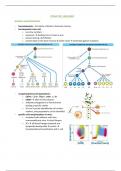
NORMAL HAEMATOPOIESIS
− haematopoiesis = formation of blood in the bone marrow
− hematopoietic stem cell:
o very low numbers
o quiescent → dividing once or twice a year
o present during a full lifetime
o present deep in the bone marrow & divide rarely → protected against mutations
− recognizing blood cell populations:
o CD34+, CD38-, Thy1+, c-Kit+, IL-3R-
o CD38+ → after the first division
o antibody conjugated to a fluorochrome
binding a specific marker
o SCs can’t just be identified by cell surface
markers, only populations can be identified
− specific cell transplantations in mice:
o nucleated cells (effector cells) into
immunodeficient mice → short lifespan
o SCs → all blood lineages (myeloid and
lymphoid) develop after 9 months →
transplantation/reconstitution with 1 cell
, LEUKAEMIA DEVELOPMENT
− disbalance proliferation/differentiation/apoptosis caused by genetic mutations
− >20% undifferentiated cells in the bone marrow
− myeloid vs. lymphoid
− acute (rapid increase) vs. chronic (slower growing disease)
− early days morphological classification → nowadays genetic classification
− symptoms: fatigue, fever, anaemia, swollen lymph nodes, night sweats, pain in joints and bones, loss
of weight, bleeding tendency, enlarged spleen, kidney, and the liver, bone tenderness → very
general complaints
− treatment:
o 2 courses of very intensive chemotherapy + a final course if the patient can take it
o subtype specific treatments (rare)
o mostly allogeneic transplantation, autologous are rarer
− cell of origin:
o multiple mutations and multiple disrupted pathways needed for leukaemia to arise
o possible in short-term SC if there is a mutation in the self-renewal machine
o mutations in the early SC stay present due to self-renewal potential
NORMAL HAEMATOPOIESIS
− haematopoiesis = formation of blood in the bone marrow
− hematopoietic stem cell:
o very low numbers
o quiescent → dividing once or twice a year
o present during a full lifetime
o present deep in the bone marrow & divide rarely → protected against mutations
− recognizing blood cell populations:
o CD34+, CD38-, Thy1+, c-Kit+, IL-3R-
o CD38+ → after the first division
o antibody conjugated to a fluorochrome
binding a specific marker
o SCs can’t just be identified by cell surface
markers, only populations can be identified
− specific cell transplantations in mice:
o nucleated cells (effector cells) into
immunodeficient mice → short lifespan
o SCs → all blood lineages (myeloid and
lymphoid) develop after 9 months →
transplantation/reconstitution with 1 cell
, LEUKAEMIA DEVELOPMENT
− disbalance proliferation/differentiation/apoptosis caused by genetic mutations
− >20% undifferentiated cells in the bone marrow
− myeloid vs. lymphoid
− acute (rapid increase) vs. chronic (slower growing disease)
− early days morphological classification → nowadays genetic classification
− symptoms: fatigue, fever, anaemia, swollen lymph nodes, night sweats, pain in joints and bones, loss
of weight, bleeding tendency, enlarged spleen, kidney, and the liver, bone tenderness → very
general complaints
− treatment:
o 2 courses of very intensive chemotherapy + a final course if the patient can take it
o subtype specific treatments (rare)
o mostly allogeneic transplantation, autologous are rarer
− cell of origin:
o multiple mutations and multiple disrupted pathways needed for leukaemia to arise
o possible in short-term SC if there is a mutation in the self-renewal machine
o mutations in the early SC stay present due to self-renewal potential