PSYCH.1010 Exam 1 (100% correct and graded A+)
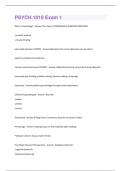
What is Psychology? - Answer-The science of BEHAVIOR and MENTAL PROCESSES -scientific method -critcally thinking observable behavior (OVERT) - Answer-Behaviors that can be obviously seen by others (speech and physical movement) internal mental processes (COVERT) - Answer-hidden/hard to find, cannot be directly observed (remembering, thinking, problem solving, decision making, dreaming) Empricism - Answer-gathering knowledge through careful observation GOALS (of psychologist) - Answer--describe -explain -predict -control Trepanning - Answer-drilling holes in someones head to see whats in there Phrenology - Answer-reading bumps on the head (like palm reading) *behavior doesn't always match mental Four Major Research Perspectives - Answer--biological (internal) -cognitive (internal) -behavioral (external)-socioculture (external) (used to describe a more complete explanation of our behavior and mental processing) biological perspective - Answer-our physiological hardware (especially the brain and nervous system) is viewed as the major determiner of behavior and mental processing cognitive perspective - Answer-how our mental processes such as perception, memory and problem solving, work and impact behavior behavior perspective - Answer-how external environmental events condition observable behavior (environmental events condition our behavior and are the cause of it) socioculture - Answer-how other people and the cultural context impact on behavior and mental processes bystander affect - Answer-the probability of a victim receiving help is higher when there is only ONE bystander than when there are many reason being: if there are many bystanders, each assumes someone else will help Eclectic - Answer-using many different approaches (multiple perspectives)to help us gain a more complete understanding of our behavior and mental process hingsight bias (I knew it all along) - Answer-the tendency after learning about an outcome, to be overconfident in ones ability to have perdicted it (research shows that after learning about an experimental finding, the finding seems obvious and very predictable) W.James - Answer--functionalist -considered to be the first psychologist-interested in how mind functions -how we think/process info history of psychology mind-body dualism - Answer-mind-body dualism-are mind/body seperate or do they interact? -nature vs. nurture -W. JAMES nature vs. nurture - Answer-nature- biological/genetic, things you were born with nurture-things you gain/develop externally W.WUNDT (germany) - Answer--influence of physiology -structalist -first to design experiments -FATHER OF EXPERIMENTAL PSYCHOLOGY -believed in structure/anatomy of mind S. FREUD (europe) - Answer--physican -interested in abnormal human behavior -LEVELS OF CONCIOUSNESS (aware/unaware) -analyzed dreams -manifest/latent content manifest/latent contents - Answer-manifest content- the literal dream latent content-different meaning to dream, can mean different things to different people 3 categories of research methods - Answer--descriptive -correlational -experimentaldescriptive method - Answer-THREE TYPES -obsevational techniques -case studies -survey research all used to provide objective and detailed descriptions of behavior and mental processes oberservational techniques - Answer-researcher directly observes the behavior of interest -naturalistic observation -participant observation naturalistic observation - Answer-behavior of interest is observed in a natural setting without the researcher intervening participant observation - Answer-the observer becomes part of the group being observed -has less subject bias -realistic case studies - Answer--studies an indivduals in dept over an extended period of time -used in situations where disorder is rare -get to interact with individual you're studying -can be experimental/subject bias -time consuming, expensive, can have many problems
Written for
- Institution
- PSYCH.1010
- Course
- PSYCH.1010
Document information
- Uploaded on
- March 6, 2024
- Number of pages
- 15
- Written in
- 2023/2024
- Type
- Exam (elaborations)
- Contains
- Questions & answers
Subjects

Also available in package deal