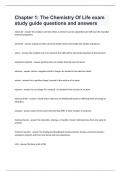
Chapter 1: The Chemistry Of Life exam study guide questions and answers
molecule the smallest unit into which an element can be subdivided and still have the essential chemical properties. elements substances that cannot be broken down chemically into simpler substances atoms the smallest unit of an element that still had the chemical properties of that element. subatomic particles particles that are smaller than the level of atoms electron carries a negative electric charge. are located in the electron cloud. proton has a positive charge. located in the nucleus of an atom neutron has no charge (it is neutral). it is located in the nucleus of an atom. electron shells a cloud where electrons are distributed based on differing levels of energy or attraction. isotopes atoms of the same element that differ in their number of neutrons. chemical bonds the attraction, sharing, or transfer of outer shell electrons from one atom to another. chemical reaction the making and breaking of chemical bonds. during a chemical reaction, substances interact and form new bonds and new substances cells the basic units of life the Law of Conservation of Matter states that matter is neither created nor destroyed in chemical reactions. activation energy the energy needed to get a chemical reaction started. ion an atom or a molecule that has acquired a positive or negative charge as a result of gaining or losing electrons. ionic bond the attraction between oppositely charged ions covalent bond when two atoms share one or more pairs of electrons. hydrogen bond a weak attraction occurs when a slightly positive hydrogen atom in a molecule and a nearby slightly negative atom of another molecule. pH scale the level of H+ and OH- ions in a solution is described by a range of numbers from 0 to 14. basic a solution that has more OH- than H+ ions acidic a solution that has more H+ than OH- ions organic compounds when carbon atoms are combined with hydrogen and usually oxygen. they frequently also contain nitrogen, sulfur, and phosphorous. macromolecules the backbone of large complex molecules carbohydrates one of four macromolecules. contain hydrogen and oxygen atoms in a two-to-one ratio monosaccharides simple sugar molecules disaccharide two simple sugar molecules bonded together to form a double sugar (monosaccharide + monosaccharide = disaccharide) polysaccharides several glucose molecules bonded together to form complex carbohydrates. lipids another macromolecule. also called fats or oils. lipids contain carbon, hydrogen, and oxygen, but not in a fixed ratio. phospholipids glycerol + 2 fatty acids + phosphate group = phospolipid cholesterol essential for manufacturing sex hormones. is part of the membrane structure of animal cells and important in nutrition proteins another macromolecule. there are many functions of proteins, but the most essential role is as enzymes. amino acids the building blocks of proteins. they are small molecules that contain carbon, hydrogen, oxygen, and nitrogen atoms. It has a central carbon, an amino group, an acid group, a hydrogen atom, and a variable group(also called the R group). peptide bonds covalent bonds formed between two amino acids. (the acid group of one molecule links up with an amino group from another molecule) polypeptide a long chain pf amino acids (more than just two amino acids linking up) primary structure the sequence of amino acids in a polypeptide chain forms the primary structure secondary structure polypeptide chain with f
Written for
- Institution
- Chemistry of Life
- Course
- Chemistry of Life
Document information
- Uploaded on
- March 5, 2024
- Number of pages
- 4
- Written in
- 2023/2024
- Type
- Exam (elaborations)
- Contains
- Questions & answers
Subjects
-
chapter 1 the chemistry of life exam

Also available in package deal