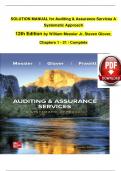
SOLUTION MANUAL for Auditing & Assurance Services A
Systematic Approach
12th Edition by William Messier Jr, Steven Glover,
Chapters 1 - 21 / Complete
1
,• Table of Contents
Chapter 1: An Introduction to Assurance and Financial Statement Auditing
Chapter 2: The Financial Statement Auditing Environment
Chapter 3: Audit Planning, Types of Audit Tests, and Materiality
Chapter 4: Risk Assessment
Chapter 5: Evidence and Documentation
Chapter 6: Internal Control in a Financial Statement Audit
Chapter 7: Auditing Internal Control over Financial Reporting
Chapter 8: Audit Sampling: An Overview and Application to Tests of Controls
Chapter 9: Audit Sampling: An Application to Substantive Tests of Account Balances
Chapter 10: Auditing the Revenue Process
Chapter 11: Auditing the Purchasing Process
Chapter 12: Auditing the Human Resource Management Process
Chapter 13: Auditing the Inventory Management Process
Chapter 14: Auditing the Financing/Investing Process:Prepaid Expenses, Intangible Assets, and Property, Plant, and
Equipment
Chapter 15: Auditing the Financing/Investing Process:Long-Term Liabilities, Stockholders’ Equity, and Income
Statement Accounts
Chapter 16: Auditing the Financing/Investing Process: Cashand Investments
Chapter 17: Completing the Audit Engagement
Chapter 18: Reports on Audited Financial Statements
Chapter 19: Professional Conduct, Independence, and Quality Management
Chapter 20: Legal Liability
Chapter 21: Assurance, Attestation, and Internal Auditing Services
2
,CHAPTER 1
AN INTRODUCTION TO ASSURANCE AND FINANCIAL STATEMENT AUDITING
Answers to Review Questions
1-1 The study of auditing is more conceptual in nature compared to other accounting
courses. Rather than focusing on learning the rules, techniques, and computations required to
prepare financial statements, auditing emphasizes learning a framework of analytical and logical
skills to evaluate the relevance and reliability of the systems and processes responsible for
financial information, as well as the information itself. To be successful, students must learn the
framework and then learn to use logic and common sense in applying auditing concepts to
various circumstances and situations.
Understanding auditing can improve the decision making ability of consultants, business
managers, and accountants by providing a framework for evaluating the usefulness and
reliability of information.
1-2 There is a demand for auditing in a free-market economy because the agency
relationship between an absentee owner and a manager produces a natural conflict of interest
due to the information asymmetry that exists between the owner and manager. As a result, the
agent agrees to be monitored as part of his/her employment contract. Auditing appears to be a
cost-effective form of monitoring.
The empirical evidence suggests auditing was demanded prior to government regulation
such as statutory audit requirements. Additionally, many private companies and other entities
not subject to government auditing regulations also demand auditing.
1-3 The agency relationship between an owner and manager produces a natural conflict of
interest because of differences in the two parties’ goals and because of information asymmetry
that exists between them. That is, the manager generally has more information about the ‘true’
financial position and results of operations of the entity than the absentee owner does. If both
parties seek to maximize their own self-interest, it is likely that the manager will not act in the
best interest of the owner and may manipulate the information provided to the owner
accordingly.
1-4 Independence is an important standard for auditors. If an auditor is not independent of
the client, users may lose confidence in the auditor’s ability to report truthfully on the financial
statements, and the auditor’s work loses its value. From an agency perspective, if the principal
(owner) knows that the auditor is not independent, the owner will not trust the auditor’s work.
Thus, the agent will not hire the auditor because the auditor’s report will not be effective in
reducing information risk from the perspective of the owner.
1-5 Auditing (broadly defined) is a systematic process of objectively obtaining and
evaluating evidence regarding assertions about economic actions and events to ascertain the
degree of correspondence between those assertions and established criteria and
communicating the results to interested users.
Assurance is engagement in which a practitioner expresses a conclusion designed to
enhance the degree of confidence of the intended users other than the responsible party about
the outcome of the evaluation or measurement of a subject matter against criteria.
Examples of assurance services are assurance (audit) of financial statements,
assurance of prospective financial information, assurance of reporting on internal control,
assurance of sustainability reporting, and assurance of electronic commerce.
3
, 1-6 The phrase systematic process implies that there should be a well-planned, logical
approach for conducting an audit that involves objectively obtaining and evaluating evidence.
1-7 Materiality: "Omissions or misstatements of items are material if they could, individually
or collectively, influence the economic decisions of users taken on the basis of the financial
statements. Materiality depends on the size and nature of the omission or misstatement judged
in the surrounding circumstances. The size or nature of the item, or a combination of both, could
be the determining factor." (IASB).
Audit risk is defined as the risk that the auditor expresses an inappropriate audit opinion
when the financial statements are materially misstated (ISA 200).
The audit report states that the auditor obtains “reasonable assurance” whether the
financial statements are free from “material” misstatement. The term reasonable assurance
informs the reader that there is some level of risk that the audit did not detect all material
misstatements. In addition, the auditor’s opinion commonly uses the wording that the financial
statements present fairly, “in all material respects.” These phrases communicate to third parties
that the audit report is limited to material information.
1-8 On most audits, it is not feasible or cost-effective to audit all transactions. For example,
in a small business, the auditor might be able to examine all transactions that occurred during
the period. However, it is unlikely that the owner of the business could afford to pay for such an
extensive audit. For a large organization, the sheer volume of transactions prevents the auditor
from examining every transaction. Thus, there is a trade-off between the exactness or precision
of the audit and its cost.
1-9 The major phases of the audit are:
Client acceptance/continuance and establishing engagement terms
Preplanning
Assess risks and establish materiality
Plan the audit
Consider internal control
Audit business processes and related accounts
Complete the audit
Evaluate results and issue audit report
1-10 The auditor’s understanding of the entity and its environment includes knowledge
about: (1) the nature of the entity, (2) its objectives and strategies, (3) its industry, regulatory,
and other external factors, (4) its management, (5) its governance, (6) its measurement and
performance process, and (7) its business processes.
1-11 Sometimes auditors will face situations where no standard audit procedure exists, such
as the example from the text of verifying the inventory of reindeer. Such circumstances require
that the auditor possess creativity and innovation when planning and administering audit
procedures where little or no precedent exists. Every client is different, and applying auditing
concepts in different situations requires logic and common sense, and frequently creativity and
innovation.
Solutions to Problems
1-12 The memo should cite the following facts:
There is a historical relationship between accounting and auditing.
4
Systematic Approach
12th Edition by William Messier Jr, Steven Glover,
Chapters 1 - 21 / Complete
1
,• Table of Contents
Chapter 1: An Introduction to Assurance and Financial Statement Auditing
Chapter 2: The Financial Statement Auditing Environment
Chapter 3: Audit Planning, Types of Audit Tests, and Materiality
Chapter 4: Risk Assessment
Chapter 5: Evidence and Documentation
Chapter 6: Internal Control in a Financial Statement Audit
Chapter 7: Auditing Internal Control over Financial Reporting
Chapter 8: Audit Sampling: An Overview and Application to Tests of Controls
Chapter 9: Audit Sampling: An Application to Substantive Tests of Account Balances
Chapter 10: Auditing the Revenue Process
Chapter 11: Auditing the Purchasing Process
Chapter 12: Auditing the Human Resource Management Process
Chapter 13: Auditing the Inventory Management Process
Chapter 14: Auditing the Financing/Investing Process:Prepaid Expenses, Intangible Assets, and Property, Plant, and
Equipment
Chapter 15: Auditing the Financing/Investing Process:Long-Term Liabilities, Stockholders’ Equity, and Income
Statement Accounts
Chapter 16: Auditing the Financing/Investing Process: Cashand Investments
Chapter 17: Completing the Audit Engagement
Chapter 18: Reports on Audited Financial Statements
Chapter 19: Professional Conduct, Independence, and Quality Management
Chapter 20: Legal Liability
Chapter 21: Assurance, Attestation, and Internal Auditing Services
2
,CHAPTER 1
AN INTRODUCTION TO ASSURANCE AND FINANCIAL STATEMENT AUDITING
Answers to Review Questions
1-1 The study of auditing is more conceptual in nature compared to other accounting
courses. Rather than focusing on learning the rules, techniques, and computations required to
prepare financial statements, auditing emphasizes learning a framework of analytical and logical
skills to evaluate the relevance and reliability of the systems and processes responsible for
financial information, as well as the information itself. To be successful, students must learn the
framework and then learn to use logic and common sense in applying auditing concepts to
various circumstances and situations.
Understanding auditing can improve the decision making ability of consultants, business
managers, and accountants by providing a framework for evaluating the usefulness and
reliability of information.
1-2 There is a demand for auditing in a free-market economy because the agency
relationship between an absentee owner and a manager produces a natural conflict of interest
due to the information asymmetry that exists between the owner and manager. As a result, the
agent agrees to be monitored as part of his/her employment contract. Auditing appears to be a
cost-effective form of monitoring.
The empirical evidence suggests auditing was demanded prior to government regulation
such as statutory audit requirements. Additionally, many private companies and other entities
not subject to government auditing regulations also demand auditing.
1-3 The agency relationship between an owner and manager produces a natural conflict of
interest because of differences in the two parties’ goals and because of information asymmetry
that exists between them. That is, the manager generally has more information about the ‘true’
financial position and results of operations of the entity than the absentee owner does. If both
parties seek to maximize their own self-interest, it is likely that the manager will not act in the
best interest of the owner and may manipulate the information provided to the owner
accordingly.
1-4 Independence is an important standard for auditors. If an auditor is not independent of
the client, users may lose confidence in the auditor’s ability to report truthfully on the financial
statements, and the auditor’s work loses its value. From an agency perspective, if the principal
(owner) knows that the auditor is not independent, the owner will not trust the auditor’s work.
Thus, the agent will not hire the auditor because the auditor’s report will not be effective in
reducing information risk from the perspective of the owner.
1-5 Auditing (broadly defined) is a systematic process of objectively obtaining and
evaluating evidence regarding assertions about economic actions and events to ascertain the
degree of correspondence between those assertions and established criteria and
communicating the results to interested users.
Assurance is engagement in which a practitioner expresses a conclusion designed to
enhance the degree of confidence of the intended users other than the responsible party about
the outcome of the evaluation or measurement of a subject matter against criteria.
Examples of assurance services are assurance (audit) of financial statements,
assurance of prospective financial information, assurance of reporting on internal control,
assurance of sustainability reporting, and assurance of electronic commerce.
3
, 1-6 The phrase systematic process implies that there should be a well-planned, logical
approach for conducting an audit that involves objectively obtaining and evaluating evidence.
1-7 Materiality: "Omissions or misstatements of items are material if they could, individually
or collectively, influence the economic decisions of users taken on the basis of the financial
statements. Materiality depends on the size and nature of the omission or misstatement judged
in the surrounding circumstances. The size or nature of the item, or a combination of both, could
be the determining factor." (IASB).
Audit risk is defined as the risk that the auditor expresses an inappropriate audit opinion
when the financial statements are materially misstated (ISA 200).
The audit report states that the auditor obtains “reasonable assurance” whether the
financial statements are free from “material” misstatement. The term reasonable assurance
informs the reader that there is some level of risk that the audit did not detect all material
misstatements. In addition, the auditor’s opinion commonly uses the wording that the financial
statements present fairly, “in all material respects.” These phrases communicate to third parties
that the audit report is limited to material information.
1-8 On most audits, it is not feasible or cost-effective to audit all transactions. For example,
in a small business, the auditor might be able to examine all transactions that occurred during
the period. However, it is unlikely that the owner of the business could afford to pay for such an
extensive audit. For a large organization, the sheer volume of transactions prevents the auditor
from examining every transaction. Thus, there is a trade-off between the exactness or precision
of the audit and its cost.
1-9 The major phases of the audit are:
Client acceptance/continuance and establishing engagement terms
Preplanning
Assess risks and establish materiality
Plan the audit
Consider internal control
Audit business processes and related accounts
Complete the audit
Evaluate results and issue audit report
1-10 The auditor’s understanding of the entity and its environment includes knowledge
about: (1) the nature of the entity, (2) its objectives and strategies, (3) its industry, regulatory,
and other external factors, (4) its management, (5) its governance, (6) its measurement and
performance process, and (7) its business processes.
1-11 Sometimes auditors will face situations where no standard audit procedure exists, such
as the example from the text of verifying the inventory of reindeer. Such circumstances require
that the auditor possess creativity and innovation when planning and administering audit
procedures where little or no precedent exists. Every client is different, and applying auditing
concepts in different situations requires logic and common sense, and frequently creativity and
innovation.
Solutions to Problems
1-12 The memo should cite the following facts:
There is a historical relationship between accounting and auditing.
4