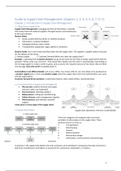
Guide to Supply Chain Management: Chapters 1, 2, 3, 4, 5, 6, 7, 9, 11
Chapter 1: Introduction to Supply Chain Management
1.1 What Starts a Supply Chain
Supply Chain Management: managing the flow of information, materials
and service from raw material suppliers through factories and warehouses
to the end customer.
Reverse flows:
• Goods, quality defect products or obsolete products
• Information, customer feedback
• Packaging material, outer cartons
• Transportation equipment, cages, pallets or containers
Reverse Funds: this is the money that flows back into the supply chain. The supplier’s supplier wants to be paid
for the delivery of tea leaves.
1. Product Supply 2. Customer Demand Which one starts the supply chain?
Example = operating from customer demand, you go to buy some tea but find an empty supermarket with the
question “Please order your tea here”. They would then explain that the order is automatically transmitted to
the tea bag supplier in India in order to grow, pick a process the required amount of tea leaves that are filled
into tea bags. Does this work? It probably doesn’t.
Commodities (=not differentiated) such as tea, coffee, rice, bread, milk etc. are more likely to be produced on
a product supply basis. In this case product supply starts the supply chain and it has started before you come
into the supermarket.
Customer demand driven products: customised products, tailor-made clothes, customised tools.
1.2 A Functional View of Supply Chain Management
• Plan process: balance demand and supply
(amount, what, raw materials?)
• Source process: selecting suppliers
• Make process: setting up manufacturing
• Deliver Process: order management, logistics
• Return process: post-delivery customer
support
Takes place in every stage of the supply chain!
1.3 Supply Chain Players Supply Chain Operations reference model (SCOR)
There are categories of companies that are service
providers to other players in the supply chain. These
perform services in areas as:
• Transportation
• Warehousing
• Finance
• Market research
• New product design
• Information, communication and technology
Customers in the supply chain (before the end customer) can be distributors (companies that take inventory in
bulk from manufacturers and deliver an assortment to customers), wholesalers, or retailers
1
,1.4 Supply Chain Dynamics
Supply chain reacts to changes in their environment:
• Customer demand
• Product Supply
• Exchange rates
• Temperature
Constant Balance supply with demand (supply reacts to how much is needed, rate of customer demand)
Inventory plays an important role in balancing demand and supply
Balance inventory level and service level
2
, Chapter 2: Guide to Plan in Supply Chain Management
2.1 Inventory and Supply Chains
Inventory: the quantity of goods that is available on hand or in stock.
There are 3 main formats of inventory: raw material, work in progress and finished goods.
Reasons for holding inventory
Protect against uncertainty: variations in demand/restrictions in supply
Cost reduction: stock held close to customer (transportation costs)
Protect against quality defects: faulty product substituted quickly
Stabilise manufacturing: high summer demand: produce entire year
Anticipation stock: pre-launch stock to buffer demand uncertainty
Balancing supply and demand
2.1.1 Different Types of Inventory
• Cycle or replenishment stock: the inventory necessary to meet the normal daily demand.
• Safety stock: buffers against forecast error and the supplier’s unreliability.
• In transit stock: is in the process of being transported to a stocking or delivery point.
• Seasonal stock: built up in advance to meet increased sales volumes during a specific time of year.
• Promotional stock: this stock feeds into marketing campaigns and advertising.
• Speculative stock: held to protect against price increase or periods of limited availability.
• Dead or obsolete stock: is no longer usable or saleable in the market.
Although all types of stocks are important, cycle stock and safety stock are those types that are most looked
after in inventory management.
2.1.2 Cycle Stock
Two important cycle stock concepts:
• Average cycle stockholding: the average cycle stock held during a
particular timeframe.
• Average cycle stock investment
Average cycle stock holding = typical quantity of the orders/2
Average cycle stock investment = average cycle stockholding X products cost
(Assumption that demand is stable)
2.1.3 Safety Stock
Goal: guard against stock-outs due to:
• Unplanned production and delivery delays
• Unplanned demand
3
Chapter 1: Introduction to Supply Chain Management
1.1 What Starts a Supply Chain
Supply Chain Management: managing the flow of information, materials
and service from raw material suppliers through factories and warehouses
to the end customer.
Reverse flows:
• Goods, quality defect products or obsolete products
• Information, customer feedback
• Packaging material, outer cartons
• Transportation equipment, cages, pallets or containers
Reverse Funds: this is the money that flows back into the supply chain. The supplier’s supplier wants to be paid
for the delivery of tea leaves.
1. Product Supply 2. Customer Demand Which one starts the supply chain?
Example = operating from customer demand, you go to buy some tea but find an empty supermarket with the
question “Please order your tea here”. They would then explain that the order is automatically transmitted to
the tea bag supplier in India in order to grow, pick a process the required amount of tea leaves that are filled
into tea bags. Does this work? It probably doesn’t.
Commodities (=not differentiated) such as tea, coffee, rice, bread, milk etc. are more likely to be produced on
a product supply basis. In this case product supply starts the supply chain and it has started before you come
into the supermarket.
Customer demand driven products: customised products, tailor-made clothes, customised tools.
1.2 A Functional View of Supply Chain Management
• Plan process: balance demand and supply
(amount, what, raw materials?)
• Source process: selecting suppliers
• Make process: setting up manufacturing
• Deliver Process: order management, logistics
• Return process: post-delivery customer
support
Takes place in every stage of the supply chain!
1.3 Supply Chain Players Supply Chain Operations reference model (SCOR)
There are categories of companies that are service
providers to other players in the supply chain. These
perform services in areas as:
• Transportation
• Warehousing
• Finance
• Market research
• New product design
• Information, communication and technology
Customers in the supply chain (before the end customer) can be distributors (companies that take inventory in
bulk from manufacturers and deliver an assortment to customers), wholesalers, or retailers
1
,1.4 Supply Chain Dynamics
Supply chain reacts to changes in their environment:
• Customer demand
• Product Supply
• Exchange rates
• Temperature
Constant Balance supply with demand (supply reacts to how much is needed, rate of customer demand)
Inventory plays an important role in balancing demand and supply
Balance inventory level and service level
2
, Chapter 2: Guide to Plan in Supply Chain Management
2.1 Inventory and Supply Chains
Inventory: the quantity of goods that is available on hand or in stock.
There are 3 main formats of inventory: raw material, work in progress and finished goods.
Reasons for holding inventory
Protect against uncertainty: variations in demand/restrictions in supply
Cost reduction: stock held close to customer (transportation costs)
Protect against quality defects: faulty product substituted quickly
Stabilise manufacturing: high summer demand: produce entire year
Anticipation stock: pre-launch stock to buffer demand uncertainty
Balancing supply and demand
2.1.1 Different Types of Inventory
• Cycle or replenishment stock: the inventory necessary to meet the normal daily demand.
• Safety stock: buffers against forecast error and the supplier’s unreliability.
• In transit stock: is in the process of being transported to a stocking or delivery point.
• Seasonal stock: built up in advance to meet increased sales volumes during a specific time of year.
• Promotional stock: this stock feeds into marketing campaigns and advertising.
• Speculative stock: held to protect against price increase or periods of limited availability.
• Dead or obsolete stock: is no longer usable or saleable in the market.
Although all types of stocks are important, cycle stock and safety stock are those types that are most looked
after in inventory management.
2.1.2 Cycle Stock
Two important cycle stock concepts:
• Average cycle stockholding: the average cycle stock held during a
particular timeframe.
• Average cycle stock investment
Average cycle stock holding = typical quantity of the orders/2
Average cycle stock investment = average cycle stockholding X products cost
(Assumption that demand is stable)
2.1.3 Safety Stock
Goal: guard against stock-outs due to:
• Unplanned production and delivery delays
• Unplanned demand
3