Advanced Theory Final Exam Questions with 100% Correct Answers | Graded A+
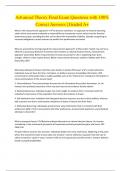
What is the measurement approach?-To decision usefulness--an approach to financial reporting under which accountants undertake a responsibility to incorporate current values into the financial statements proper, providing that this can be done with reasonable reliability, thereby recognizing an increased obligation to assist investors to predict firm performance and value Why are accountants moving toward the measurement approach?-Securities market may not be as efficient as previously believed. If investors don't behave as rational decision theory, measurement approach would help. Better measurements increase accountant's role in explaining share price changes. Ohlson's clean surplus theory. Better measurement decreases auditor's liability when firms financially suffer. What does behavioral finance find that casts doubt on market efficiency?-1. Limited attention: Individuals may not have the time, inclination, or ability to process all available information. Will concentrate on information that is readily available such as the "bottom line" and ignore information in notes and elsewhere in the annual report 2. Overconfidence: They overestimate the precision of information they collect themselves. Ex: An investor who privately researches a firm may overreact to the evidence he/she obtains 3. Representativeness: Individual assigns too much weight to evidence that is consistent with the individual's impressions of the population from which the evidence is drawn. 4. Self-attribution bias: Individuals feel that good decision outcomes are due to their abilities; whereas bad outcomes are due to unfortunate realizations of states of nature (not their fault) 5. Motivated Reasoning: Individuals accept at face value information that is consistent with their preferences (GN). If info is inconsistent with their preferences, received with skepticism, and individual attempts to discredit it What is prospect theory?-Behavioral based alternative to rational decision theory. An investor considering a risky investment (prospect) will separately evaluate prospective gains and losses. SEE PAGE 194 Prospect theory assumes loss aversion- individuals dislike even very small losses. Beginning at the point where the investment starts to lose value, the investor's rate of utility loss is greater than the rate of utility increase for a gain in value. Investor holds on to losing stocks and sells winners. Investor behaves based on payoff probabilities.
Written for
- Institution
- Advanced Theory
- Course
- Advanced Theory
Document information
- Uploaded on
- March 4, 2024
- Number of pages
- 30
- Written in
- 2023/2024
- Type
- Exam (elaborations)
- Contains
- Questions & answers
Subjects
-
advanced theory final exam questions with answers

Also available in package deal