Neuropsychology period 1
Brain damage
Task 1 A matter of approach – development of neuropsychology & paradigm shifts
Neuropsychology - the scientific study of the relations between brain function and behavior.
Neuropsychology is strongly influenced by two experimental and theoretical investigations into brain
function:
1. The brain theory, which states that the brain is the source of behavior; and
2. The neuron theory, the idea that the unit of brain structure and function is the neuron, or
nerve cell.
The brain theory
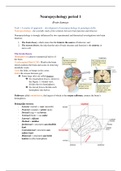
Hemispheres: (almost) symmetrical halves of
the brain
Cerebrospinal fluid (CSF): Fluid in the brain
which cushions the brain and assists in removing
metabolic waste.
Gyri: the folds, or bumps in the cortex
Sulci: the creases between gyri
➔ Some large sulci are called fissures:
➔ the longitudinal fissure, shown in
the Figure 1.1 frontal view,
divides the two hemispheres,
➔ the lateral fissure divides each
hemisphere into halves.
Pathways called commissures, the largest of which is the corpus callosum, connect the brain’s
hemispheres.
Belangrijke termen:
- Anterior (rostral) = voor (aanzicht)
- Posterior (caudal) = achter (post)
- Dorsaal (rug) = van boven
- Ventraal (buik) = van onder
- Lateraal = zijkant
- Mediaal = midden
- Ipsilateraal = structuren aan dezelfde
kant
- Contralateraal= structuren aan
andere kant
- Bilateraal = structuren aan beide
kanten (in elke hemisphere)
,The cortex of each hemisphere forms four lobes (named
after the skull bones beneath which they lie).
1. The temporal lobe is located below the lateral
fissure at approximately the same place as the thumb
on your upraised fist.
2. The frontal lobe lies immediately above the
temporal lobe, so called because it is located at the
front of the brain beneath the frontal bones.
3. The parietal lobe is located behind the frontal lobe
4. The occipital lobe constitutes the area at the back of
each hemisphere.
➔ Frontal lobe
o Initiëren en coördineren van motorische bewegingen; hogere cognitieve
vaardigheden zoals het oplossen van problemen, denken, plannen en organiseren.
Ook voor veel aspecten van de persoonlijkheid en emotionele verwerking
o Broca’s area
➔ Parietal lobe
o Sensorische/zintuigelijke processen, aandacht en taal
o Schade
➔ Rechterkant: moeilijkheden met navigeren van ruimten
➔ Linkerkant: taal barrieres
➔ Occipital lobe
o Verwerkt visuele informatie (herkenning van kleuren en vormen)
➔ Temporal lobe
o Language (wernicke’s)
o Auditive informatie
o Alle andere zintuigen
o Limbisch systeem
➔ Korte termijn geheugen
,Twee subcorticale structuren
➔ Basal ganglia
o Anterior regio van de cortex
o Putamen, globus pallidus & caudate nucleus
➔ Caudate nucleus ontvangt projecties van alle gebieden van de cortex en stuurt
zijn eigen projecties door de putamen en globus pallidus naar de thalamus en
vanuit daar naar de frontale corticale gebieden
o Connecties met substantia nigra
o Beweging en simpele vormen van leren
o Aantasting:
➔ Abnormale beweging
• Excessive movement
o Huntington’s disease (progressieve celdood basal ganglia) =
involuntairy body movements
o Tourette’s = involuntairy motor tics
• Loss of movement
o Parkinsons’s (loss of connections into/out of the basal
ganglia)
➔ Limbic system
o Lymbische ring
➔ Amygdala = emotionele gedragingen
➔ Hippocampus = geheugen en ruimtelijke
navigatie, gevoelig voor effecten van stress
➔ Septum = emotionele gedragingen
➔ Cingulate cortex = seksuele gedragingen
➔ Information flows from the mammillary
bodies in the hypothalamus to the anterior
thalamic nucleus tot the cingulate cortex to
the hippocampus and back to the mammillary
bodies
Blood supply
➔ 2 interne halsslagaders (carotid arteries)
➔ 2 vertebrale slagaders
➔ In de hersenen verspreiden ze in kleinere (slag) aders
➔ 3 cerebral arteries that irrigate the forebrain
o Anterior cerebral artery (ACA) = voorste hersenslagader
➔ Medial and dorsal parts of the cortex
o Middle cerebral artery (MCA) = middelste hersenslagader
➔ Lateral surface of cortex
o Posterior cerebral artery (PCA) = onderste/achterste hersenslagader
➔ Ventral and posteral surfaces
Central nervous system (CNS) = the brain and spinal cord together → connected with rest of the
body via fibers
, De hersenen en spinal cord worden op 4 manieren beschermd
➔ De hersenen worden omringd door bot skull/schedel
➔ Binnen het schedel zit een drie laagse set membranen (meninges)
o Dura mater
➔ Most outer layer
➔ Though and inflexible
➔ Enclosing the brain in a kind of loose sack
o Arachnoid membrane
➔ Very thin sheet of delicate tissue that follows the
brains contours
➔ Spider web
➔ Not in sulci
o Pia mater
➔ Thin layer with blood vessels
➔ Adheres to surface of the brain into fissures
➔ The brain and spinal cord worden beschermd voor schokken en plotse druk door
cerebrospinal fluid (CSF)
o Circulates through the brains four ventricle’s spinal colomn and within the
subarachnoid space in de meninges
o Is continuously being made & drained off into the circulatory system through
connecting channels among the ventricle’s
➔ Blocked outflow = hydrocephalus
➔ Blood-brain barrier
o Limiting the movement of chemicals from the rest of the body into the CNS &
bescherming tegen giftige substanties en infecties
o Door glia cellen worden capillary cells gestimuleerd om tight junction te creeren
Nerve fibers constitute the peripheral nervous system (PNS)
➔ Tissue of the PNS can regrow after damage, lost tissues
in the CNS wont be regenerated
➔ Nerve fibers that bring information to the CNS are
extensively connected to sensory receptors on the
body’s surface and to muscles, enabling the brain to
sense the world and to react (afferent) → somatic
nervous system (SNS)
➔ Sensory pathways; collections of fibers carry
messages for specific senses, such as hearing,
vision, and touch.
▪ collected on one side of the body mainly
to the cortex in the opposite
hemisphere.
▪ The brain uses this information to
construct perceptions of the world,
memories of past events, and expectations about the future
➔ Motor pathways, groups of nerve fibers that connect the brain and spinal cord to the
body’s muscles through the SNS. Movements produced by motor pathways include
the eye movements that you are using to read this book, the hand movements that you
make while turning or scrolling through the pages, and your body’s posture as you
read. (efferent)
Brain damage
Task 1 A matter of approach – development of neuropsychology & paradigm shifts
Neuropsychology - the scientific study of the relations between brain function and behavior.
Neuropsychology is strongly influenced by two experimental and theoretical investigations into brain
function:
1. The brain theory, which states that the brain is the source of behavior; and
2. The neuron theory, the idea that the unit of brain structure and function is the neuron, or
nerve cell.
The brain theory
Hemispheres: (almost) symmetrical halves of
the brain
Cerebrospinal fluid (CSF): Fluid in the brain
which cushions the brain and assists in removing
metabolic waste.
Gyri: the folds, or bumps in the cortex
Sulci: the creases between gyri
➔ Some large sulci are called fissures:
➔ the longitudinal fissure, shown in
the Figure 1.1 frontal view,
divides the two hemispheres,
➔ the lateral fissure divides each
hemisphere into halves.
Pathways called commissures, the largest of which is the corpus callosum, connect the brain’s
hemispheres.
Belangrijke termen:
- Anterior (rostral) = voor (aanzicht)
- Posterior (caudal) = achter (post)
- Dorsaal (rug) = van boven
- Ventraal (buik) = van onder
- Lateraal = zijkant
- Mediaal = midden
- Ipsilateraal = structuren aan dezelfde
kant
- Contralateraal= structuren aan
andere kant
- Bilateraal = structuren aan beide
kanten (in elke hemisphere)
,The cortex of each hemisphere forms four lobes (named
after the skull bones beneath which they lie).
1. The temporal lobe is located below the lateral
fissure at approximately the same place as the thumb
on your upraised fist.
2. The frontal lobe lies immediately above the
temporal lobe, so called because it is located at the
front of the brain beneath the frontal bones.
3. The parietal lobe is located behind the frontal lobe
4. The occipital lobe constitutes the area at the back of
each hemisphere.
➔ Frontal lobe
o Initiëren en coördineren van motorische bewegingen; hogere cognitieve
vaardigheden zoals het oplossen van problemen, denken, plannen en organiseren.
Ook voor veel aspecten van de persoonlijkheid en emotionele verwerking
o Broca’s area
➔ Parietal lobe
o Sensorische/zintuigelijke processen, aandacht en taal
o Schade
➔ Rechterkant: moeilijkheden met navigeren van ruimten
➔ Linkerkant: taal barrieres
➔ Occipital lobe
o Verwerkt visuele informatie (herkenning van kleuren en vormen)
➔ Temporal lobe
o Language (wernicke’s)
o Auditive informatie
o Alle andere zintuigen
o Limbisch systeem
➔ Korte termijn geheugen
,Twee subcorticale structuren
➔ Basal ganglia
o Anterior regio van de cortex
o Putamen, globus pallidus & caudate nucleus
➔ Caudate nucleus ontvangt projecties van alle gebieden van de cortex en stuurt
zijn eigen projecties door de putamen en globus pallidus naar de thalamus en
vanuit daar naar de frontale corticale gebieden
o Connecties met substantia nigra
o Beweging en simpele vormen van leren
o Aantasting:
➔ Abnormale beweging
• Excessive movement
o Huntington’s disease (progressieve celdood basal ganglia) =
involuntairy body movements
o Tourette’s = involuntairy motor tics
• Loss of movement
o Parkinsons’s (loss of connections into/out of the basal
ganglia)
➔ Limbic system
o Lymbische ring
➔ Amygdala = emotionele gedragingen
➔ Hippocampus = geheugen en ruimtelijke
navigatie, gevoelig voor effecten van stress
➔ Septum = emotionele gedragingen
➔ Cingulate cortex = seksuele gedragingen
➔ Information flows from the mammillary
bodies in the hypothalamus to the anterior
thalamic nucleus tot the cingulate cortex to
the hippocampus and back to the mammillary
bodies
Blood supply
➔ 2 interne halsslagaders (carotid arteries)
➔ 2 vertebrale slagaders
➔ In de hersenen verspreiden ze in kleinere (slag) aders
➔ 3 cerebral arteries that irrigate the forebrain
o Anterior cerebral artery (ACA) = voorste hersenslagader
➔ Medial and dorsal parts of the cortex
o Middle cerebral artery (MCA) = middelste hersenslagader
➔ Lateral surface of cortex
o Posterior cerebral artery (PCA) = onderste/achterste hersenslagader
➔ Ventral and posteral surfaces
Central nervous system (CNS) = the brain and spinal cord together → connected with rest of the
body via fibers
, De hersenen en spinal cord worden op 4 manieren beschermd
➔ De hersenen worden omringd door bot skull/schedel
➔ Binnen het schedel zit een drie laagse set membranen (meninges)
o Dura mater
➔ Most outer layer
➔ Though and inflexible
➔ Enclosing the brain in a kind of loose sack
o Arachnoid membrane
➔ Very thin sheet of delicate tissue that follows the
brains contours
➔ Spider web
➔ Not in sulci
o Pia mater
➔ Thin layer with blood vessels
➔ Adheres to surface of the brain into fissures
➔ The brain and spinal cord worden beschermd voor schokken en plotse druk door
cerebrospinal fluid (CSF)
o Circulates through the brains four ventricle’s spinal colomn and within the
subarachnoid space in de meninges
o Is continuously being made & drained off into the circulatory system through
connecting channels among the ventricle’s
➔ Blocked outflow = hydrocephalus
➔ Blood-brain barrier
o Limiting the movement of chemicals from the rest of the body into the CNS &
bescherming tegen giftige substanties en infecties
o Door glia cellen worden capillary cells gestimuleerd om tight junction te creeren
Nerve fibers constitute the peripheral nervous system (PNS)
➔ Tissue of the PNS can regrow after damage, lost tissues
in the CNS wont be regenerated
➔ Nerve fibers that bring information to the CNS are
extensively connected to sensory receptors on the
body’s surface and to muscles, enabling the brain to
sense the world and to react (afferent) → somatic
nervous system (SNS)
➔ Sensory pathways; collections of fibers carry
messages for specific senses, such as hearing,
vision, and touch.
▪ collected on one side of the body mainly
to the cortex in the opposite
hemisphere.
▪ The brain uses this information to
construct perceptions of the world,
memories of past events, and expectations about the future
➔ Motor pathways, groups of nerve fibers that connect the brain and spinal cord to the
body’s muscles through the SNS. Movements produced by motor pathways include
the eye movements that you are using to read this book, the hand movements that you
make while turning or scrolling through the pages, and your body’s posture as you
read. (efferent)