C963 WGU exam latest update with questions & veried answers graded A
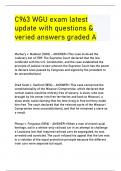
C963 WGU exam latest update with questions & veried answers graded A Marbury v. Madison (1803) - ANSWER>>This case involved the Judiciary Act of 1789. The Supreme Court declared that the law conflicted with the U.S. Constitution, and the case established the principle of judicial review wherein the Supreme Court has the power to declare laws passed by Congress and signed by the president to be unconstitutional. Dred Scott v. Sanford (1856) - ANSWER>>This case concerned the constitutionality of the Missouri Compromise, which declared that certain states would be entirely free of slavery. A slave, who was brought by his owner into free territories and back to Missouri, a slave state, sued claiming that his time living in free territory made him free. The court declared that the relevant parts of the Missouri Compromise were unconstitutional, and that he remained a slave as a result. Plessy v. Ferguson (1896) - ANSWER>>When a man of mixed racial heritage, sat in a whites-only railroad car in an attempt to challenge a Louisiana law that required railroad cars be segregated, he was arrested and convicted. The court refused his appeal that the law was in a violation of the equal protection principle because the different train cars were separate but equal. United States v. Miller (1939) - ANSWER>>In the early 1980s, following an assassination attempt on President Ronald Reagan, laws requiring background checks for prospective gun buyers were passed. In this case, the Supreme Court upheld the 1934 National Firearms Act's prohibition of sawed-off shotguns, largely on the basis that possession of such a gun was not related to the goal of promoting a "well regulated militia." Korematsu v. United States (1944) - ANSWER>>During World War II, citizens of Japanese descent living on the West Coast, whether naturalized immigrants or Japanese Americans born in the United States, were subjected to the indignity of being removed from their communities and interned under Executive Order 9066. When challenged, the Supreme Court decision in this case upheld the actions of the government as a necessary precaution in a time of war. Brown v. Board of Education (1954) - ANSWER>>This case challenged the principle of "separate but equal." It was brought by students who were denied admittance to certain public schools based exclusively on race. The unanimous decision in this case determined that the existence of racially segregated public schools violated the equal protection clause of the Fourteenth Amendment. Mapp v. Ohio (1961) - ANSWER>>In this Supreme Court case it was decided that evidence obtained without a warrant that didn't fall under one of the exceptions mentioned above could not be used as evidence in a state criminal trial, giving rise to the broad application of what is known as the exclusionary rule, which was first established in 1914 on a federal level in Weeks v. United States. Gideon v. Wainwright (1963) - ANSWER>>This case perpetuated from the arrest of a man who was accused of breaking into a poolroom and stealing money from a cigarette machine. Not being able to afford a lawyer, and being denied a public defender by the judge, the man defended himself and was subsequently found guilty. Upon his appeal, the Supreme Court declared that the Sixth Amendment required that those facing felony criminal charges be supplied with legal representation. Sherbert v. Verner (1963) - ANSWER>>In this case the Supreme Court ruled that states could not deny unemployment benefits to an individual who turned down a job because it required working on the Sabbath. Griswold v. Connecticut (1965) - ANSWER>>Although several state constitutions do list the right to privacy as a protected right, the explicit recognition by the Supreme Court of a right to privacy in the U.S. Constitution emerged only in the middle of the twentieth century. In this 1965 case, the court spelled out the right to privacy for the first time in a case that struck down a state law forbidding even married individuals to use any form of contraception. Miranda v. Arizona (1966) - ANSWER>>When a man was arrested, interrogated, and confessed to kidnapping, the arresting officers neglected to inform him of his Fifth Amendment right not to self-incriminate. His appeal to the Supreme Court upon being found guilty resulted in a decision that the right to not incriminate oneself relies
Written for
- Institution
- C963 WGU
- Course
- C963 WGU
Document information
- Uploaded on
- March 3, 2024
- Number of pages
- 7
- Written in
- 2023/2024
- Type
- Exam (elaborations)
- Contains
- Questions & answers
Subjects
- c963 wgu
- c963 wgu exam
-
c963 wgu exam latest update with questions verie
-
c963 wgu exam latest update

Also available in package deal