IGCSE Economics Exam|100 Complete
Questions and Answers
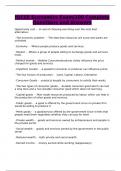
Opportunity cost - -A cost of choosing one thing over the next best alternative. -The economic problem - -The idea that resources are scare and wants are unlimited -Economy - -Where people produce goods and services. -Market - -Where a group of people willing to exchange goods and services meet. -Perfect market - -Neither Consumer/producer solely influence the price charged for goods and services -Imperfect market - -a powerful consumer or producer can influence prices -The four factors of production - -Land, Capital, Labour, Enterprise -Consumer Goods - -products bought by consumers to satisfy their wants -The two types of consumer goods - -durable consumer good which can last a long time and a non-durable consumer good which does not last long. -Capital goods - -Man made resources produced by labour which can help in
the production of other goods and services. -Public goods - -a good is offered by the government since no private firm would be willing to produce it -Merit goods - -a good/service offered by the government since it feels that people need them regardless whether they can pay for them -Private wealth - -goods and services owned by entrepreneurs and people in
the private sector -Social wealth - -goods and services owned by the government in the public
sector -National wealth - -both private and social wealth. -Earned income - -money earned while working (wage/salary). -Unearned income - -money generated from assets and wealth (no working required) -Resource allocation - -how much factors of production are used in the production of a particular good/service. -Economic system - -Used to answer a countries three economics questions,
what, how, and for whom -The free market system - -both producers and consumers determine what and for whom they produce goods -The main aim of entrepreneurs - -Profit -The price mechanism - -used by entrepreneurs to decide what to produce -Average product - -=total product/units of labour -Primary Industry - -Raw materials are obtained, farming mostly. -Secondary industry - -where materials are processed into goods and services, in factories. -Tertiary industry - -when goods and services are then sold, shops etc. -Specialization - -when a country is good at producing a certain good/service. -Division of Labour - -when a workforce is separated for each to do a specific task in producing a good or service. -Marginal Product - -= Change in total product / change in total labour. -The law of diminishing returns - -adding more units of factors of production
give diminishing results to total product. -Increasing returns - -when added factors of production increase total output. -Fixed costs - -costs that do not change as output changes -Variable cost - -costs that increase per increasing output -Total costs - -both fixed and variable costs
Questions and Answers
Opportunity cost - -A cost of choosing one thing over the next best alternative. -The economic problem - -The idea that resources are scare and wants are unlimited -Economy - -Where people produce goods and services. -Market - -Where a group of people willing to exchange goods and services meet. -Perfect market - -Neither Consumer/producer solely influence the price charged for goods and services -Imperfect market - -a powerful consumer or producer can influence prices -The four factors of production - -Land, Capital, Labour, Enterprise -Consumer Goods - -products bought by consumers to satisfy their wants -The two types of consumer goods - -durable consumer good which can last a long time and a non-durable consumer good which does not last long. -Capital goods - -Man made resources produced by labour which can help in
the production of other goods and services. -Public goods - -a good is offered by the government since no private firm would be willing to produce it -Merit goods - -a good/service offered by the government since it feels that people need them regardless whether they can pay for them -Private wealth - -goods and services owned by entrepreneurs and people in
the private sector -Social wealth - -goods and services owned by the government in the public
sector -National wealth - -both private and social wealth. -Earned income - -money earned while working (wage/salary). -Unearned income - -money generated from assets and wealth (no working required) -Resource allocation - -how much factors of production are used in the production of a particular good/service. -Economic system - -Used to answer a countries three economics questions,
what, how, and for whom -The free market system - -both producers and consumers determine what and for whom they produce goods -The main aim of entrepreneurs - -Profit -The price mechanism - -used by entrepreneurs to decide what to produce -Average product - -=total product/units of labour -Primary Industry - -Raw materials are obtained, farming mostly. -Secondary industry - -where materials are processed into goods and services, in factories. -Tertiary industry - -when goods and services are then sold, shops etc. -Specialization - -when a country is good at producing a certain good/service. -Division of Labour - -when a workforce is separated for each to do a specific task in producing a good or service. -Marginal Product - -= Change in total product / change in total labour. -The law of diminishing returns - -adding more units of factors of production
give diminishing results to total product. -Increasing returns - -when added factors of production increase total output. -Fixed costs - -costs that do not change as output changes -Variable cost - -costs that increase per increasing output -Total costs - -both fixed and variable costs