Law of Tort
14th December 2022
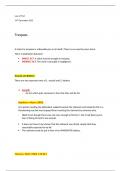
Trespass
A claim for trespass is actionable per se (in itself.) There is no need to prove harm.
There is distinction between:
DIRECT ACT: A claim may be brought in trespass.
INDIRECT ACT: The claim is brought in negligence.
Assault and Battery:
There are two separate torts of 1. assault and 2. battery
1. Assault:
- An act which puts someone in fear that they will be hit.
Stephens v Myers (1830)
At a parish meeting the defendant walked towards the claimant and raised his fist in a
threatening way but was stopped from reaching the claimant by someone else.
- HELD: Even though the D was not near enough to hit the C, the C had been put in
fear of being hit and it was assault.
It does not have to be shown that the claimant was afraid, simply that they
reasonably expected to be hit.
The claimant must be put in fear of an IMMEDIATE battery.
Thomas v NUM (1985) 2 All ER 1
, During the miners strike, striking miners picketing a coal mine made violent gestures to
working miners being escorted to the mine in buses.
- HELD: The miners on the bus were quite safe, there was no danger of an immediate
battery – so no assault.
Can words be an assault?
There are conflicting cases on this point:
Meade’s Case (1823) 1 Lew CC 184 – NOT an assault.
R v Wilson (1955) 1 WLR 493 – Words could be an assault.
R v Ireland [1998] (HL) – Silent phone calls were a criminal assault.
Words may be relevant to deciding if an assault has been committed.
Tuberville v Savage (1669)
The defendant put his hand on his sword and said “If it were not assize time, I would not
take such language from you.”
- HELD: The effect of D’s words was that he was saying he would not do anything
because the judges were in town.
- Statement + action.
1. Battery:
- application of unlawful force to another person.
- The act must be a direct act.
Does not have to be personal contact:
Throwing water at someone
Snatching a handbag
You cannot touch someone without their consent.
Purposes of trespass to protect from bodily injury and to protect personal dignity.
Example: Kissing a sleeping person.
Letang v Cooper [1965]
14th December 2022
Trespass
A claim for trespass is actionable per se (in itself.) There is no need to prove harm.
There is distinction between:
DIRECT ACT: A claim may be brought in trespass.
INDIRECT ACT: The claim is brought in negligence.
Assault and Battery:
There are two separate torts of 1. assault and 2. battery
1. Assault:
- An act which puts someone in fear that they will be hit.
Stephens v Myers (1830)
At a parish meeting the defendant walked towards the claimant and raised his fist in a
threatening way but was stopped from reaching the claimant by someone else.
- HELD: Even though the D was not near enough to hit the C, the C had been put in
fear of being hit and it was assault.
It does not have to be shown that the claimant was afraid, simply that they
reasonably expected to be hit.
The claimant must be put in fear of an IMMEDIATE battery.
Thomas v NUM (1985) 2 All ER 1
, During the miners strike, striking miners picketing a coal mine made violent gestures to
working miners being escorted to the mine in buses.
- HELD: The miners on the bus were quite safe, there was no danger of an immediate
battery – so no assault.
Can words be an assault?
There are conflicting cases on this point:
Meade’s Case (1823) 1 Lew CC 184 – NOT an assault.
R v Wilson (1955) 1 WLR 493 – Words could be an assault.
R v Ireland [1998] (HL) – Silent phone calls were a criminal assault.
Words may be relevant to deciding if an assault has been committed.
Tuberville v Savage (1669)
The defendant put his hand on his sword and said “If it were not assize time, I would not
take such language from you.”
- HELD: The effect of D’s words was that he was saying he would not do anything
because the judges were in town.
- Statement + action.
1. Battery:
- application of unlawful force to another person.
- The act must be a direct act.
Does not have to be personal contact:
Throwing water at someone
Snatching a handbag
You cannot touch someone without their consent.
Purposes of trespass to protect from bodily injury and to protect personal dignity.
Example: Kissing a sleeping person.
Letang v Cooper [1965]