Webce Life and Health Exam with complete and verified solutions
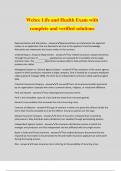
Webce Life and Health Exam with complete and verified solutions Representations and Warranties - answerRepresentations are statements the applicant makes on an application that are deemed to be true to the applicant's best knowledge. Warranties are statements the insurer makes in the contract. Underwriting vs. Actuarial Departments - answerTwo related insurance company functions. Through the process of _________, applications are assessed for insurability and to assign premium rates. The ________ department analyzes data to help estimate future losses and to produce rate tables. Managerial System vs. General Agency System - answerTwo variations of the career agency system in which producers represent a single company. One is headed by a company employee called a general manager (GM), the other by an independent contractor called a general agent (GA). Fraternal Insurance Company - answerA non-profit form of insurance provider sponsored by an organization of people who share a common ethnic, religious, or vocational affiliation. Peril and Hazard - answerTwo related general insurance terms: Peril is the immediate cause of a loss (and the event that is insured against). Hazard is any condition that increases the risk of incurring a loss. Contract of adhesion - answerA type of contract in which one party (the offeror) drafts the terms that must be accepted as-is by the offeree. Insurance policies are this type. Mutual Insurance Company - answerA form of insurance company that is owned by policyowners. May distribute policy dividends (non-taxable) through participating policies. Independent Agency System - answerAn insurance distribution system in which the manager and producers are fully independent and not affiliated with any single insurer. Buyer's Guide and Policy Summary - answerTwo related disclosure documents that are required by most states to be presented to life and health insurance applicants at some point during the buying process. Risk - answerA basic insurance term referring to the possibility of incurring a loss. Law of Large Numbers - answerA mathematical principle that is the basis for predicting the odds of a loss occurring in a certain population in any given year. Social Security (OASDI) - answerA federal insurance program that provides disability, death, and retirement benefits to covered workers and their qualifying beneficiaries. Agents vs. Brokers - answerTwo basic types of insurance producer: an ______ represents a single insurer and a _____ sells policies from multiple insurers. Reinsurance - answerThe process through which insurance companies spread large risks among other insurers. Domestic, Foreign, and Alien Insurers - answerInsurers can be categorized by their state of domicile. There are three categories, known as _____, _____, and _____. Stock Insurance Company - answerA form of insurance company that is owned by stockholders who may or may not also be policyowners. May distribute stock dividends (taxable). Admitted Insurer - answerAn insurer that has a certificate of authority in a given state is said to be an___________ insurer in that state. Express, Implied, and Apparent Authority - answerExpress authority—The right to sign an application as an agent for the insurer. Implied authority—Using a computer program to identify insurance needs and to recommend solutions. Apparent authority—Advising the applicant to not disclose on the application any important health facts that might reduce his or her insurability. Indemnity vs. Valued Contract - answerTwo forms of insurance contract. An indemnity contract bases policy benefits on reimbursement of actual losses. A valued contract bases benefits on a stated amount without regard for the value of the loss. Loss - answerAn unplanned reduction in economic value resulting from the occurrence of a covered peril. Medicare - answerA federal insurance program that provides medical care benefits to covered workers (retirees). Underwriting - answerThe process by which an insurance company assesses an application to determine if it represents an insurable risk. Risk Management - answerThe natural process by which people contend with the perils faced daily, of which there are five common techniques. The five basic elements of a valid contract - answerOffer, acceptance, consideration, competent parties, and legal purpose Concealment - answerThe willful nondisclosure of material facts on an application for the purpose of obtaining insurance. Insurable Risk (5 Criteria) - answerLoss must be definable and measurable. The covered peril must be accidental or outside the insured's control. The risk must be shared by a large group of similar risks. The loss must not be catastrophic. The risk must not be generally excluded from coverage. Needs Approach - answerThe needs approach to determining life insurance needs is based on a detailed review of a person's specific situation. It examines personal and family income, liabilities, and assets, as well as future financial goals, to calculate the right amount of life insurance. Bring-Back Rule - answerIn estate planning, this rule requires life insurance policies transferred from the insured within 3 years before death to be returned to the decedent's estate for valuation purposes. Life Insurance "Living Benefits" - answerLiving benefits are made possible by the policy's cash value, which is always available to the policyowner through policy loans, withdrawals, and partial surrenders. The funds may be used for any purpose. Key Person Life Insurance - answerIf a key employee ends his or her employment, the employer can continue the policy in force. However, many employers choose to: sell the policy to the insured for an amount equal to its cash value surrender the policy or change insureds if allowed by the insurance company and applicable state law Annuity - answerAn insurance contract between a person and an insurer to distribute an accumulated sum of money over a certain period, including the person's lifetime. Annuities come in many forms, but they all have two common purposes: to accumulate money on a tax-deferred basis to distribute the accumulated money as income in a guaranteed amount for a guaranteed period (including the annuitant's life) Decreasing Term Life Insurance - answerThis form of term life features a death benefit that diminishes over time and premium that remains level for the term of the policy. Fully Insured Status (Social Security) - answerTo be considered fully insured, a worker must have 40 quarters of coverage. A fully insured worker is eligible for disability, retirement, and death benefits. Cross-Purchase Buy-Sell Agreement - answerA type of buy-sell agreement in which each owner purchases a life insurance policy on each of the other owners. ERISA - answerThe Employee Retirement Income Security Act of 1974 (ERISA) protects the rights of employees covered under an employer-sponsored plan by stipulating minimum participation, vesting, and funding requirements. Irrevocable Beneficiary - answerThis beneficiary designation cannot be changed by the policyowner without that beneficiary's permission. Guaranteed Insurability Rider - answerThis life policy rider guarantees that additional coverage can be added to a whole life policy even if the insured has become uninsurable. Annuity Beneficiary - answerThe person the annuity owner chooses to receive the annuity contract's values if either the owner or the annuitant dies before annuitization. Whole Life Insurance - answerWhole life insurance features a guaranteed cash value, a fixed guaranteed death benefit, level premiums, and coverage that can remain in effect as long as the insured lives (up to age 120). Its most basic form is called straight (or ordinary) whole life insurance. Buy-Sell Agreement - answerA legal agreement through which two or more owners of a business arrange for the disposition of each owner's share of the business upon death. Expense Charge (Load Factor) - answerThe load factor reflects the costs the insurer expects to incur on the policy. In determining its load factor, an insurer is generally guided by three objectives: to cover total operating costs to provide a safety margin to contribute to profits or surplus Term Life Insurance - answerThis basic form of life insurance provides temporary protection and does not include a cash value while the insured is alive. Insurable Interest - answerThe financial interest a policyowner has in a person or property being insured, justifying the purchase of insura
Written for
- Institution
- WebCE
- Course
- WebCE
Document information
- Uploaded on
- March 2, 2024
- Number of pages
- 46
- Written in
- 2023/2024
- Type
- Exam (elaborations)
- Contains
- Questions & answers
Subjects
-
webce life and health exam with complete and verif

Also available in package deal