

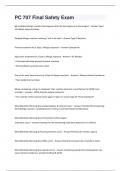
PC 707 Final Safety Exam IgE mediated allergic reaction that happens after the 2nd exposure to the antigen? - Answer -Type I Immediate hypersensitivity Delayed Allergic reaction involving T cell in the skin? - Answer -Type IV Reaction Primary treatment for a Type 1 Allergic response? - Answer -Epinephrine Adjunctive treatment for a Type 1 Allergic response - Answer -‣ H1 Blockers ‣ Corticosteroids help prevent bi phasic reactions ‣ Bronchodilators provide some relief - One of the most Severe forms of a Type IV allergic reactions. - Answer -‣ Stevens Johnson Syndrome ‣ Toxic epidermal necrolysis When considering a drug "re challenge" after reaction what are crucial factors the APRN must consider? - Answer -‣ What drug the patient reacted to ‣ The severity of the reaction (never again in Type I or severe type IV) *most important* What Black Box Warning does Carbamazepine & Lamictal carry? - Answer -Potential life -threatening dermatologic reaction, including Steven's Johnson and Toxic Epidermal Necrolysis What Black Box Warning does Promethazine (Phenergan) antiemetic carry? - Answer -Potential for life threatening respiratory depression in children. What Black Box Warning do Fluoroquinolones carry? - Answer -Potential for tendon rupture What Black Box Warning does SSRIs carry? - Answer -Potential increased risk of suicide in teens. What Black Box Warning does opioids carry? - Answer -Combining opioids & benzodiazepines can cause extreme sleepiness, slowed breathing & death Insulin/Sulfonaureas adverse effect - Answer -Hypoglycemia! Tricyclic Antidepressants - Answer -Very risky for overdose Nitrofurantoin (Macrobid) adverse effect - Answer -Pulmonary Toxicity (rare ) Proton Pump Inhibitors Increases the risks for - Answer -‣ Upon starting: Community acquired pneumonia ‣ Over time more likely to get infections like TB ‣ Over time possible increased potential for fractures Bisphosphonates potential risk - Answer -osteonecrosis of the jaw As we age, our kidneys become smaller & there is a decrease in renal blood flow. Why is this a prescribing consideration? - Answer -Decreased renal clearance of drugs As we age, our liver become smaller, has decreased blood flow & first pass metabolism decreases. Why is this a prescribing consideration? - Answer -Decreased liver size also means decreased production of CYP 450 enzymes! So if you need to select a drug for the elderly, try to select drugs that use Phase 2 metabolism (not affected by age) Phase I is affected & involves the CYPs. AS we age, there is a decrease in total body water by 10 -15%! Why is this a concern when prescribing for the elderly? - Answer -Decrease in total body water results in decreased distribution of water soluble medications & causes increased serum levels of drugs. Why are the elderly at higher risk of Torsades de Points? - Answer -Elderly tend to be on more drugs, so more of a chance to have multiple QT prolongation drugs. Additional risk of TdP with low potassium, *low magnesium* & bradycardia - more common in the elderly. Afib more likely
Preview 2 out of 9 pages
Exam (elaborations)
PC 707 Final Safety Exam Questions With Correct Answers Solved 100%!!
Preview 2 out of 9 pages
IgE mediated allergic reaction that happens after the 2nd exposure to the antigen? - Answer-Type I Immediate hypersensitivity Delayed Allergic reaction involving T cell in the skin? - Answer-Type IV Reaction Primary treatment for a Type 1 Allergic response? - Answer-Epinephrine Adjunctive treatment for a Type 1 Allergic response - Answer-‣ H1 Blockers ‣ Corticosteroids help prevent bi phasic reactions ‣ Bronchodilators provide some reliefOne of the most Severe forms of a Type IV allergic reactions. - Answer-‣ Stevens Johnson Syndrome ‣ Toxic epidermal necrolysis When considering a drug "re challenge" after reaction what are crucial factors the APRN must consider? - Answer-‣ What drug the patient reacted to ‣ The severity of the reaction (never again in Type I or severe type IV) *most important* What Black Box Warning does Carbamazepine & Lamictal carry? - Answer-Potential life-threatening dermatologic reaction, including Steven's Johnson and Toxic Epidermal Necrolysis What Black Box Warning does Promethazine (Phenergan) antiemetic carry? - Answer-Potential for life threatening respiratory depression in children. What Black Box Warning do Fluoroquinolones carry? - Answer-Potential for tendon rupture What Black Box Warning does SSRIs carry? - Answer-Potential increased risk of suicide in teens. What Black Box Warning does opioids carry? - Answer-Combining opioids & benzodiazepines can cause extreme sleepiness, slowed breathing & deathInsulin/Sulfonaureas adverse effect - Answer-Hypoglycemia! Tricyclic Antidepressants - Answer-Very risky for overdose Nitrofurantoin (Macrobid) adverse effect - Answer-Pulmonary Toxicity (rare ) Proton Pump Inhibitors Increases the risks for - Answer-‣ Upon starting: Community acquired pneumonia ‣ Over time more likely to get infections like TB ‣ Over time possible increased potential for fractures Bisphosphonates potential risk - Answer-osteonecrosis of the jaw As we age, our kidneys become smaller & there is a decrease in renal blood flow. Why is this a prescribing consideration? - Answer-Decreased renal clearance of drugs As we age, our liver become smaller, has decreased blood flow & first pass metabolism decreases. Why is this a prescribing consideration? - Answer-Decreased liver size also means decreased production of CYP 450 enzymes! So if you need to select a drug for the elderly, try to select drugs that use Phase 2 metabolism (not affected by age) Phase I is affected & involves the CYPs. AS we age, there is a decrease in total body water by 10-15%! Why is this a concern when prescribing for the elderly? - Answer-Decrease in total body water results in decreased distribution of water soluble medications & causes increased serum levels of drugs. Why are the elderly at higher risk of Torsades de Points? - Answer-Elderly tend to be on more drugs, so more of a chance to have multiple QT prolongation drugs. Additional risk of TdP with low potassium, *low magnesium* & bradycardia- more common in the elderly. Afib more likelyWhat are the concerns with anticholinergic drugs & the elderly? - Answer-In the elderly Anticholinergic drugs can cause: ‣ Memory impairment, ‣ confusion, ‣ falls, ‣ hallucinations, ‣ tachycardia & ‣ acute angle glaucoma
Content preview
Document information
- Uploaded on
- March 1, 2024
- Number of pages
- 9
- Written in
- 2023/2024
- Type
- Exam (elaborations)
- Contains
- Questions & answers
$8.49
Wrong document? Swap it for free
Within 14 days of purchase and before downloading, you can choose a different document. You can simply spend the amount again.
Written by students who passed
Immediately available after payment
Read online or as PDF

Reputation scores are based on the amount of documents a seller has sold for a fee and the reviews they have received for those documents. There are three levels: Bronze, Silver and Gold. The better the reputation, the more your can rely on the quality of the sellers work.
Available in package deal
Package deal
PC 707 Bundled Exams 2024 with complete solutions

