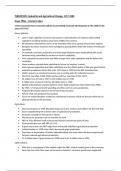
THEMETWO: Industrial and Agricultural Change, 1917-1985
Essay Titles – Essays to plan
1.How successful were economic policies in promoting economic development in the USSR in the
years 1917-41?
Heavy industry:
Lenin’s state capitalist economy was based on nationalisation of industry which ended
capitalism by taking industry away from middle-class owners.
All industries nationalised, were run by Vesenkha who were a group of economic experts:
Designed to ensure factories were managed by placing them under the control of well-paid
specialists.
Co-ordinate economic production and only large industries were nationalised with small
factories being controlled by workers or back to capitalists.
Very unpopular because there was little change from state capitalism and life before the
revolution.
Many workers rejected state capitalism in favour for workers’ control.
Lenin ignored opposition and state capitalism was the official policy of the new government.
Industrial production fell to 20% of its 1913 level in 1923 but the NEP remedied this.
Stalin’s move to a command economy was a turning point for industrial success.
First Five-Year Plan (1928-1932) and Second Five-Year Plan (1933-1937).
35 million tons of coal in 1927 to 160 million tons in 1940.
4 million tons of steel in 1927 to 18 million tons in 1940.
Quickly industrialised country and lives under Stalin would have been better than Hitler.
By 1940, 1/3 of government spending priorities were on arms production.
Prepared the Soviet Union for the threat of Nazi invasion.
40% of what was produced was wasted.
Focus on industrialisation created an unbalanced economy which set the precedent for an
ultimate decline in the economy.
Agriculture:
War Communism in 1918 allocated resources to the workers and soldiers for the Civil War.
Grain requisitioning led to lower rates of agricultural production.
Peasants not paid for their grain or labour.
Therefore the peasants had no incentive to work.
NEP of 1921 allowed small scale private industry and private plots of land.
Grain production was still 48% of 1913.
If given more time, the NEP might have eventually stabilised agricultural production.
Collectivisation in 1928 under Stalin decreased grain production.
Execution or deportation of kulaks (dekulakisation) who were often the most experienced
farmers reduced agricultural production.
73.3 million tons of grain harvest in 1928 went to 67.6 million tons in 1934.
Light industry:
With the re-emergence of the market under the NEP, a black market grew in the economy.
Since the Five-Year Plans were so focused on industry, consumer goods were neglected.
Essay Titles – Essays to plan
1.How successful were economic policies in promoting economic development in the USSR in the
years 1917-41?
Heavy industry:
Lenin’s state capitalist economy was based on nationalisation of industry which ended
capitalism by taking industry away from middle-class owners.
All industries nationalised, were run by Vesenkha who were a group of economic experts:
Designed to ensure factories were managed by placing them under the control of well-paid
specialists.
Co-ordinate economic production and only large industries were nationalised with small
factories being controlled by workers or back to capitalists.
Very unpopular because there was little change from state capitalism and life before the
revolution.
Many workers rejected state capitalism in favour for workers’ control.
Lenin ignored opposition and state capitalism was the official policy of the new government.
Industrial production fell to 20% of its 1913 level in 1923 but the NEP remedied this.
Stalin’s move to a command economy was a turning point for industrial success.
First Five-Year Plan (1928-1932) and Second Five-Year Plan (1933-1937).
35 million tons of coal in 1927 to 160 million tons in 1940.
4 million tons of steel in 1927 to 18 million tons in 1940.
Quickly industrialised country and lives under Stalin would have been better than Hitler.
By 1940, 1/3 of government spending priorities were on arms production.
Prepared the Soviet Union for the threat of Nazi invasion.
40% of what was produced was wasted.
Focus on industrialisation created an unbalanced economy which set the precedent for an
ultimate decline in the economy.
Agriculture:
War Communism in 1918 allocated resources to the workers and soldiers for the Civil War.
Grain requisitioning led to lower rates of agricultural production.
Peasants not paid for their grain or labour.
Therefore the peasants had no incentive to work.
NEP of 1921 allowed small scale private industry and private plots of land.
Grain production was still 48% of 1913.
If given more time, the NEP might have eventually stabilised agricultural production.
Collectivisation in 1928 under Stalin decreased grain production.
Execution or deportation of kulaks (dekulakisation) who were often the most experienced
farmers reduced agricultural production.
73.3 million tons of grain harvest in 1928 went to 67.6 million tons in 1934.
Light industry:
With the re-emergence of the market under the NEP, a black market grew in the economy.
Since the Five-Year Plans were so focused on industry, consumer goods were neglected.