Chapter 0 – Actuarial Control Cycle (ACC)
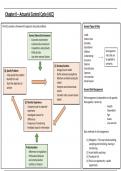
The ACC provides a framework to approach actuarial problems. General Types of Risks
General External Environment Credit
- Economic environment Interest rate
- Commercial environment Mortality
- Competitors and products Operational
- Political state Inflation Some general
- Any other external factors Underwriting risks that can
Insurance be applied to
External scenarios.
(2) Develop Solution
- Design/source model Diversification
(3) Specify Problem
- Define relevant assumptions Expenses
- Fully specify the problem
- Mention sensitivity testing for Anti-selection
- Identify the risks
model Moral Hazard
- State the objectives to
achieve - Interpret and communicate
results General Risk Management
- Consider other scenario based
details Risk management is dependent on risk appetite.
(1) Monitor Experience Risk appetite is driven by:
- Compare actual vs expected - Wealth
experience - Dependents
- Investigate reasons for - Age
differences - Assets
- Frequency of monitoring - Loss aversion
- Feedback loops for information -
Basic methods of risk management:
(1) Mitigation – This may include avoiding,
accepting and minimizing, sharing or
Professionalism transferring.
- Adherence to regulations (2) Asset-liability matching
- Professional behavior (3) Pooling of risk
and communication (4) Risk as an opportunity – upside
- Conflicts of interest opportunity
The ACC provides a framework to approach actuarial problems. General Types of Risks
General External Environment Credit
- Economic environment Interest rate
- Commercial environment Mortality
- Competitors and products Operational
- Political state Inflation Some general
- Any other external factors Underwriting risks that can
Insurance be applied to
External scenarios.
(2) Develop Solution
- Design/source model Diversification
(3) Specify Problem
- Define relevant assumptions Expenses
- Fully specify the problem
- Mention sensitivity testing for Anti-selection
- Identify the risks
model Moral Hazard
- State the objectives to
achieve - Interpret and communicate
results General Risk Management
- Consider other scenario based
details Risk management is dependent on risk appetite.
(1) Monitor Experience Risk appetite is driven by:
- Compare actual vs expected - Wealth
experience - Dependents
- Investigate reasons for - Age
differences - Assets
- Frequency of monitoring - Loss aversion
- Feedback loops for information -
Basic methods of risk management:
(1) Mitigation – This may include avoiding,
accepting and minimizing, sharing or
Professionalism transferring.
- Adherence to regulations (2) Asset-liability matching
- Professional behavior (3) Pooling of risk
and communication (4) Risk as an opportunity – upside
- Conflicts of interest opportunity