Rivier University Division of Nursing and Health Professions Undergraduate Nursing Education
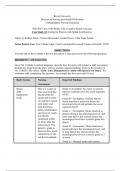
Rivier University Division of Nursing and Health Professions Undergraduate Nursing Education NSG 456 Care of the Patient with Complex Health Concerns Case Study #3: Caring for Patients with Spinal Cord Injuries Name: (s) Kaitlyn Sarno, Chelsea Shoemaker, Jordan Parece, Chad Saint-Amant Neehr Perfect Case: Tim Collado, DIRECTIONS Visit the link to Tim Collado’s. Review the patient’s chart and answer the following questions. Question #1: (40 Points total) Given Mr. Collado’s medical diagnosis, describe how the nurse will conduct a shift assessment. Include any of the tools the nurse will use and the expected findings. Refer to the resource in Mr. Collado’s file called, “Early Acute Management in Adults with Spinal Cord Injury” for assistance with completing this question. An example has been provided for you. Body System Nursing Assessment Expected Findings Neuro – This is a system of Grade A=Complete: No motor or sensory function is preserved in the sacral segments S4-S5. Grade B = Incomplete: Sensory but not motor function is preserved below the neurological level and includes the sacral segments S4-S5. Grade C = Incomplete: Motor function is preserved below the neurological level, and more than half of key muscles below the neurological level have a muscle grade less than 3. Grade D = Incomplete: Motor function is preserved below the neurological level, and at least half of key muscles below the neurological level have a muscle grade of 3 or more. Grade E = Normal: motor and sensory AISI tests used to define Impairment and describe the Scale extent and severity of a patient’s spinal cord injury and help determine future rehabilitation and recovery needs. It is ideally completed within 72 hours after the initial injury. The patient’s grade is based on how much sensation he or she can feel at multiple points on the body, as well as tests of motor function. Based on Mr. Collado’s findings, the result of this test is a Grade C. function are normal Body System Nursing Assessment Expected Findings Respiratory Lung sounds, breathing pattern, respirations, oxygen saturation. Clear lung sounds, no usage of accessory muscles, regular rate and rhythm of respirations. Labs: arterial blood gases (ABGs) , pulse oximetry GI Monitor for ileus High risk of paralytic ileus, ulcer, and constipation; pancreatitis, and distension. However, it is hypoactive BS; expected that the client will retain normal GI abdominal functioning, as evidenced by regular bowel distension; N/V movements, normal bowel sounds, and absence of abdominal distension. GU Assess bladder for No retention of urine as evidenced by output distention; 30 mL/hour; non-cloudy or odorous urine; retention; cloudy, no s/s of infection; no discomfort or pain. If odorous urine, and the patient were to experience bladder use a bladder scan retention or distension, urine output would to see if patient is be less than 30mL/hour. retaining urine. Patients labs show an elevated BUN and Labs: Urinalysis, BUN, creatinine, BNP. basic metabolic panel. creatinine, which means the patient’s urine is concentrated and he may have fluid loss. Muskuloskeletal Mobility (PROM) Impaired mobility; paraplegia; will be on strict bed rest. Integumentary Braden Scale; skin color and turgor; diet, evaluate for perforations on skin, bruising, signs of internal bleeding. Labs: CBC Skin may become compromised after prolonged bed rest. Patient also not able be able to feel lower body injuries that may be internal bleeding, so the nurse should inspect this. It is expected that this patient does not have any complications. As long as the patient is properly hydrated, skin turgor will be regular with no tenting. Also, if the patient is well perfused, skin color will be normal for ethnicity Braden Score: 12; High risk for pressure ulcers Sensory Perception score of 3: Has some sensory impairment which limits ability to feel pain or discomfort in 1 or 2 extremities. Moisture score of 3: Skin is occasionally moist, requiring an extra linen change approximately once a day. Activity score of 1: Confined to bed Mobility score of 1: Completely immobile Nutrition score of 3: Adequate Friction and shear score of 1: Requires moderate to maximum assistance in moving. Complete lifting without sliding against sheets is impossible.
Document information
- Uploaded on
- February 28, 2024
- Number of pages
- 10
- Written in
- 2023/2024
- Type
- Exam (elaborations)
- Contains
- Questions & answers