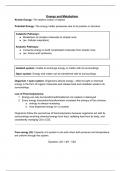
Energy and Metabolism
Kinetic Energy: The relative motion of objects
Potential Energy: The energy matter possesses due to its position or structure
Catabolic Pathways:
● Breakdown of complex molecules to simpler ones
● (ex. Cellular respiration)
Anabolic Pathways:
● Consume energy to build complicated molecules from simpler ones
● (ex. Amino acid synthesis)
Isolated system: Unable to exchange energy or matter with its surroundings
Open system: Energy and matter can be transferred with its surroundings.
Organism = open system: Organisms absorb energy-- either by light or chemical
energy in the form of organic molecules and release heat and metabolic waste to its
surroundings.
Law of Thermodynamics:
1. Energy can only be transformed/transferred not created or destroyed
2. Every energy transaction/transformation increases the entropy of the universe.
a. entropy is always increasing
b. How dispersed energy is in a system
Organisms follow the second law of thermodynamics because organisms act with its
surroundings receiving chemical energy from food, radiating heat from its body, and
consistently changing O2 to CO2.
Free energy (G): Capacity of a system to do work when both pressure and temperature
are uniform through the system.
Equation: ΔG = ΔH - TΔS
, ΔG - Change in free energy
ΔH - Change in enthalpy
ΔS - Change in entropy
T - Absolute temperature (K)
Spontaneous: Process is capable of moving in a given direction without needing to be
driven by an outside force.
G (-) = spontaneous
G (+) = nonspontaneous
G (0) = equilibrium/ nonspontaneous
Process is spontaneous ONLY when moving towards equilibrium
Exergonic: Proceeds with net release of free energy/ reaction looses free energy
● G is negative
● Spontaneous
● Less energy required to break bonds than what is released when new ones
form
Endergonic: Absorbs free energy from surroundings/ reaction gains free energy
● G is positive
● Nonspontaneous
● Moves away from equilibrium
● Stores free energy in molecules
● Requires more energy than what is released with new formed bonds
Free energy is made available during a reaction (during reaction there is normally a
release of energy)
Cellular work:
● Chemical - Pushes endergonic reactions that would not occur spontaneously
(ex. Synthesis of polymers from monomers)
● Transport - Pumping substances across membrane against direction of
spontaneous movement
● Mechanical - Contraction of muscle cells and movement of chromosomes during
cellular reproduction (ex. beating of cilia)
Energy coupling: The use of energy formed from an exergonic process to drive an
endergonic one
Kinetic Energy: The relative motion of objects
Potential Energy: The energy matter possesses due to its position or structure
Catabolic Pathways:
● Breakdown of complex molecules to simpler ones
● (ex. Cellular respiration)
Anabolic Pathways:
● Consume energy to build complicated molecules from simpler ones
● (ex. Amino acid synthesis)
Isolated system: Unable to exchange energy or matter with its surroundings
Open system: Energy and matter can be transferred with its surroundings.
Organism = open system: Organisms absorb energy-- either by light or chemical
energy in the form of organic molecules and release heat and metabolic waste to its
surroundings.
Law of Thermodynamics:
1. Energy can only be transformed/transferred not created or destroyed
2. Every energy transaction/transformation increases the entropy of the universe.
a. entropy is always increasing
b. How dispersed energy is in a system
Organisms follow the second law of thermodynamics because organisms act with its
surroundings receiving chemical energy from food, radiating heat from its body, and
consistently changing O2 to CO2.
Free energy (G): Capacity of a system to do work when both pressure and temperature
are uniform through the system.
Equation: ΔG = ΔH - TΔS
, ΔG - Change in free energy
ΔH - Change in enthalpy
ΔS - Change in entropy
T - Absolute temperature (K)
Spontaneous: Process is capable of moving in a given direction without needing to be
driven by an outside force.
G (-) = spontaneous
G (+) = nonspontaneous
G (0) = equilibrium/ nonspontaneous
Process is spontaneous ONLY when moving towards equilibrium
Exergonic: Proceeds with net release of free energy/ reaction looses free energy
● G is negative
● Spontaneous
● Less energy required to break bonds than what is released when new ones
form
Endergonic: Absorbs free energy from surroundings/ reaction gains free energy
● G is positive
● Nonspontaneous
● Moves away from equilibrium
● Stores free energy in molecules
● Requires more energy than what is released with new formed bonds
Free energy is made available during a reaction (during reaction there is normally a
release of energy)
Cellular work:
● Chemical - Pushes endergonic reactions that would not occur spontaneously
(ex. Synthesis of polymers from monomers)
● Transport - Pumping substances across membrane against direction of
spontaneous movement
● Mechanical - Contraction of muscle cells and movement of chromosomes during
cellular reproduction (ex. beating of cilia)
Energy coupling: The use of energy formed from an exergonic process to drive an
endergonic one