Biology 1010 - Exam 1 Chapters 1-4 2024 study guide fully solved & verified for accuracy.
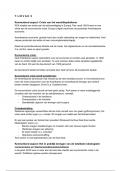
The three domains Bacteria, Archaea, Eukarya Negative feedback versus positive feedback Feedback regulation is when the output or product of a process regulates that very process. An example of negative feedback is sweating, insulin producing cells. An example of positive feedback is blood clotting. Natural selection Requires genetic information, dissent with modification, and differential reproductive success Darwins mechanism for descent with modification Individuals that are best suited for their environment will survive in that environment Model organisms Well studied, easy to grow, results are widely accepted Adaptive radiation the diversification of a group of organisms into forms filling different ecological niches. An example of this would be the finches from the Galápagos Islands. Taxonomy The science of classifying organisms. Domain, kingdom, phylum, class, order, family, genus, species Qualities of a good scientific hypothesis Testable and falsifiable Experimental design Includes a large sample size, includes a control, and alters only one condition between groups Four elements that make up approximately 96% of living matter Carbon, hydrogen, oxygen, and nitrogen Atomic mass The number of protons and neutrons, can be approximated by the mass number Isotopes Atoms of an element with the same number of protons but different number of neutrons, and example of this would be carbon 12 and carbon 13 Atomic number The number of protons in and atom, an example problem would be the atomic number is eight, how do you get a complete valence electron shell? Add to electrons Trace elements Required by an organism in only minute quantities Polar versus nonpolar covalent bonds Nonpolar bonds are when two atoms share electrons equally. Polar bonds are when two atoms do not share electrons equally. Covalent bonds versus ionic bonds Ionic bonds have attractions between anions and cations while covalent bonds have sharing of electrons Hydrogen bonds Form when a hydrogen atom forms a covalent bond with another atom; Example is water forming bonds with other elements Single versus double covalent bonds Single covalent bonds are one pair of electrons while double covalent bonds are two pairs of electrons Atom stability An atom is the most stable when all of its electron rings are filled Molecular versus structural formula Structural formula is H - H, molecular formula is H2 Chemical equilibrium reached when the forward and reverse reaction rates are equal Four properties of water Cohesion of water molecules, water moderates temperature on earth surface, ice floats on water, water is the solvent for life Surface tension The measure of how hard it is to break the surface of a liquid; an example of this would be a spider walking on the surface of a pond Kinetic energy Energy of motion; and example of this would be an ice cube cooling a drink, the kinetic energy of the ice slows Hydrophobic versus hydrophilic Hydrophobic is water fearing while hydrophilic is water loving pH scale Numbers increase by tenfold, and example question would be to rent from low to high blood, stomach acid, and urine. The lowest would be stomach acid, the middle would be urine, and the highest would be blood. Which of the following solution to require the most base to bring it to neutral? The lowest one Buffers Substances that maintain a constant pH, minimize changes in concentration Mole Gram molecular weight of a substance, a mole of one substance in a mole of another substance have the same number of molecules Solution versus solvent versus solute Solution is two or more components, solvent does the dissolving, and solute is the substance being dissolved Element present in all organic molecules Carbon; Complexity and variety of molecules, form a polar and nonpolar bonds Stanley Miller His experiment support of that organic compounds synthesize abiotically Structural isomers versus cis-trans isomers versus enantiomers Structural isomers have different covalent arrangements of their atoms; cis-trans isomers have the same covalent bonds but different special arrangements; enantiomers are isomers that are mirror images of each other
Written for
- Institution
- Biology 1010
- Course
- Biology 1010
Document information
- Uploaded on
- February 27, 2024
- Number of pages
- 4
- Written in
- 2023/2024
- Type
- Exam (elaborations)
- Contains
- Questions & answers
Subjects
-
biology 1010 exam 1 chapters 1 4 2024 study

Also available in package deal