Maternal Newborn ATI CAPSTONE Questions and Answers Latest 2024/2025 (100% Verified)
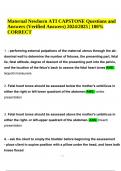
Maternal Newborn ATI CAPSTONE Questions and Answers Latest 2024/2025 (100% Verified) Fetal heart tones should be assessed above the mother's umbilicus in either the right- or left-upper quadrant of the abdomen. ANS: breech presentation 4. - ask the client to empty the bladder before beginning the assessment - place client in supine position with a pillow under the head, and have both knees flexed Maternal Newborn ATI CAPSTONE Questions and Answers (Verified Answers) 2024/2025 | 100% CORRECT 2 / 15 - place a small , rolled towel under the client's right or left hip to displace the uterus off the major blood vessels to prevent supine hypotensive syndromeANS: considerations 5. - every 30-60 minutes ANS: intermittently auscultate during the latent phase 6. - every 15-30 minutes ANS: intermittently auscultate during the active phase 7. - every 5-15 minutes ANS: intermittently auscultate during the second stage 8. - determine active labor - rupture of membranes spontaneously or artificially - preceding and subsequent to ambulation - prior to following administration of or a change in medication analgesia - at peak action of anesthesia - following vaginal examination - following expulsion of an enema - after urinary catheterization - abnormal or excessive uterine contractions ANS: indications for leopold maneu- vers 9. 110-160 w/ increases and decreases from baseline ANS: normal FHR 3 / 15 10. - accomplished by securing an ultrasound transducer over the clients abdomen, which records the FHR pattern and a tocotransducer on the fundus that records the uterine contraindications ANS: continuous electronic fetal monitoring 11. - multiple gestations - oxytocin infusion - placenta previa 4 / 15 - fetal bradycardia - maternal complications - intrauterine growth restriction - post-date gestation - active labor - meconium stained amniotic fluid - abruptio placentae - abnormal nonstress test or contraction stress test - abnormal uterine contractions - fetal distress ANS: indications for electronic fetal monitoring 12. - fetal monitoring system with FHR interpretation system ANS: Three Tier Sys- tem 13. - baseline FHR of 110-160 /min - baseline FHR variability ANS: moderate - accelerations present or absent - early decelerations ANS: present or absent - variable/late decelerations ANS: absent ANS: - category 1 14. - tracings include all FHR tracings not categorized as category 1 or 3. - baseline rate (tachycardia, bradycardia not accompanied by absent baseline variability) - baseline FHR variability (minimal baseline variability, absent baseline variability not accompanied by recurrent decelerations, marked baseline variability) 5 / 15 - episodic or periodic decelerations ( prolonged FHR decel equal or greater than 2 min but less than 10 min, recurrent late decelerations w/ moderate baseline variability, recurrent variable decels w/ minimal or moderate baseline variability - variable decels w/ additional characteristics including overshoots, shoulders, or slow return to baseline FHR ANS: Category 2 15. - FHR tracings include either sinusoidal pattern, absent baseline FHR variability (recurrent late/variable decels, bradycardia) - increment, acme, decrement ANS: category 3 16. - beginning of the contraction as intensity is increasing ANS: increment uterine contractions 17. - peak intensity of the contraction ANS: adme uterine contractions 18. - the decline of the contraction intensity as contraction is ending ANS: - decre- ment uterine contractions 6 / 15 19. - Variable transitory increase in the FHR above baseline ANS: accelerations 20. - healthy fetal/placental exchange - vaginal exam - fundal pressure - intact CNS response to fetal movement - uterine contractions - fetal scalp stimulation ANS: causes of accelerations 21. - be reassuring - no interventions required - indicate reactive nonstress test ANS: nursing interventions for accelerations 22. - FHR less than 110/min for 10 min or more ANS: fetal bradycardia 23. - uteroplacental insufficiency - umbilical cord prolapse - materanl hypotension - prolonged umbilical cord compression - anesthetic medications - fetal congenital heart block - viral infections - maternal hypoglycemia - fetal heart failure EMAIL ME: For help with report, Assignment, Essay and thesis writing 7 / 15 - maternal hypothermia ANS: causes of fetal bradycardia 24. - discontinue oxytocin if being administered - assist the client to a side-lying position - administer oxygen by mask at 10 L/min via non-rebreather face mask - insert IV catheter if one is not in place and administer maintenance IV fluids - administer tocolytics - notify HCP ANS: nursing interventions for fetal bradycardia 25. - FHR greater than 160/min for 10 minutes or more ANS: Fetal tachycardia 26. - maternal infection - fetal anemia - fetal cardiac dysrhythmias - maternal use of cocaine or meth - maternal dehydration - maternal or fetal infection - maternal hyperthyroidism ANS: causes of fetal tachycardia
Written for
- Institution
- Maternal Newborn ATI CAPSTONE
- Course
- Maternal Newborn ATI CAPSTONE
Document information
- Uploaded on
- February 27, 2024
- Number of pages
- 33
- Written in
- 2023/2024
- Type
- Exam (elaborations)
- Contains
- Questions & answers
Subjects
- maternal newborn
- ati capstone
- latest updated 2024
- 2025
-
maternal newborn ati capstone
-
maternal newborn ati capstone questions and answer
-
verified and graded answers

Also available in package deal