Surgery NBME Form 4 - Questions and Answers
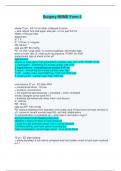
Surgery NBME Form 4 - Questions and Answers obese 72 yo - ED 15 min after collapsed at home > wife reports he's had upper abd pain, n/v for past 24 hrs PMHx: HTN and CAD diaphoretic 97.7 F P: 115/min, irr irregular RR: 22/min palp sys BP: 80 mmHg PE: no JVD; lungs clear; no murmurs/gallops; abd tender/rigid pulm art cath: dec CI, mean pulm art pressure, PCWP; inc SVR predominant type of shock in this pt? hypovolemic shocks vs swan-ganz Cath parameters (cardiac index (CI), CVP, PCWP, SVR) 1. cardiogenic - everything inc except cardiac index low 2. hypovolemic - everything low except SVR inc 3. septic - everything low except cardiac index high 4. PE - cardiac index and PCWP low; CVP and SVR high 5. anaphylactic - cardiac index high; SVR low unconscious 27 yo - ED after MVA > unrestrained driver - hit tree > at scene: unconscious > not breathing spontaneously > intubated + mech ventilated arrival: Glasgow coma score 9/15 > breathes spontaneously when mech vent discont P: 124/min RR: 16/min palp sys BP: 100 mmHg PE: copious bleeding from laceration over scalp; pool of blood around head; obvious fx of L.humerus; breath sounds heard BL; soft abd; stable pelvis IV administration of crystalloid sln + what else is next step in mgnt? direct pressure to the bleeding laceration bleeding is best controlled w/ local pressure > push/occlude lacerated vessel until it can be repaired in military setting, your best option is tourniquets major complication: hemorrhagic shock - tx w/ whole blood 72 yo - ED after fainting > eating breakfast 5 min before collapsed and had sudden onset of back pain localized to L1 > no hx of back pain or other symptoms P: 140/min RR: 30/min BP: 85/40 mmHg PE: breath sounds normal; peripheral pulses palp; abd - mod distention and tenderness to deep palp most likely dx? ruptured abdominal aortic aneurysm AAA > usually asymptomatic - pulsatile abd mass > older men > size (key to mgnt) - watch out for rupture ~ <4 cm - safely observed ~ >5-6 cm - elective repair bc chance of rupture very high ~ aneurysms that grow > 1 cm/yr - elective repair * 70% of them - perc inserted vasc stents tender AAA - going to ruptured w/in 1-2 days > immediate repair excruciating back pain in large AAA - aneurysm already leaking > retroperitoneal hematoma already forming > blowout into peritoneal cavity - min-hrs away > tx: emergency surg 67 yo - severe head injury 2 wks ago required mech vent serial CXR: consistent w/ ARDS cx of bronchial washings: numerous organisms > broad-spectrum AB current CXR: cavitary lesion in RUL in lung most likely dx? lung abscess intubation - high risk of aspiration and subsequent abscess formation X-rays: no lesion > cavitary lesion numerous organisms + new cavitary lesion (supine dep - RUL) + recent AB broad spectrum > abscess 52 yo - ED due to 2 days of abd cramps/vomiting > not passed stool/flatus PMHx: abd hysterectomy (10 yrs ago) 99.8 F P: 110/min BP: 140/70 mmHg PE: lungs clear; abd - distention and mild tenderness but no peritoneal signs, bowel sounds active and in rushes CBC: Hct, WBC - WNL CMP: inc BUN, glucose, Cr most likely dx? complete small-bowel obstruction reason for obstruction = adhesions hyperactive bowel sounds can be heard in the beginning of SBO > bowels are trying to move stuff ~ becomes hypoactive when SBO wins 12 yo - ED 30 min after falling off second-floor balcony P: 105/min RR: 22/min BP: 105/77 mmHg PE: chest clear; abd soft/nontender CXR: gucci next step in dx? X-ray of the cervical spine manage ABCDs - airway, breathing, circulation, disability > neck/neuro fxns assessed 37 yo - ED immediately after hubby found her lying in bed in deep stupid > no hx of seizure disorder; no meds 99.5 F P: 54/min BP: 180/100 mmHg PE: dense L.hemiparesis and early decerebrate posturing; no evidence of trauma most likely dx? ruptured intracerebral aneurysm decerebrate posture = abnormal body posture that involves the arms and legs being held straight out, the toes being pointed downward, and the head and neck being arched backward > muscles are tightened and held rigidly > suggests severe damage to the brain > more serious than decorticate posturing ~ sign of damage to the nerve pathway bet the brain and spinal cord Cushing reflex = HTN, bradycardia, resp dep > physiological nervous system response to inc ICP meningioma: > presentation depends on location > can be related to cranial neuropathy > incidence inc w/ age > imaging; dural tail > tx: surgery; radiation for unresectable ones
Written for
- Institution
- Surgery NBME
- Course
- Surgery NBME
Document information
- Uploaded on
- February 27, 2024
- Number of pages
- 22
- Written in
- 2023/2024
- Type
- Exam (elaborations)
- Contains
- Questions & answers
Subjects

Also available in package deal