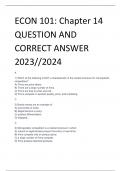
ECON 101: Chapter 14 QUESTION AND CORRECT ANSWER 2023//2024
ECON 101: Chapter 14 QUESTION AND CORRECT ANSWER 2023//2024 A 1) Which of the following is NOT a characteristic of the market structure for monopolistic competition? A) Firms are price takers. B) There are a large number of firms. C) Firms are free to enter and exit. D) Firms compete on product quality, price, and marketing. C 2) Brand names are an example of A) economies of scale. B) illegal barriers to entry. C) product differentiation. D) oligopoly. C 3) Monopolistic competition is a market structure in which A) natural or legal barriers prevent the entry of new firms. B) firms compete only on product price. C) a large number of firms compete. D) firms produce identical products. C 4) All of the following characteristics apply to monopolistic competition EXCEPT A) firms compete on product quality, price, and marketing. B) there are no barriers to enter or exit the industry. C) each firm produces the same identical product. D) a large number of firms compete. D 5) In monopolistic competition, each firm supplies a ________ part of the total market output and its actions ________ the actions of the other firms. A) small; directly affect B) large; directly affect C) large; do not directly affect D) small; do not directly affect A 6) A monopolistically competitive firm is like a monopoly firm insofar as A) both have MR curves that lie below their demand curves. B) neither is protected by high barriers to entry. C) both earn an economic profit in the long run. D) both face perfectly elastic demand. C 7) When comparing perfect competition and monopolistic competition, we find that A) firms in monopolistic competition face barriers to entry, unlike firms in perfect competition. B) firms in monopolistic competition produce identical products just as do firms in perfect competition. C) advertising plays a large role in monopolistic competition, unlike in perfect competition. D) firms in monopolistic competition are price takers just as is the case for firms in perfect competition. C 8) Which of the following is NOT true of monopolistic competition? A) There are a large number of firms. B) Firms can compete on price and quality. C) Firms produce a good that is a perfect substitute for their competitors' goods. D) There is free entry and exit. A 9) One difference between perfect competition and monopolistic competition is that A) firms in monopolistic competition face a downward-sloping demand curve. B) monopolistic competition has barriers to entry. C) a perfectly competitive industry has fewer firms. D) in perfect competition, firms produce slightly differentiated products. B 10) Brand name drugs are chemically identical to their generic counterparts. Yet, consumers often prefer the brand name product to the generic product. Making consumers think that a brand name drug differs from its generic counterpart is an example of A) perfect competition. B) product differentiation. C) oligopolistic behavior. D) price taking behavior. B 11) The best example of a g
Written for
- Institution
- ECON
- Course
- ECON
Document information
- Uploaded on
- February 26, 2024
- Number of pages
- 13
- Written in
- 2023/2024
- Type
- Exam (elaborations)
- Contains
- Questions & answers
Subjects
-
econ 101 chapter 14 question and correct answer
-
econ 101 chapter 14 question and correct answe

Also available in package deal