Psychology 101 People Latest 2024 Rated A
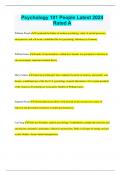
Psychology 101 People Latest 2024 Rated A Wilhelm Wundt Considered the Father of modern psychology; study of mental processes, introspection, and self-exam; established the first psychology laboratory in Germany William James founder of functionalism; studied how humans use perception to function in our environment; important emotion theory Mary Calkins American psychologist who conducted research on memory, personality, and dreams; established one of the first U.S. psychology research laboratories; first woman president of the American Psychological Association. Student of William James. Sigmund Freud Austrian physician whose work focused on the unconscious causes of behavior and personality formation; founded psychoanalysis. Carl Jung Field: neo-Freudian, analytic psychology; Contributions: people had conscious and unconscious awareness; archetypes; collective unconscious; libido is all types of energy, not just sexual; Studies: dream studies/interpretation Abraham Maslow ; Field: humanism; Contributions: hierarchy of needs-needs at a lower level dominate an individual's motivation as long as they are unsatisfied, self-actualization, transcendence Carl Rogers ; Field: humanistic; Contributions: founded person-centered therapy, theory that emphasizes the unique quality of humans especially their freedom and potential for personal growth, unconditional positive regard, fully functioning person Albert Ellis ; Field: cognitive-behavioral; Contributions: Rational-Emotive Therapy (RET), focuses on altering client's patterns of irrational thinking to reduce maladaptive behavior and emotions Charles Darwin Biologist who developed the theory of evolution of species; argued that all living forms evolved through the successful ability to adapt in a struggle for survival. Ivan Pavlov a Russian researcher in the early 1900s who was the first research into learned behavior (conditioning) who discovered classical conditioning John Watson behaviorism; emphasis on external behaviors of people and their reactions on a given situation; famous for Little Albert study in which baby was taught to fear a white rat John Garcia Researched taste aversion. Showed that when rats ate a novel substance before being nauseated by a drug or radiation, they developed a conditioned taste aversion for the substance. Proves that taste aversions can be conditioned. B.F. Skinner pioneer of operant conditioning: everything we do is determined by our past history of rewards and punishments. Used operant conditioning apparatuses to study schedules of reinforcement on pidgeons and rats. Albert Bandura Theory:"Social (or Observational) Learning Theory". Bandura found that children learn by observing others. In a classroom setting, This may occur through modeling or learning vicariously through others'experiences.
Written for
- Institution
- Psychology 101
- Course
- Psychology 101
Document information
- Uploaded on
- February 25, 2024
- Number of pages
- 5
- Written in
- 2023/2024
- Type
- Exam (elaborations)
- Contains
- Questions & answers
Subjects
-
psychology 101 people latest 2024 rated a

Also available in package deal