BIOCHEM ACS STUDY GUIDE LATEST
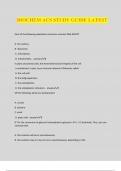
BIOCHEM ACS STUDY GUIDE LATEST Each of the following subcellular structures contains DNA EXCEPT A. the nucleus. B. ribosomes. C. chloroplasts. D. mitochondria. - answerB In plant and animal cells, the three-dimensional integrity of the cell is maintained, in part, by an internal network of filaments called A. the cell wall. B. the Golgi apparatus. C. the cytoskeleton. D. the endoplasmic reticulum. - answerC Of the following, which are prokaryotes? A. viruses B. bacteria C. yeast D. plant cells - answerB G° for the conversion of glycerol-3-phosphate to glycerol + Pi is -2.2 kcal/mole. Thus, you can conclude that A. this reaction will occur spontaneously. B. this reaction may or may not occur spontaneously, depending on the actual concentrations of reactants and products. C. this reaction will only occur spontaneously if it is coupled to another reaction that has a more favorable G°. D. this reaction is so strongly favorable that it could be coupled to drive an otherwise unfavorable cell reaction. - answerB In most biochemical reactions, ∆PV is A. negligible B. positive C. negative D. dependent on ∆E - answerA According to the Second Law of Thermodymnamics, A. the total entropy change in any reaction that occurs spontaneously must be greater than 0. B. the total entropy change in any reaction that occurs spontaneously must be less than 0. C. the total entropy of the universe remains constant. D. the total entropy of the universe is always decreasing. - answerA Which of the following is true? A. Liquid and solid water have the same number of hydrogen bonds per molecule of water B. Liquid water has more hydrogen bonds per molecule than does solid water C. Solid water has more hydrogen bonds per molecule than does liquid water D. Hydrogen bonding is a major factor in the structure of gaseous water E. None is true - answerC What is the pH of an aqueous solution that has a [OH-] of 3.45 x 10⁻⁵ M? A. 3.47 B. 4.47 C. 5.53 D. 9.54 E. none of the above - answerD A peptide was found to have a molecular mass of about 650 and upon hydrolysis produced Ala, Cys, Lys, Phe, and Val in a 1:1:1:1:1 ratio. The peptide upon treatment with Sanger's reagent produced DNP-Cys and exposure to carboxypeptidase produced valine. Chymotrypsin treatment of the peptide produced a dipeptide that contained sulfur and has a UV absorbance, and a tripeptide. Exposure of the peptide to trypsin produced a dipeptide and a tripeptide. Deduce the sequence of the peptide. A. Val-Ala-Lys-Phe-Cys B. Cys-Lys-Phe-Ala-Val C. Cys-Ala-Lys-Phe-Val D. Cys-Phe-Lys-Ala-Val E. Val-Phe-Lys-Ala-Cys - answerD Which amino acid has an R-group pKa closest to physiological pH? A. lysine B. histidine C. glutamate D. arginine E. aspartate - answerB Which is true regarding the orientation of the R-groups in beta structures? A. In the parallel beta sheet structures the amino acid R-groups are all on the same side of the sheet. B. In the antiparallel beta sheet structure the R-groups on alternate strands are on the same side of the sheet. C. In parallel and antiparallel sheets consecutive R-groups on each peptide strand alternate sides of the sheet. D. Because of the free rotation around the alpha carbon, the R-groups can seek the least crowded region and are not restricted to specific side of the sheet. E. a and b - answerC A reagent commonly employed to cleave disulfide bonds in proteins is A. 2,4-dinitrofluoroben
Written for
- Institution
- Biochemistry ACS
- Course
- Biochemistry ACS
Document information
- Uploaded on
- February 25, 2024
- Number of pages
- 33
- Written in
- 2023/2024
- Type
- Exam (elaborations)
- Contains
- Questions & answers
Subjects
-
biochem acs study guide latest

Also available in package deal